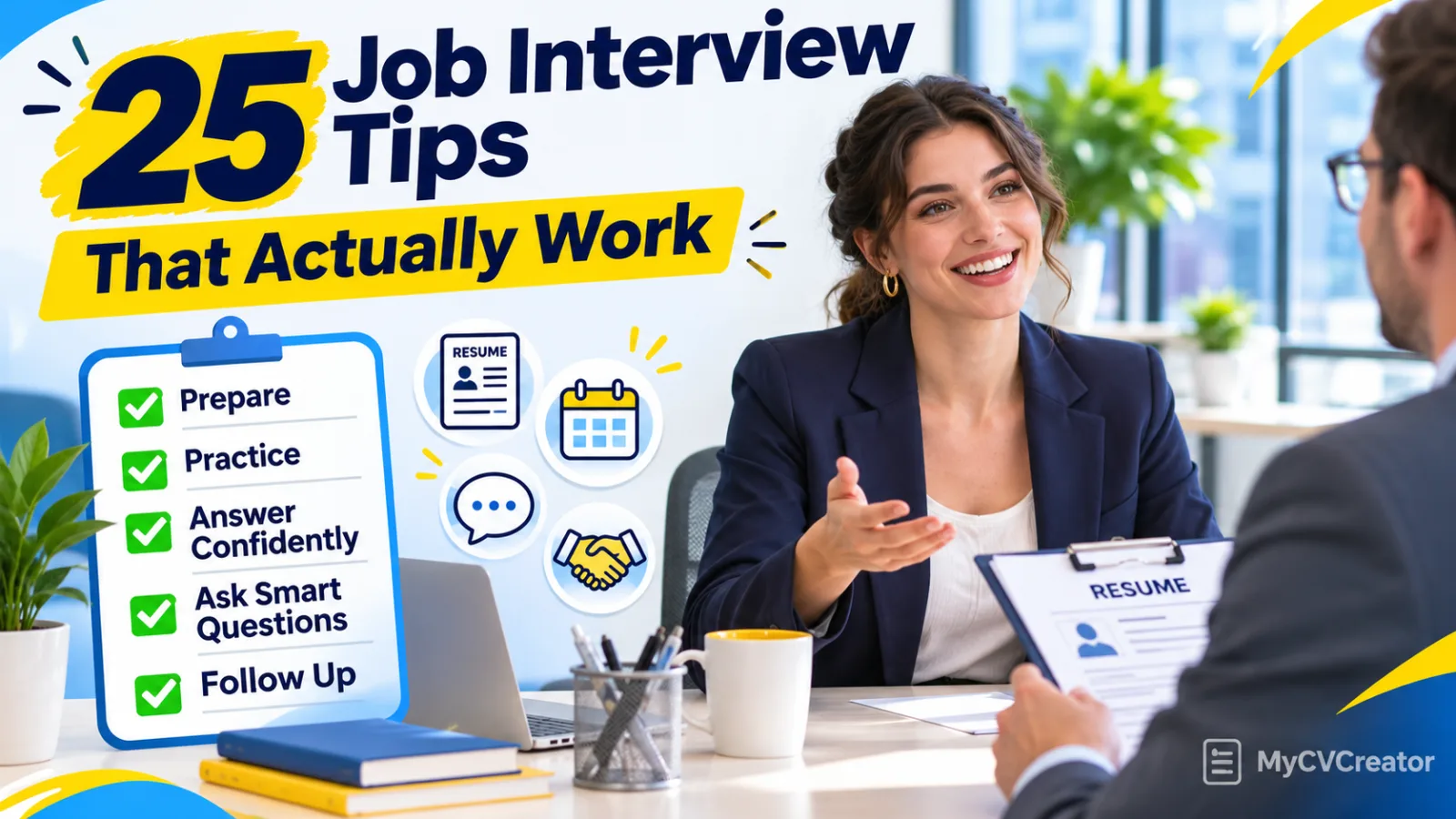
Quick answer: The best interview tips are: research the company and role, prepare five strong stories from your experience using the STAR method, practise answering out loud, prepare two or three questions to ask, arrive or log in early, answer with specific examples and numbers, keep answers to about two minutes, and send a short thank-you message within 24 hours.
Those eight cover most of what separates a good interview from a forgettable one. Below are 25 tips in the order you will need them: before the interview, on the day, during it, and afterwards. There is also a section on what has changed in 2026, including video and AI-led interviews, and a short list of quick tips if your interview is tomorrow.
If your interview is tomorrow: 10 quick tips
- Reread the job description and highlight the top five requirements.
- Spend 20 minutes on the company's website, recent news and LinkedIn page.
- Write down five stories from your experience that match those requirements.
- Practise your answer to "Tell me about yourself" out loud, under two minutes.
- Prepare two questions to ask the interviewer.
- Check the time, location or video link, and the interviewer's name.
- Lay out your clothes and test your camera and microphone if it is online.
- Print or save your resume and the job description.
- Get a proper night's sleep. It does more for you than an extra hour of cramming.
- Plan to arrive 10 minutes early, or log in 5 minutes early.
Before the interview
1. Study the job description, not just the company
Most candidates research the company and skim the role. Do the opposite. The job description tells you exactly what the interviewer will be checking for. Highlight every skill, responsibility and requirement, and make sure you have an example ready for the most important ones.
2. Research the organisation properly
Know what the organisation does, who its customers are, how it makes money, and anything notable from the last six months: a new product, an expansion, a merger, a leadership change. Look at the interviewer's LinkedIn profile if you know their name. This lets you tailor your answers and ask better questions.
3. Prepare five stories, not fifty answers
You cannot predict every question, but you can predict the themes. Prepare five strong stories from your work, studies or volunteering that cover:
- A result you are proud of
- A problem you solved
- A time you worked well with others, or handled a disagreement
- A mistake or failure, and what you learned
- A time you took initiative or led something
With these five, you can answer most behavioural questions by choosing the right story. Our guide to common interview questions shows how one story can answer several questions.
4. Use the STAR method
Structure each story with STAR:
| Part | What to say | Share of the answer |
|---|---|---|
| Situation | The context, briefly | 10 percent |
| Task | What you needed to achieve | 10 percent |
| Action | What you did, specifically | 60 percent |
| Result | What happened, ideally with a number | 20 percent |
The most common mistake is spending too long on the situation and rushing the action and result. The interviewer is mostly interested in what you did and what changed.
5. Prepare your answer to "Tell me about yourself"
This is the opening question in most interviews, and it sets the tone. Use a simple shape: present, past, future.
I'm a customer success specialist with four years in software support. Right now I manage about 60 business accounts, and last year I cut churn on my accounts by a fifth. Before that I worked in telecoms support, which is where I learned to handle difficult conversations calmly. I'm looking for a role where I can work with larger clients, which is why this position caught my attention.
Keep it under two minutes. Do not recite your whole history.
6. Practise out loud
Reading your answers in your head is not practice. Say them out loud, ideally to another person or on a recording. You will hear where you ramble, where you lose the thread, and which stories land. Two or three rounds make a visible difference.
7. Know your numbers
Have your key figures ready: team sizes, budgets, sales, customers served, time saved, percentages improved. Specific numbers make answers believable and memorable. Check they match your resume.
8. Prepare questions to ask
At the end of almost every interview you will be asked, "Do you have any questions for us?" Always have two or three ready. Good ones focus on the role, the team and how success is measured:
- What would success look like in the first six months?
- What are the biggest challenges the team is facing right now?
- How does this role work with other teams?
- What do you enjoy most about working here?
Avoid asking about salary, holidays or remote work in a first interview unless the interviewer raises them.
9. Prepare for the salary question
You may be asked about salary expectations at any stage. Research the typical range for the role and location beforehand, and decide your answer in advance. Our salary negotiation guide covers how to answer without underselling yourself.
On the day
10. Plan your logistics
For in-person interviews, plan your route and leave time for delays. Aim to arrive 10 minutes early, not 30. For video interviews, test your link, camera, microphone and internet connection beforehand, and close every other application.
11. Dress one level above the everyday dress code
If the company is casual, wear smart casual. If it is business casual, lean towards business. When in doubt, it is better to be slightly overdressed than underdressed. Clothes should be clean, fitted and comfortable enough that you are not thinking about them.
12. Bring the right things
A copy of your resume, the job description, a notepad and pen, your questions, and any documents requested such as ID, certificates or a portfolio. For video interviews, keep these beside you, not on the screen you are looking at.
13. Treat everyone as part of the interview
The receptionist, the person who meets you at the door and the colleague who joins for five minutes may all be asked for their impression. Be polite and friendly to everyone from the moment you arrive.
During the interview
14. Make a strong first minute
Smile, make eye contact, offer a greeting and thank them for their time. The first minute shapes how the rest of the interview is heard.
15. Listen to the whole question
Nervous candidates often start answering before the question has finished. Listen fully, pause for a second or two, then answer. If a question is unclear, ask: "Do you mean in terms of the team, or the project itself?" That shows care, not weakness.
16. Answer with examples, not adjectives
"I'm very organised" is a claim. "I managed travel and diaries for three directors and never had a double booking in two years" is evidence. Every time you describe yourself, follow it with a real example.
17. Keep answers to about two minutes
Long answers lose the interviewer. Short ones look thin. Aim for one to two minutes for most answers. If they want more detail, they will ask.
18. Be honest about what you do not know
If you do not know something, say so, then show how you would find out or how you handled something similar. Interviewers respect honesty far more than a confident guess that falls apart under a follow-up question.
19. Turn weaknesses into evidence of growth
When asked about a weakness or failure, choose something real but not central to the job, explain what happened, and spend most of your answer on what you changed. Avoid fake weaknesses such as "I work too hard."
20. Watch your body language
Sit upright, keep your hands visible and relaxed, nod to show you are listening, and keep steady eye contact without staring. On video, look at the camera when you are speaking, not at the interviewer's face on screen.
21. Never criticise a former employer
Even if your last job was difficult, keep it neutral. "I'm looking for a role with more room to grow" is fine. Complaints about a previous manager make interviewers wonder what you would say about them.
22. Close with interest
At the end, thank them, restate briefly why you are interested and what you would bring, and ask about next steps: "What does the rest of the process look like?"
After the interview
23. Send a thank-you message within 24 hours
A short email to each interviewer, thanking them, mentioning one specific point from the conversation, and confirming your interest. Three or four sentences are enough.
Hello Ms Okafor,
Thank you for meeting with me today about the Operations Coordinator role. I especially enjoyed hearing about your plans for the new Abuja warehouse, and it confirmed how much I would like to help set it up.
Please let me know if I can provide anything else.
Kind regards, Daniel Adeyemi
24. Write notes straight away
Within an hour, write down the questions you were asked, how you answered and what you would improve. If you get a second interview, you will be glad you did, and over several interviews your answers will steadily improve.
25. Follow up once, then move on
If you have heard nothing after the date they gave you, send one polite follow-up. Then keep applying. Do not pause your search while you wait for one decision.
What is different about interviews in 2026
Video interviews are standard
Many first and second rounds now happen on video. Treat them exactly like in-person interviews: dress properly, find a quiet room, face a window or lamp for light, raise the camera to eye level and look at the lens when you speak.
One-way and AI-led interviews are common
You may be asked to record answers to preset questions with no person on the other end, or to speak with an AI interviewer that asks follow-up questions. You usually get a short time to think and a time limit to answer. Practise with a timer. Our guides to one-way video interviews and the 2026 screening stack explain how these work.
Using AI during an interview can get you flagged
Reading answers from an AI tool during a live or recorded interview is increasingly detected through eye movement, pauses and answers that sound scripted. Use AI to prepare, not to perform. Our article on AI cheating in interviews covers what employers look for.
Identity checks are more frequent
Some employers now verify that the person interviewing is the real applicant, with ID checks or a live camera requirement. Have your ID ready and keep your camera on. See Prove You're Real for more.
Judgment matters more than tool knowledge
Interviewers increasingly ask how you would check AI-generated work, or when you would choose not to use an AI tool. Have a clear, sensible answer ready. Our piece on why employers want critical thinking more than AI skills explains why.
Common interview mistakes to avoid
- Arriving late, or joining a video call late
- Not knowing what the company does
- Rambling answers with no clear point
- Talking only about duties, not results
- Criticising a previous employer
- Having no questions at the end
- Checking your phone during the interview
- Exaggerating experience you cannot back up in follow-up questions
- Asking about pay and holidays before the employer raises them
- Forgetting to send a thank-you message
Frequently asked questions
What are the best tips for a job interview? Research the role and company, prepare five strong stories using the STAR method, practise out loud, answer with specific examples, prepare questions to ask, and send a thank-you message within 24 hours.
How should I prepare for a job interview? Study the job description, research the organisation, prepare stories for common question themes, practise your answers aloud, prepare questions, plan your logistics and gather the documents you need.
How long should interview answers be? About one to two minutes for most questions. Give enough detail to show what you did and what resulted, then stop.
What should I say in "Tell me about yourself"? A short present, past and future answer: what you do now, a key result, relevant background and why you want this role. Keep it under two minutes.
What should I bring to a job interview? Copies of your resume, the job description, a notepad and pen, your questions, and any documents the employer asked for, such as ID or certificates.
How early should I arrive for an interview? About 10 minutes early for in-person interviews, and 5 minutes early for video calls.
Should I send a thank-you email after an interview? Yes, within 24 hours. Keep it short, mention something specific from the conversation and confirm your interest.
How do I calm my nerves before an interview? Prepare thoroughly, practise out loud, arrive early, and take a few slow breaths before you start. Some nerves are normal and interviewers expect them.
The short version
Good interviews are won in preparation. Study the job description, prepare five strong stories with real results, practise them out loud and have questions ready. On the day, arrive early, listen carefully, answer with examples and keep answers focused. Afterwards, send a thank-you message and keep applying while you wait.
Make sure your resume is as strong as your answers: build or update it on MyCVCreator.
Related reading
- Common Interview Questions and How to Answer Them
- How to Pass a One-Way Video Interview
- AI and Automated Interviews: The 2026 Screening Stack
- AI Cheating in Interviews: What Gets You Flagged
- How to Negotiate Salary in the US
- Skills to Put on a Resume in 2026
- How to Make a Video Resume
- How to Job Search in a Low-Hire, Low-Fire Market