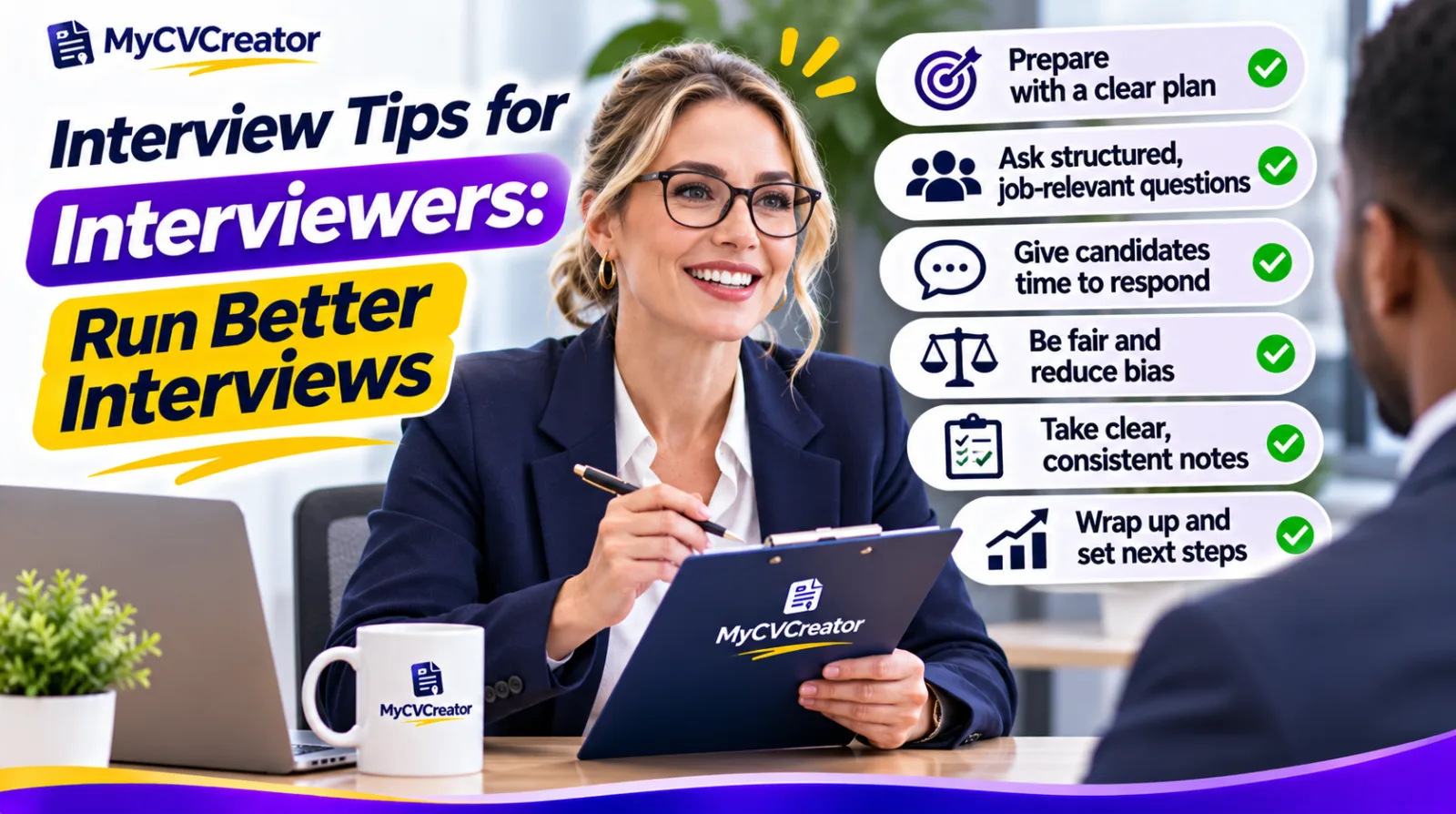
Quick answer: To run a good interview, decide before you start what the job needs and how you will score it, ask every candidate the same core questions, use behavioural questions that ask for real examples, listen far more than you talk, take notes on evidence rather than impressions, avoid questions about protected characteristics such as age, religion or family plans, score each candidate on your own before discussing them, and tell every candidate what happens next.
Most interviewing advice is written for candidates. But a weak interviewer costs a business more than a weak candidate does: the wrong hire, a good candidate lost to a competitor, or in the worst case a discrimination claim. This guide is for managers, business owners and anyone asked to sit on an interview panel. It covers preparation, the questions to ask and avoid, running the conversation, scoring fairly, and the different interview formats, including group interviews.
Why structure matters
The most common interviewing mistake is to "have a chat and see." Unstructured interviews feel natural, but they mostly measure whether the interviewer liked the candidate, which often comes down to shared background, confidence or a good first minute.
Decades of research on hiring have consistently found that structured interviews, where every candidate is asked the same job-related questions and scored against the same criteria, predict job performance better than unstructured ones. They are also fairer and easier to defend if a decision is ever challenged.
Structure does not mean robotic. It means you decide in advance what you are looking for, and you look for it the same way with everyone.
Before the interview
1. Define what success looks like
Start from the job, not the candidate. Write down:
- The three to five outcomes the person must deliver in the first year
- The skills and qualities needed to deliver them
- The must-haves versus the nice-to-haves
If you have not written a job description yet, our guide on how to write a job description shows how.
2. Build a simple scorecard
Turn those requirements into four to six criteria, with a short description of what a strong, average and weak answer looks like for each. Use a simple scale, for example 1 to 4, and avoid a middle score that lets interviewers sit on the fence.
| Criterion | 1 (weak) | 4 (strong) |
|---|---|---|
| Customer handling | Generic answer, no example | Specific example, clear actions, measurable result |
| Problem-solving | Describes the problem only | Explains diagnosis, options considered and outcome |
| Teamwork | Takes all the credit or none | Clear about own role and how they worked with others |
3. Prepare your questions
Write one or two questions for each criterion, and use them with every candidate. Prepare follow-up prompts too.
4. Read the application properly
Read the resume and cover letter before the interview, not during it. Note anything you want to explore: a gap, a career change, a claim you want evidence for. Gaps and career changes are not red flags by themselves; ask about them neutrally.
5. Agree roles if there is a panel
Decide who asks which questions, who takes the lead, and who keeps time. Candidates notice when a panel is disorganised.
6. Sort out logistics
Confirm the time, location or video link, and who the candidate will meet. Send the candidate this information in advance, along with anything they need to prepare. Make sure the room is quiet and you will not be interrupted.
The types of interview questions
Behavioural questions
These ask what the candidate has done, on the principle that past behaviour is the best guide to future behaviour.
- Tell me about a time you had to deal with an unhappy customer. What did you do?
- Describe a project that did not go as planned. What happened, and what did you change?
- Tell me about a time you disagreed with a colleague or manager. How did you handle it?
- Give me an example of a time you improved a process.
Good answers follow the STAR shape: situation, task, action, result. If an answer drifts into generalities ("I always try to..."), bring it back: "Can you tell me about a specific time?"
Situational questions
These ask what the candidate would do. They are useful for graduates or career changers with less direct experience.
- A customer is shouting at you about a delayed order that is not your fault. What do you do?
- You realise on Thursday that you will miss a Friday deadline. What would you do?
Skills and technical questions
These test specific abilities: a short case, a written exercise, a coding task, a role-play or a practical demonstration. Keep any task short, relevant to the real job and the same for every candidate. Do not ask candidates to do unpaid work that you would actually use.
Motivation questions
- What attracted you to this role?
- What kind of work environment brings out your best?
- What are you looking for in your next role that you do not have now?
Good follow-up probes
- What exactly did you do, as opposed to the team?
- What was the result? How did you measure it?
- What would you do differently now?
- What was the hardest part?
- Who else was involved, and what was their role?
Questions you must not ask
In most countries it is unlawful, or at least very risky, to ask questions that relate to protected characteristics, because they can be used as evidence of discrimination even if you had no such intention.
Avoid questions about:
- Age: "How old are you?" "When did you graduate from school?"
- Marriage, relationships and family: "Are you married?" "Do you have children?" "Are you planning a family?"
- Pregnancy
- Religion: "Which church do you attend?" "Will you need time off for religious holidays?"
- National origin or ethnicity: "Where are you originally from?" "Is that your real accent?"
- Health and disability: "Do you have any health conditions?" "Have you ever taken sick leave?"
- Sexual orientation or gender identity
- Arrest record: in many places you may not ask, or may only ask later in the process
- Salary history: a growing number of US states and cities ban asking candidates what they currently earn. Our guide to salary history bans explains where.
What you can ask instead:
| Instead of | Ask |
|---|---|
| "Do you have children?" | "This role requires occasional weekend work. Are you able to do that?" |
| "Where are you from?" | "Are you legally able to work in this country?" |
| "Do you have any health problems?" | "Are you able to perform the essential duties of this role, with or without reasonable adjustments?" |
| "How old are you?" | "Are you over 18?" (only where legally relevant) |
| "What do you earn now?" | "What are your salary expectations for this role?" |
Laws differ by country and by US state, so check local rules. This is general information, not legal advice. Our article on the employment law mistakes that kill small businesses covers the wider risks, and our guide to E-Verify and employment verification covers right-to-work checks in the US.
Running the interview
Open well
Greet the candidate warmly, introduce everyone, offer water, and explain the format: how long the interview will take, what you will cover and that there will be time for their questions. A relaxed candidate gives you better information.
Talk less than you think you should
Aim for the candidate to speak for about 70 to 80 percent of the time. Interviewers who spend half the interview describing the company learn very little about the person in front of them.
Ask one question at a time
Two-part questions get half-answered. Ask, then wait. Silence is fine; let candidates think.
Take notes on evidence
Write down what the candidate said and did, not your reactions. "Reduced refund processing from five days to two by changing the approval step" is useful. "Seemed confident" is not. Tell the candidate at the start that you will be taking notes.
Watch for bias in yourself
Common traps:
- First impressions: deciding in the first few minutes, then hearing only what confirms it
- Similarity: favouring people who share your background, school, interests or style
- Halo effect: letting one strong point colour everything else
- Confidence over competence: mistaking fluent talking for ability
- Contrast: judging a candidate against the person before rather than against the criteria
Your scorecard is the main defence. Score against the criteria, not against your gut.
Sell the role honestly
Candidates are assessing you too. Explain the role, the team and what makes the organisation a good place to work, but be honest about the challenges. A candidate who joins with false expectations is likely to leave early.
Leave time for their questions
Allow at least ten minutes. The quality of their questions tells you a lot. Our guide to the questions candidates ask interviewers shows what well-prepared candidates tend to ask.
Close clearly
Thank the candidate, explain the next steps and give a realistic timeline. Then keep to it.
After the interview
Score immediately and independently
Complete your scorecard straight after the interview, while your memory is fresh, and before you discuss the candidate with anyone else. If panel members talk first, the most senior or most confident voice tends to set everyone's scores.
Hold a short debrief
Go through the criteria one at a time, sharing evidence for each score. Where scores differ widely, discuss the evidence, not the overall impression.
Check references properly
Ask referees about specific behaviours and results, not general character. "Can you give me an example of how she handled a difficult client?" tells you more than "Would you rehire her?"
Tell every candidate the outcome
Let every interviewed candidate know the result, ideally within a week. Brief, constructive feedback, where you can give it, makes a big difference to how candidates talk about your organisation. Silence after an interview is one of the most common complaints job seekers have.
Different interview formats
Phone or video screen
A short call, usually 15 to 30 minutes, to check basics: interest, availability, pay expectations and the must-have requirements. Keep it consistent across candidates.
Video interviews
Treat them like in-person interviews: test your technology, use a quiet room with good light, look at the camera when speaking and switch off notifications. Allow for small connection delays before assuming a candidate has finished.
Panel interviews
Two to four interviewers, each focusing on different criteria. Agree roles in advance and keep the panel small enough that the candidate is not overwhelmed.
Group interviews
A group interview is an interview in which several candidates are assessed at the same time, usually through a group task, a discussion or a series of short exercises, with one or more interviewers observing.
They are common for retail, hospitality, customer service, graduate schemes and seasonal hiring, where an employer needs to assess many candidates and wants to see teamwork and communication in action.
To run one well:
- Explain the format and what you are looking for at the start
- Use a task that resembles the real job
- Observe and note what each person actually does: who listens, who involves quiet colleagues, who keeps the group on track, who takes credit
- Give every candidate a chance to contribute
- Follow up with a short one-to-one conversation with each candidate
Be careful not to reward the loudest person in the room. In many jobs, the candidate who helps the group reach a good decision is more valuable than the one who talks most.
One-way and AI-assisted interviews
Many employers now use recorded video interviews or AI tools for early screening. If you do, tell candidates clearly that they are being used, keep a human involved in decisions, and check the tools for bias. Our guides to the 2026 screening stack and one-way video interviews explain how candidates experience them.
Interviewing in the AI era
Two newer issues are worth planning for.
AI-assisted answers. Some candidates use AI tools during remote interviews. Signs include long pauses before every answer, eyes moving as if reading, and polished but generic answers that fall apart under follow-up questions. The best defence is good follow-up: ask for specific details, numbers and what they would do differently. Our article on AI cheating in interviews covers what to look for.
Identity checks. Fraudulent candidates using another person's identity, or even deepfake video, have become a real issue in remote hiring. Ask for cameras to be on, verify identity at the offer stage, and consider meeting finalists in person or on a live call where possible. See Prove You're Real.
Quick checklist for interviewers
Before
- Define the outcomes and criteria for the role
- Build a scorecard and prepare the same core questions for everyone
- Read the application in advance
- Agree panel roles and confirm logistics
During 5. Open warmly and explain the format 6. Ask behavioural questions and probe for specifics 7. Listen more than you talk and take evidence-based notes 8. Avoid questions about protected characteristics 9. Leave time for the candidate's questions 10. Explain next steps
After 11. Score independently before discussing 12. Debrief on evidence, criterion by criterion 13. Check references with specific questions 14. Tell every candidate the outcome
Frequently asked questions
How do I conduct a good job interview? Prepare a scorecard based on the job's requirements, ask every candidate the same core questions, use behavioural questions that ask for real examples, listen more than you talk, take evidence-based notes and score candidates independently before discussing them.
What questions should an interviewer ask? Behavioural questions such as "Tell me about a time you handled a difficult customer," situational questions for less experienced candidates, relevant skills questions and motivation questions, with follow-up probes for specifics.
What questions should an interviewer never ask? Questions about age, marital status, children or pregnancy, religion, national origin, health or disability, sexual orientation, and in many US states salary history. Ask about the ability to meet job requirements instead.
What is a group interview? An interview in which several candidates are assessed at the same time, usually through group tasks or discussion, often used for retail, hospitality, customer service and graduate hiring.
How long should a job interview last? Screening calls typically last 15 to 30 minutes. Most full interviews last 45 to 60 minutes, including time for the candidate's questions.
What is a structured interview? An interview in which every candidate is asked the same job-related questions and scored against the same criteria. Structured interviews are fairer and better at predicting job performance than informal conversations.
How do I avoid bias when interviewing? Define criteria in advance, use the same questions for everyone, score against a scorecard, take notes on evidence and complete your scores before discussing candidates with others.
The short version
Good interviewing is mostly preparation and discipline. Decide what the job needs, turn it into a scorecard and ask every candidate the same questions. During the interview, listen, probe for specific examples and stay away from personal questions. Afterwards, score on your own before you compare notes, and let every candidate know where they stand. Do that consistently and you will hire better people, more fairly, and protect your organisation in the process.
Related reading
- How to Write a Job Description
- Where to Post a Job for Free in 2026
- Hiring Your First Employee: A Checklist
- The Employment Law Mistakes That Kill Small Businesses
- Salary History Questions and State Bans
- Questions to Ask the Interviewer
- Interview Tips for 2026 (for Candidates)
- AI Cheating in Interviews: What Gets You Flagged