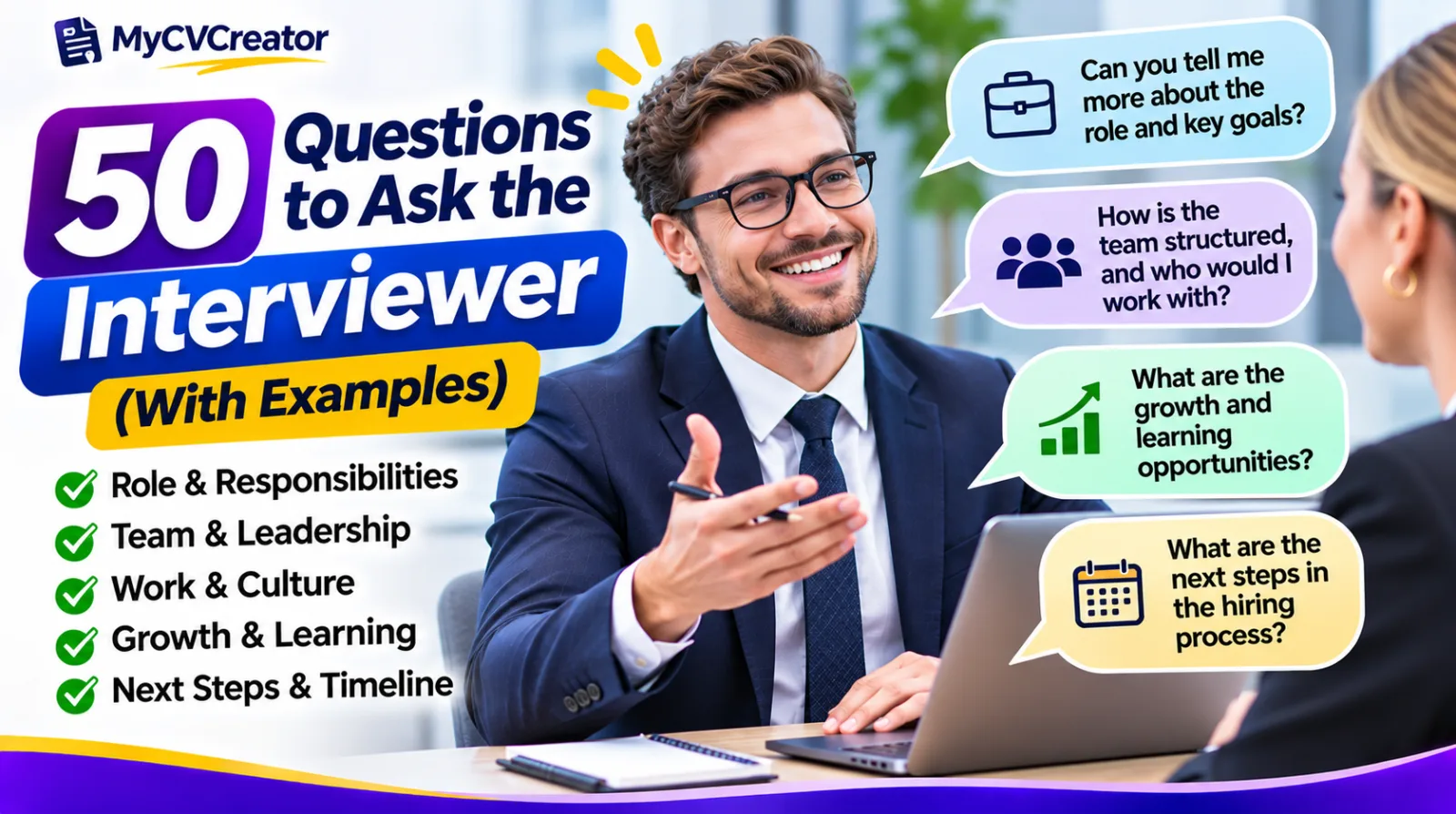
Quick answer: The best questions to ask an interviewer are about the role, the team and how success is measured. Five strong examples: "What would success look like in the first six months?", "What are the biggest challenges facing the team right now?", "How would you describe the team's working style?", "What do the most successful people in this role do differently?" and "What are the next steps in the process?" Prepare three to five and ask two or three.
"Do you have any questions for us?" comes at the end of almost every interview. It is not a formality. A good question shows you have listened, done your research and are thinking seriously about doing the job. Saying "No, I think you've covered everything" wastes the last chance you have to make an impression.
Below are 50 questions grouped by topic, guidance on which to ask at each stage of the process, the questions to avoid, and what to do when the interviewer has already answered everything you prepared.
Why your questions matter
Your questions do three jobs at once:
- They show interest. Thoughtful questions signal that you want this job, not just any job.
- They show how you think. Asking about challenges and priorities suggests someone who will look for problems to solve.
- They help you decide. An interview is also your chance to find out whether you want to work there.
How many questions should you ask?
Prepare five to eight, because some will be answered during the interview. Ask two or three at the end. If the interviewer is short on time, ask your single best question and offer to follow up by email.
Write your questions down and bring them with you. Glancing at a notepad is perfectly acceptable and shows preparation.
Questions about the role
- What does a typical day or week look like in this role?
- What would success look like in the first 30, 60 and 90 days?
- What would you expect me to achieve in the first six months?
- What are the most important priorities for whoever takes this role?
- Is this a new role, or would I be replacing someone?
- What are the biggest challenges someone in this position will face?
- Which skills are most important for doing this job well?
- How is performance measured in this role?
Questions about the team
- Who would I be working with most closely?
- How big is the team, and how is it structured?
- How would you describe the team's working style?
- How does this team work with other departments?
- What does the team do well, and where is it trying to improve?
- How does the team share knowledge and support new members?
Questions for the hiring manager
- How would you describe your management style?
- How do you prefer to communicate with your team?
- What do the most successful people on your team have in common?
- How do you give feedback, and how often?
- What do you enjoy most about leading this team?
- What would you most want help with from the person in this role?
Questions about the company and its direction
- What are the company's main goals for the next year?
- How has the company changed in the last couple of years?
- What are the biggest opportunities or challenges facing the business right now?
- How does this team contribute to the company's wider goals?
- I read about [recent news, product or expansion]. How does that affect this team?
That last question is one of the strongest you can ask, because it proves you did your research. Fill it in with something specific.
Questions about culture and working life
- How would you describe the culture here in three words?
- What do you enjoy most about working here?
- How do people here celebrate success?
- How does the company handle disagreements or different opinions?
- What does work-life balance look like for this team?
- How has the company supported employees through recent changes?
Questions about growth and development
- What training or development opportunities are available?
- Where have people in this role progressed to?
- How does the company support people who want to take on more responsibility?
- Are there opportunities to learn new skills or work on projects outside the role?
- How often are performance reviews, and what do they focus on?
Questions about tools, AI and ways of working
- What tools and systems does the team use day to day?
- How is the team using AI tools, and how are their outputs checked?
- Which parts of this role do you expect to change most in the next year or two?
- For hybrid or remote roles: how does the team stay connected and make decisions when people are not in the same place?
Questions 38 and 39 are especially strong in 2026. They show you understand how work is changing and that you think about quality, not just speed.
Questions about the process and next steps
- What are the next steps in the hiring process?
- When do you expect to make a decision?
- Is there anything else I can provide to help your decision?
- Who else will I meet during the process?
Always finish with one of these. It tells you what to expect and gives you a natural reason to follow up.
Bold questions to use carefully
These can be very effective when the interview has gone well and the tone is relaxed. Use one at most.
- Is there anything in my background that makes you unsure I am the right fit?
- What would make someone really stand out in this role?
- What surprised you most when you joined the company?
- Why did you choose to work here, and why do you stay?
- If I were to start tomorrow, what is the first problem you would want me to work on?
- What is one thing you wish you had known before starting in this role?
Question 45 takes confidence. Its value is that it gives you a chance to address a concern before the interviewer leaves the room. If they raise something, answer calmly with evidence.
Which questions to ask at each stage
| Stage | Who you are talking to | Best questions to ask |
|---|---|---|
| Phone or recruiter screen | Recruiter or HR | Role basics, process and timeline (1, 5, 41, 42) |
| First interview | Hiring manager | Success, priorities and challenges (2, 4, 6, 15, 20) |
| Panel interview | Several team members | Team working style and collaboration (11, 12, 13, 27) |
| Technical or skills interview | Specialists | Tools, systems and problems (37, 38, 49) |
| Final interview | Senior leader | Strategy, direction and growth (21, 23, 24, 33) |
Ask different questions at each stage. If you ask the recruiter about the team culture and then ask the hiring manager the same thing, you get two perspectives, which is fine. But asking every interviewer the identical list looks like a script.
Questions to avoid
Anything answered on the website or in the job posting. "What does the company do?" signals that you did not prepare.
Salary, benefits and holidays in the first interview, unless the interviewer raises them or you are speaking to a recruiter who asks your expectations. Save these for when an offer is likely. Our salary negotiation guide covers when and how to raise pay.
"How soon can I be promoted?" It suggests you are already looking past the job you are interviewing for. Ask about development instead (questions 32 to 34).
Questions about checking up on you, such as "Do you check social media?" or "Do you do background checks?" They raise suspicion. Our guide to how background checks work answers these privately.
Yes or no questions. "Do you like working here?" gets a one-word answer. "What do you enjoy most about working here?" starts a conversation.
Gossip or negative questions, such as "Why did the last person quit?" Ask instead whether the role is new or a replacement (question 5), which gets the same information politely.
Questions about the interviewer's personal life, age, family or background.
What if your questions have already been answered?
This happens often, especially in long interviews. Do not say "You've answered everything." Instead, try one of these:
- Ask a follow-up. "You mentioned the team is moving to a new CRM next year. How will that affect this role?"
- Ask for their view. "We talked about the main challenges. Which one would you tackle first if you were in my position?"
- Ask about them. "What do you enjoy most about working here?"
- Confirm next steps. "What are the next steps, and when should I expect to hear from you?"
A follow-up based on something said in the interview is often the strongest question of all, because it proves you were listening.
How to ask your questions well
- Listen to the answer. Do not rush to your next question. Respond to what they said, and ask a natural follow-up if it fits.
- Take brief notes. It shows you value the answer, and you can mention a point in your thank-you email.
- Connect answers back to you, briefly. "That's helpful. I did something similar when I set up the reporting process at my last job."
- Watch the time. If the interviewer looks at the clock, ask your most important question and finish.
Questions for graduates and entry-level candidates
If this is your first proper job, these are particularly useful:
- What does training look like in the first few months?
- Who would I go to with questions while I am learning?
- What do the best graduates or new starters do in their first year?
- What skills would you recommend I build to grow in this role?
Our guide on how 2026 graduates compete covers the rest of the entry-level job search.
Frequently asked questions
What questions should I ask at the end of an interview? Ask about the role, the team and how success is measured. Strong examples are "What would success look like in the first six months?", "What are the biggest challenges for the team right now?" and "What are the next steps in the process?"
How many questions should I ask the interviewer? Prepare five to eight and ask two or three. If time is short, ask your best one.
Is it bad not to ask any questions in an interview? It is a missed opportunity and can suggest low interest. Always have at least one question ready, even if it is about next steps.
Can I ask about salary in an interview? It is usually best to wait until the employer raises it or an offer is likely. Recruiters often ask early, and it is fine to discuss it then.
What is a good final question to ask? "What are the next steps in the process, and when should I expect to hear back?" It is polite and practical, and it gives you a reason to follow up.
Can I bring my questions written down? Yes. Bringing a short list on a notepad shows preparation.
What questions should I avoid in an interview? Questions answered on the company website, early questions about salary and holidays, questions about promotion timelines, yes or no questions and anything personal or negative.
The short version
Prepare five to eight questions, ask two or three, and make them about the role, the team and what success looks like. Include one question that shows you researched the company, and always finish by asking about next steps. If your questions get answered along the way, ask a follow-up based on something the interviewer said.
For the rest of your preparation, read our 25 interview tips for 2026, then make sure your resume is ready to match: build it on MyCVCreator.
Related reading
- Interview Tips for 2026: 25 Tips That Actually Work
- Common Interview Questions and How to Answer Them
- How to Negotiate Salary in the US
- How to Pass a One-Way Video Interview
- Employers Want Critical Thinking More Than AI Skills
- Entry-Level Jobs Are Shrinking: How 2026 Graduates Compete
- Job Hugging: How to Grow Without Changing Jobs