Employers Want Critical Thinking More Than AI Skills: What That Means for Your Resume
For two years the advice has been uniform: learn the tools. Put the AI tools on your resume. List the prompt engineering. Get the certificate.
The 2026 survey data says something more awkward. Employers are not primarily short of people who can operate the tools. They are short of people who can tell when the tool is wrong.
This is a meaningful shift, and it is being misread by a lot of job seekers who are busy adding a skills row that will not move their application. Here is what the data actually shows, why the shift happened, and the specific ways to put judgment on a page in a form a recruiter will believe.
What the data says
Two pieces of 2026 research point in the same direction from opposite ends of the market.
Microsoft's 2026 Work Trend Index surveyed 20,000 full-time knowledge workers who use AI at work, across ten markets, between February and April 2026. Asked which skills matter most as AI takes on more of the work, the top answer was quality control of AI output, named by 50 percent. Critical thinking, defined in the survey as analysing information objectively and reaching a reasoned judgment, came second at 46 percent. Separately, 86 percent of AI users said they treat AI output as a starting point rather than a final answer.
The most interesting finding in that report is not a headline number. It is the gap between the highest performers and everyone else. The workers the study classes as the most advanced AI users were far more likely to pause before starting a task and decide whether a person or a machine should do it: 53 percent against 33 percent. They were also more likely to deliberately do some work without AI in order to keep their own skills sharp: 43 percent against 30 percent.
Read that again, because it is the whole article in two statistics. The people getting the most out of these tools are the ones exercising the most judgment about when not to use them.
From the graduate hiring end, the National Association of Colleges and Employers surveyed employers for its Job Outlook 2026 Spring Update, fielded between 12 February and 17 March 2026. The attributes employers most wanted to see on a resume were the ability to work in a team, problem-solving ability, and effective communication. Technical skills appeared on the list, but behind all three.
That ordering is the thing worth sitting with. In the year AI tooling became standard equipment, employers hiring graduates still put problem-solving and communication ahead of technical skill.
Why the shift happened
The mechanism is not mysterious.
When a tool is scarce, knowing how to use it is valuable. When a tool is everywhere, knowing how to use it is table stakes, and the value moves to whatever the tool cannot do.
What these tools cannot do is be accountable. They produce fluent, confident, plausible output at a volume no human team could match, and a certain fraction of it is wrong in ways that are not visible on the surface. The error rate has fallen. The cost of the errors that remain has not, because the output now looks more authoritative than ever and arrives faster than anyone can check it.
So organisations have discovered a new bottleneck. They have more drafts, more analyses, more code and more copy than they can verify. What they are short of is people who will read a confident paragraph and say "this number cannot be right, and here is why."
That is a hiring problem, and it is why the language in job postings changed. Postings that a year ago asked for tool proficiency now ask for judgment, ownership, analytical rigour, comfort with ambiguity. Some technical employers have gone further and restructured their interviews: candidates are allowed to use AI tools during the exercise and are scored on whether they catch and correct what the tool got wrong.
Why "critical thinking" on a resume is worthless
Here is the trap. The word is now so common in job postings that job seekers have started pasting it back into their resumes as a skill.
Skills: Critical Thinking, Problem Solving, Communication, Attention to Detail
Nobody believes this. It costs nothing to type, every competing candidate has typed it, and it carries exactly zero information. A recruiter's eye slides straight past it. Worse, in a semantic matching system of the kind described in our piece on how AI reads your resume now, a bare claim with no supporting evidence anywhere in the document reads as noise rather than signal.
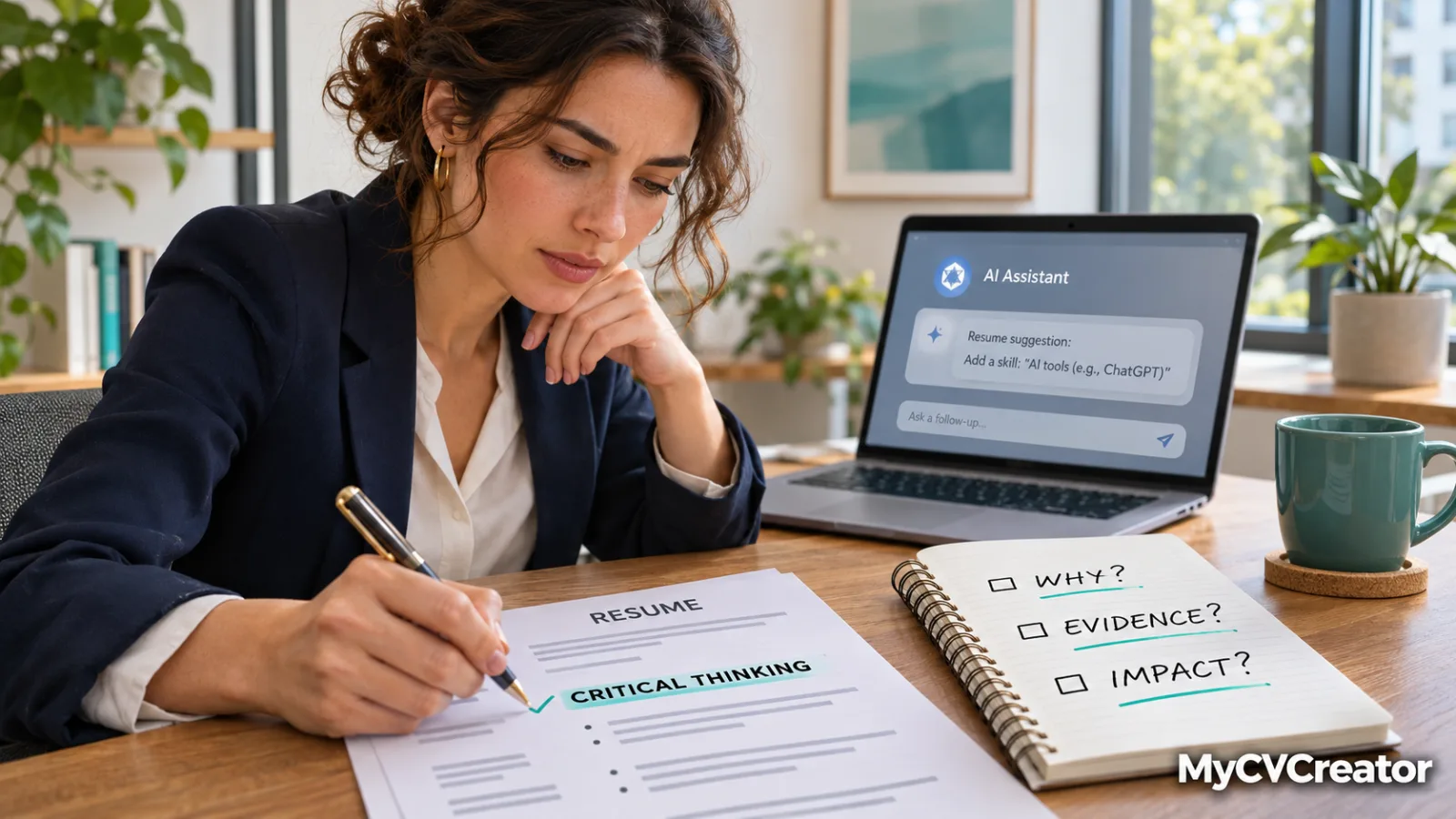
Critical thinking is not a skill you can assert. It is a thing you can only demonstrate, and the demonstration has a specific shape.
The shape of a sentence that proves judgment
A bullet point that proves tool use looks like this:
Used Python and SQL to build weekly sales reporting for the commercial team.
Fine. Dull. Describes a task. Interchangeable with a thousand others.
A bullet point that proves judgment looks like this:
Found that the weekly sales report had been double-counting returns since a system migration, corrected the logic, and reconciled nine months of historical figures with finance.
Same person, same tools, completely different signal. The second one contains a problem that was not handed to the writer, a conclusion they reached themselves, an action, and a consequence.
That is the pattern, and it generalises. A judgment bullet contains some version of:
- A thing that looked right but was not. A number, an assumption, a process, a brief, an output.
- How you noticed. This is the part people leave out, and it is the most persuasive part.
- What you did about it.
- What it was worth. Money, time, risk avoided, a decision changed.
Write four bullets in your work history to that pattern and you will have said more about your thinking than a hundred keyword rows.
Six specific things to write, with examples
Most people believe they have nothing like this to report. Almost everyone does. Here are the places to look.
The error you caught. Any time you noticed something was wrong before it went out of the door. A pricing mistake, a mislabelled dataset, a contract clause, a translation, a figure that did not reconcile.
Caught a currency conversion error in a supplier quotation comparison that would have made the more expensive vendor appear cheaper by about 12 percent.
The thing you declined to automate. Increasingly valuable and almost nobody writes it down.
Kept the final review of customer refund decisions manual after a pilot showed the automated rule misclassified roughly one in eight edge cases, and documented the exception criteria for the team.
The question that changed the brief. The occasions where the request you received was not the right request.
Asked why the churn report only counted cancellations, found a large share of inactive accounts were never captured, and revised the definition the leadership dashboard now uses.
The AI output you corrected. Specific, current and credible.
Reviewed AI-drafted product descriptions before publication and built a checklist for the three recurring failures we found, mainly invented specifications and incorrect compatibility claims.
The decision you made with incomplete information. Judgment under uncertainty, which is what seniority actually means.
With no clean historical data available, chose a conservative demand estimate for a new regional launch, documented the assumptions, and revised it monthly as the first real numbers arrived.
The disagreement you handled well. The hardest to write without sounding difficult, so keep it about the outcome.
Raised a concern about a launch date in writing with the evidence attached, the timeline moved by three weeks, and the release shipped without the known defect.
Notice that none of these sentences uses the phrase critical thinking. They do not need to.
Where to put it on the page
A few practical placements.
In the top summary. Three lines at the top of your resume, and one of them should be about how you think rather than what you have operated. "Analyst who finds the errors in the numbers before they reach the board" tells a reader more than "detail-oriented professional with strong analytical skills."
In the work history, not in a skills block. Judgment lives in context. It needs the situation to mean anything, and a skills block has no room for a situation.
Keep the tools too, but put them in their place. None of this means delete your AI skills. It means stop leading with them. Our guide on which AI skills to list and how covers the right level of specificity. The useful hierarchy is simple: tools go in a compact skills section, and the judgment you exercised while using them goes in your bullets.
In a projects section if your work history is thin. Graduates and career changers often have better evidence here than in a job. A project where you found a problem in your own data, or decided an approach would not work and changed it, is strong material. Our article on how 2026 graduates compete goes further on building a record when you do not yet have one.
The interview, where it is actually tested
A resume gets you to the conversation. The conversation is where judgment is checked, and the questions have changed shape.
Expect some version of these:
- Tell me about a time you disagreed with the data.
- What is something everyone on your last team believed that you thought was wrong?
- Walk me through a decision you got wrong and what you changed afterwards.
- Here is an AI-generated analysis. What would you check before sending it on?
- How do you decide whether to use an AI tool for a task?
That last one is now a real interview question and most candidates answer it badly, usually by saying they use AI for everything and then verify. The better answer has a rule in it. Something like: drafting and summarising, yes; anything where I cannot check the output myself, no; anything client-facing gets read line by line before it leaves.
If you want a framework for building answers of this kind, our guide to common interview questions and how to answer them sets out the small set of stories you need rather than a script per question.
One more thing worth saying plainly. In an interview, the most convincing demonstration of judgment is not a prepared anecdote. It is asking a good question about the role. Candidates who ask what the team has tried that did not work, or what the biggest source of rework is, land differently from candidates who ask about progression paths.
What this means if you are mid-career
There is an uncomfortable upside here for experienced professionals.
The thing automation has compressed hardest is production: drafting, formatting, first-pass analysis, boilerplate code. That compression hit junior work first, which is why entry-level hiring has been so difficult. What it has not compressed is pattern recognition built from having seen things go wrong before.
If you have fifteen years in a field, your value is no longer in producing the output faster than a graduate. It is in knowing which outputs are suspicious. That is a genuinely defensible position, and it is worth writing your resume to say so rather than competing on tool fluency with people who have more time to learn tools than you do. Our piece on AI-resistant careers and the resilience answer covers the broader version of this argument.
And how to actually get better at it
Not a list of courses. Three habits that show up in work you can then write about.
Check one thing a week that nobody asked you to check. A number in a recurring report, an assumption in a plan, a process everyone follows without knowing why. Most of the time it will be fine. Occasionally it will not, and that is a bullet point.
Do some work without the tool on purpose. This is the habit the Work Trend Index found separating the strongest AI users from the rest. Writing the first draft yourself occasionally, or doing the analysis by hand once, is how you keep the ability to tell when a generated version is off.
Write down your reasoning before you see the answer. Predict what the number should be before you run the query. When you are wrong, you learn something about the process. When you are right and the query disagrees, you have found a bug.
Frequently asked questions
Should I remove AI skills from my resume? No. Keep them in a skills section where they belong. The change is one of emphasis: the tools get a line, the judgment gets your bullets.
Is it worth putting critical thinking in my skills list? As a listed skill it carries almost no weight, because every candidate lists it and none of them evidence it. Spend the space on a bullet that demonstrates it instead.
How do I show critical thinking with no work experience? Through projects, coursework, volunteering or anything where you made a decision rather than followed instructions. The strongest version is a problem you found yourself. Our guide on the skills-based resume format explains how to structure a resume around that evidence.
Do employers actually test for this? Increasingly, yes. Some technical employers now let candidates use AI tools during the interview exercise and grade on error detection. Expect behavioural questions about disagreement and about incorrect data.
Is this just a trend that will reverse? The direction is tied to something structural rather than fashionable. As long as these tools produce more plausible output than organisations can verify, the people who can verify it will be the constraint, and hiring follows the constraint.
The short version
Employers are not short of people who can prompt. They are short of people who will catch the mistake.
So stop writing a resume that proves you can operate the tools, and start writing one that proves you can be trusted with the output. Four bullets built around a problem you found, a conclusion you reached, and what it was worth will do more for your application than any certificate currently on offer.
Rebuild your resume on MyCVCreator and put one of those bullets in your top three.
Sources: Microsoft 2026 Work Trend Index (20,000 AI-using knowledge workers across ten markets, fielded February to April 2026); National Association of Colleges and Employers, Job Outlook 2026 Spring Update (185 employer respondents, fielded 12 February to 17 March 2026).
Related reading
- AI Skills on Your Resume: What to List and How
- How AI Reads Your Resume Now: ATS 2.0 and Semantic Matching
- Will AI Take My Job? AI-Resistant Careers and the Resilience Answer
- Common Interview Questions and How to Answer Them
- Entry-Level Jobs Are Shrinking: How 2026 Graduates Compete
- Skills-Based Resume Format: When and How
- How to Use ChatGPT to Write Your Resume Without Sounding Like Everyone Else
- Certifications That Pay in 2026