AI Now Reads Most Resumes: What the New Data Actually Means
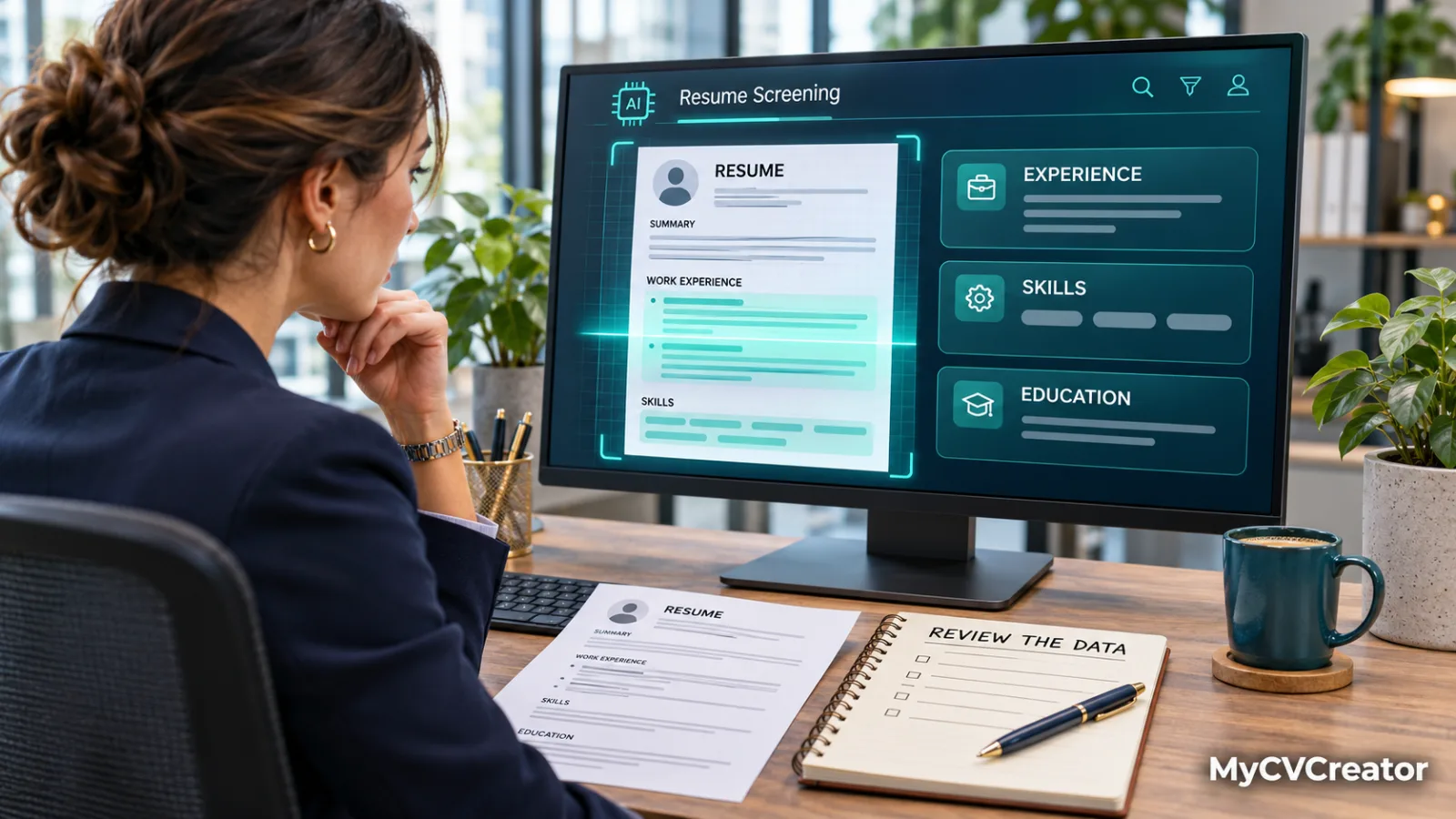
Somewhere in the last eighteen months, a line was crossed without much announcement. A resume submitted to a mid-sized or large employer today is more likely than not to be read by software before it is read by a person, and that software is no longer the crude keyword filter people have been warned about for a decade. It summarises, ranks, compares and sometimes recommends.
This article is about the numbers. If you want the mechanics of how modern screening systems parse and score a document, our companion guide on how AI reads your resume now covers that in detail. Here the question is simpler: what does the 2026 data actually show, what has been exaggerated, and what should you do differently because of it?
The headline numbers
Three recent sources, each looking from a different angle.
Resume Genius, July 2026. A survey of US hiring managers and hiring team members, fielded from June 2026, found:
- 87 percent use AI in at least one stage of recruitment.
- 58 percent use it to screen resumes and applications, the single most common use.
- 46 percent use it to write job descriptions, 44 percent to match candidates by skills, and 41 percent to schedule interviews.
- 58 percent say they have received AI-generated resumes or cover letters.
- 82 percent say they are concerned about candidates using AI in their applications.
- 86 percent expect AI to make it harder to tell whether application materials reflect a candidate's real ability.
- Only 35 percent always tell candidates when AI is used in interviews or evaluations.
Resume.org. A poll of US workers familiar with their company's hiring practices found that among companies already using AI in hiring, 79 percent use it to review resumes. On rejections specifically: 35 percent said their company rejects candidates based on AI recommendations at any stage, 39 percent only in the initial stages, and 26 percent never.
Greenhouse, July 2026. The hiring platform reported an average of 254 applicants per posting across roughly 175,000 live jobs, and a 412 percent rise in applications per recruiter. Its chief executive, Daniel Chait, described the situation as an "AI doom loop": candidates send more automated applications, recruiters deploy AI to cope with the volume, rejected candidates respond by automating further, and, in his words, "the market just isn't working for either side."
Why the numbers look different from each other
You will see figures quoted anywhere from 58 percent to 87 percent for "employers using AI," and people treat this as evidence the data is unreliable. Mostly it is not. The surveys are measuring different things.
- "Uses AI anywhere in hiring" includes scheduling interviews and drafting job ads. That is the 87 percent.
- "Uses AI to screen resumes" across all hiring managers is the 58 percent.
- "Uses AI to review resumes, among companies already using AI" is a narrower base, which is why it lands higher at 79 percent.
Read any statistic by asking what the denominator is. It will save you from a lot of alarmist headlines, and it is the same discipline that makes a resume bullet credible.
The number that matters most is not the adoption rate
Adoption is the headline. The more useful number for a job seeker is the one about rejection.
The Resume.org figures suggest that roughly three in four companies using AI in hiring let it influence rejections somewhere, and the most common pattern is at the initial stage. That is the part of the funnel where you are most exposed: before any human has a reason to give your application a second look.
Put that together with Greenhouse's 254 applicants per posting and you have the real story. The software is not replacing the recruiter's judgment on the final shortlist. It is deciding who reaches the recruiter at all. When a recruiter has 250 applications and an afternoon, the AI ranking is effectively the order in which human attention is spent, and the bottom half of that list may never be opened.
What the data does not say
Some claims circulate so widely that they are treated as fact. Several do not hold up.
"75 percent of resumes are rejected by ATS before a human sees them." This figure has been repeated for well over a decade and is still quoted in 2026. It traces back to vendor marketing rather than any published, reproducible study, and it predates the current generation of AI screening entirely. Ignore it.
"AI is making the hiring decisions." The Resume Genius report describes employer AI use as mostly administrative: screening, scheduling, drafting. Final decisions remain overwhelmingly human. The risk to you is not that a machine chooses the hire. It is that a machine chooses who gets considered.
"Recruiters can detect AI-written resumes and reject them automatically." The survey shows recruiters are concerned about AI-written materials and that most have received them. It does not show reliable detection, and current detection tools are not accurate enough to be used that way responsibly. The bigger problem with AI-written resumes is not detection. It is that they look like each other, which is a ranking problem rather than a policing one.
"Keyword stuffing beats the AI." It worked partially on older systems. It works poorly on semantic matching, which reads context rather than counting repeated terms, and it actively hurts you at the human stage that follows.
What the doom loop means for your strategy
The single most useful data point in this whole cluster is buried in the Greenhouse figures.
Greenhouse introduced a feature that lets candidates mark one job per month as their top choice. Nearly half a million such applications have been submitted, and Greenhouse reported that those candidates are hired at about five times the rate of others.
Whatever the precise cause, the direction is unambiguous. In a market flooded with mass, automated, interchangeable applications, a small number of deliberate, specific applications outperforms a large number of generic ones. That is the doom loop's escape hatch.
So the practical implication of "AI reads most resumes" is not "send more resumes." It is the opposite:
- Apply to fewer roles, and tailor every one. Fifteen properly targeted applications will usually beat a hundred and fifty sprayed ones, especially now that screening rewards relevance over volume.
- Mirror the real language of the posting, honestly. Semantic systems compare your experience with the role's requirements. If the posting says "stakeholder management" and you wrote "worked with other teams," you have made the match harder for no reason.
- Lead with evidence, not adjectives. Ranking systems and the recruiters who read their output both respond to measurable outcomes. "Cut invoice processing time from five days to two" ranks and reads better than "highly efficient finance professional."
- Get a human to see you by a second route. A referral, a direct message to the hiring manager, an alumni contact. Our guide on LinkedIn for the US job market covers how to do this without being a nuisance. The data says screening is automated. It does not say the side door is closed.
Formatting: what still breaks, and what no longer matters
Modern AI screening is better at reading messy documents than older systems were. It is not perfect, and the parsing step still happens before any intelligence is applied.
What still causes problems:
- Text inside images, including graphics with your skills drawn as bars or charts.
- Two or three column layouts where the reading order scrambles.
- Contact details placed inside a document header or footer, which some parsers skip.
- Unusual section titles that the system cannot map, such as "My Journey" instead of "Experience."
- Scanned PDFs, which are pictures of text rather than text.
What matters much less than it used to:
- Exact keyword repetition.
- Whether you used a PDF or a Word file, provided the PDF is text-based and the employer has not asked for a specific format.
- Small design touches such as a single accent colour.
A clean single-column layout with standard section headings remains the safest choice, which is why the templates on MyCVCreator are built that way.
The knockout question problem
One part of automated screening is not AI at all and is responsible for a large share of instant rejections: knockout questions. Do you have the right to work in this country without sponsorship? Do you have a specific licence? Can you work weekends? Will you relocate?
Answer one of these the "wrong" way and many systems reject you before your resume is parsed, regardless of how strong it is. Our guide to ATS knockout questions explains how to answer them honestly without disqualifying yourself through misunderstanding.
Should you use AI to write your resume?
The data says most hiring managers have received AI-generated application materials and most are uneasy about it. It does not say they reject them on sight.
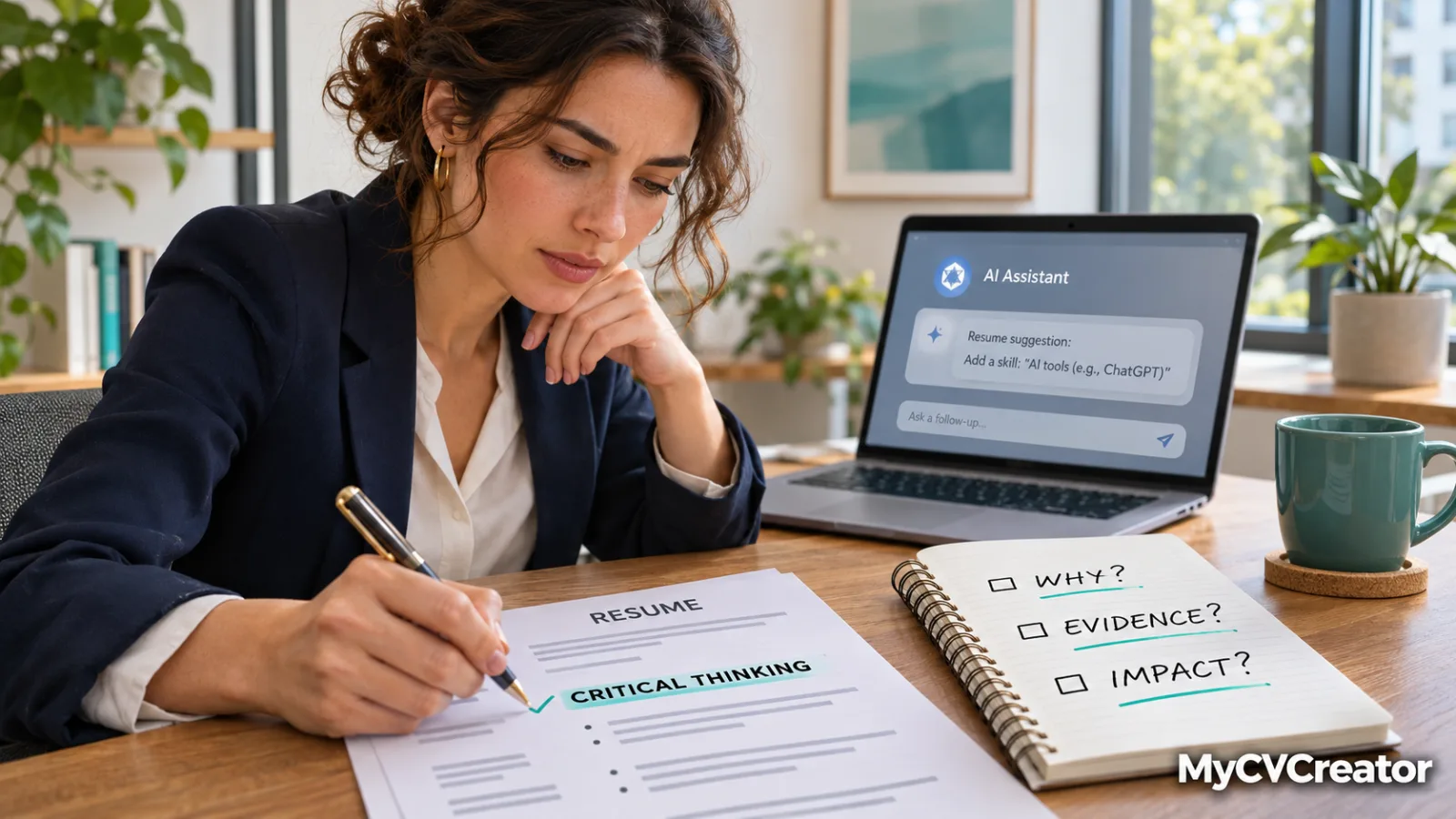
The reasonable position is this. Use AI as an editor and a drafting assistant, not as an author. Feed it your real achievements and numbers and ask it to tighten your wording, then rewrite anything that sounds like everyone else. Our guide on using ChatGPT without sounding generic walks through prompts that do this well.
What the data also shows is that the more AI generates the volume, the more the scarce quality becomes evidence of real judgment. That is the argument made in our piece on why employers want critical thinking more than AI skills, and it applies directly here: a resume that proves you caught problems and made decisions stands out from a pile that all proves the same tool fluency.
Beyond the resume: the rest of the automated stack
The resume screen is the first automated gate, not the only one. The same surveys show AI in skills assessments, background research and interviews, including one-way video interviews and AI-led voice screens. If you are getting past the resume stage and stalling after, read our guide to the 2026 screening stack. And because employers are also worried about candidate fraud, identity checks are spreading too, which our article on proving you are real explains.
If you are applying from outside the US
Most of these surveys are American, but the tools are not. The large applicant tracking platforms are used by multinational employers in the UK, the Gulf, India, Nigeria, Canada and across Europe, and their AI features ship globally. If you are applying to a multinational anywhere, assume the same screening applies.
The one adjustment for international applicants is format. A long CV with a photograph, date of birth and personal details is not just a cultural mismatch for US employers. It adds parsing noise and irrelevant data to a system trying to match skills. Our US resume vs international CV guide shows exactly what to remove.
Frequently asked questions
Do most employers use AI to screen resumes? Yes, on the 2026 data. Around 58 percent of US hiring managers say they use AI to screen resumes, and among companies already using AI in hiring the figure is around 79 percent. Roughly 87 percent use AI somewhere in recruitment.
Does AI reject resumes without a human seeing them? At some companies, at some stages. Polling suggests about a third of companies let AI recommendations drive rejections at any stage and a further large share only at the initial stage. The safest assumption is that your resume must clear an automated ranking before a person reads it.
Is the "75 percent of resumes are rejected by ATS" statistic true? There is no published study behind it. It is an old marketing figure that predates current AI screening and should not be relied on.
Can employers tell if my resume was written by AI? Not reliably. The larger risk is that AI-written resumes sound similar to each other and do not rank or read as distinctive. Edit for specifics.
Should I apply to more jobs because AI screens them? The data points the other way. Fewer, more tailored applications perform better than mass applications in a market flooded with automated ones.
The short version
AI now reads most resumes, and the new data is less dramatic and more useful than the headlines. Software is not choosing the hire. It is choosing who gets considered, at a time when every opening attracts hundreds of applicants. The candidates who do best are the ones who stopped trying to beat the system with volume and started giving it, and the human behind it, a clear, specific, evidenced reason to rank them first.
Build an AI-ready resume on MyCVCreator with a clean, parse-safe layout, then spend your effort on the content that decides the ranking.
Sources: Resume Genius, "AI's Impact on Hiring in 2026" (US hiring managers, fielded from June 2026, published July 2026); Resume.org poll of US workers familiar with company hiring practices, as reported by HCA Magazine; Greenhouse figures and comments from chief executive Daniel Chait, reported by Benzinga, July 2026.
Related reading
- How AI Reads Your Resume Now: ATS 2.0 and Semantic Matching
- ATS Knockout Questions: Why You Were Auto-Rejected
- AI and Automated Interviews: The 2026 Screening Stack
- Employers Want Critical Thinking More Than AI Skills
- How to Use ChatGPT to Write Your Resume Without Sounding Like Everyone Else
- AI Skills on Your Resume: What to List and How
- Ghost Jobs Explained
- US Resume vs International CV: What to Delete