
The AI Associate: The New Entry-Level Job Running AI Agents
Lotte Underwood is 25, has a degree and a master's in marketing, and works at a London PR agency. Her job title is AI associate. Her team is about 30 AI agents.
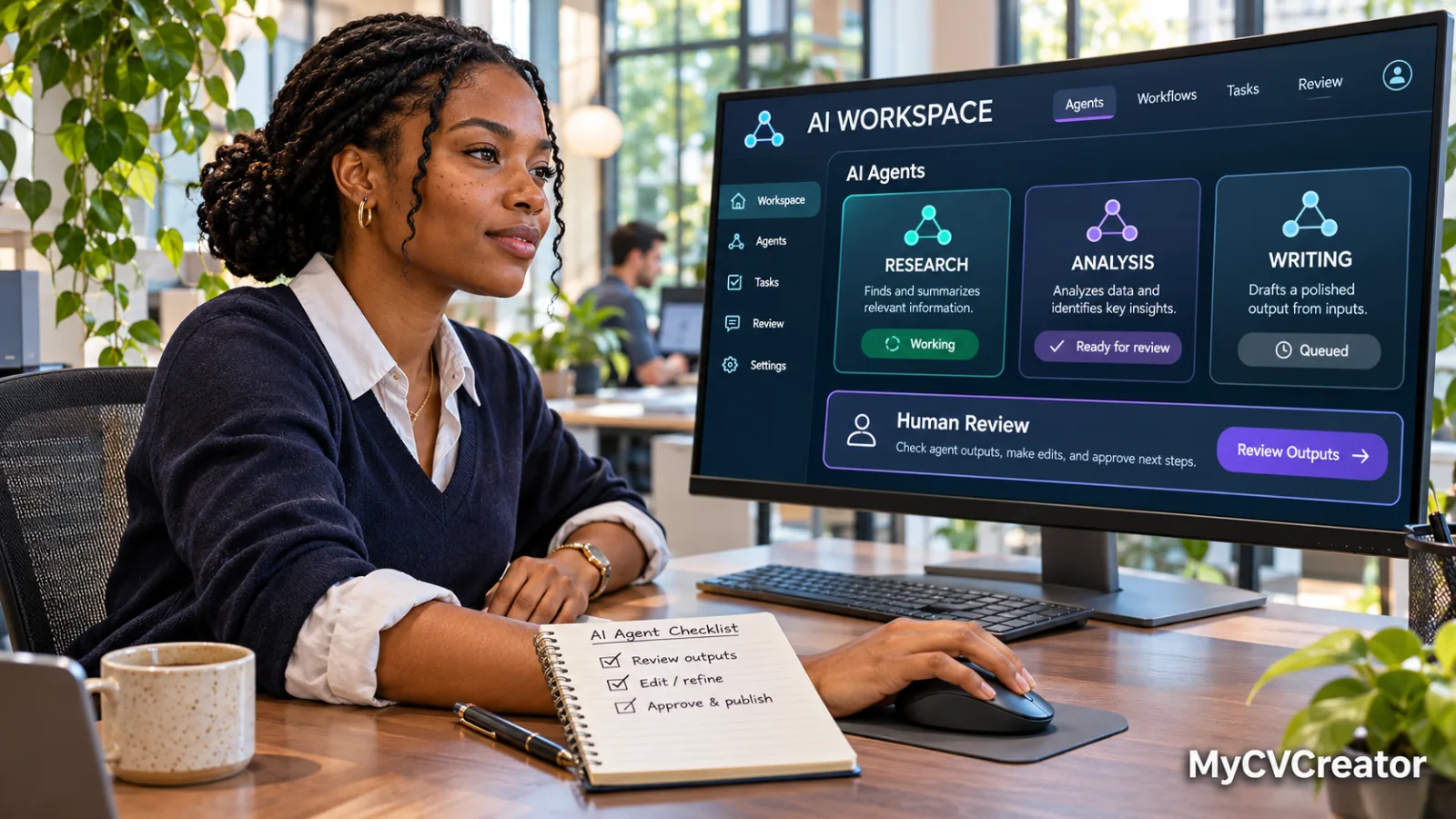
The agents handle industry research, client reports, media interview preparation, client briefs and image generation. Underwood's job is to direct them, check what they produce, pass the work to colleagues, and monitor how the agency's clients are described when people ask AI tools about them. She also attends client meetings.
Her story was reported by the BBC this week, alongside several others like it, and it captures something real about the 2026 graduate market. At the same moment that traditional entry-level hiring is contracting, a new kind of entry-level role is appearing: one where the junior person's job is not to do the first draft, but to supervise the system that does.
This guide covers what these roles involve, who is getting them, the trade-off nobody mentions in the job ad, and exactly how to position yourself for one.
What an AI associate actually is
There is no single definition yet, and the titles vary widely. You will see versions of this role advertised as:
- AI associate
- AI automation analyst
- AI operations associate or coordinator
- Agent operations specialist
- AI enablement associate
- Automation or workflow analyst with an AI focus
Under the different titles, the work has a consistent core. An AI associate sits between a team's actual business work and the AI tools that now do part of it. They set up and direct agents, check the quality of what comes back, spot where something has gone wrong, and find new places where automation would help.
Two other examples from the same BBC report show the range.
Dillan Patel, 24, a business management graduate, joined an engineering software company in Coventry as an intern 18 months ago and is now an AI automation analyst. His first significant project was building an internal chatbot to capture the knowledge of a senior colleague who was retiring. He now builds agents for specific teams and looks for manual, repetitive tasks that AI could take over.
Cian Clinton, 23, joined a consultancy after finishing his degree and uses around ten AI agents every day. "I am now taking on responsibilities which would usually take me four or five years to get to," he told the BBC.
Notice the backgrounds. Marketing. Business management. Not computer science. That is one of the more important things to understand about this role.
What the work looks like day to day
Taking the examples together, an AI associate's week usually contains some mix of:
Running agents on real work. Briefing an AI tool or chain of tools to produce research, summaries, drafts, reports or data pulls for a team.
Quality control. Reading what the agents produce and deciding whether it is right. This is the core of the job and it is where most of the value sits. An agent that confidently invents a statistic in a client report is a reputational problem, and the AI associate is the person standing between that report and the client.
Building small automations. Configuring a chatbot, an internal assistant, or a repeatable workflow for a specific team. Usually with no-code or low-code tools rather than from scratch.
Finding opportunities. Sitting with colleagues, watching where time goes, and identifying tasks worth automating.
Explaining and training. Helping less technical colleagues use the tools well, and writing the guidance they follow.
Normal junior work alongside. Client meetings, team admin, the ordinary tasks of whatever industry the company is in.
Why this role exists now
The data behind this trend comes from PwC's 2026 AI Jobs Barometer, which analysed 2.4 million US entry-level job postings. Two findings matter.
First, the entry-level roles most exposed to AI were seven times more likely to ask for skills traditionally associated with senior staff: motivational leadership, strategic decision-making and team building.
Second, those higher-expectation entry-level roles have grown 35 percent since 2019, while other entry-level roles shrank by 10 percent.
That is the shape of the market in two numbers. The traditional entry-level job, where you spent two years doing the first draft of everything while learning the trade by repetition, is shrinking because the first draft is increasingly automated. The roles that are growing ask a junior person to direct, judge and take responsibility much earlier.
The AI associate is the clearest example of the second kind. It is, quite literally, a junior role with a management component, except that what is being managed is software.
The catch nobody puts in the job ad
Here is the uncomfortable question the BBC report raised, and it is the most important part of this article if you are considering one of these jobs.
If the agents are doing the research, the drafting and the first analysis, when does the AI associate learn to do those things themselves?
Underwood said it plainly: "There's certain things that I haven't had the chance to do yet, like directly pitching to the media." For a PR professional, pitching to journalists is the core craft.
Employers are split on how much this matters. The chief operating officer of a finance group interviewed in the same report described a two-year graduate programme that rotates new hires through four areas at six-month intervals, specifically so they learn the products, draft credit papers, build customer relationships and eventually run whole transactions. His concern was graduates becoming too AI-centric and not learning the trade. PwC UK's chief technology and innovation officer put it even more directly: "AI skills on their own are not going to help you in your career."
The risk works like this. Quality control of AI output depends on knowing what good work looks like. You can only spot that a client report is wrong if you understand the client, the industry and the work well enough to know what right looks like. An AI associate who never learns the underlying craft gradually becomes worse at the part of the job that matters most, and harder to promote into a senior role in the actual business.
There is also an evidence problem. Nobody yet knows what an AI associate looks like five years into their career, because the role has barely existed for two.
None of this means the job is a bad choice. It means you take it with a plan.
How to take the job without losing the career
If you get an AI associate role, or one like it, protect yourself with three habits.
1. Insist on doing some of the underlying work yourself. Ask to write a report by hand occasionally, run an analysis without the agent, sit in on the pitch, handle a client email end to end. Frame it as quality control, because it is: you will be better at checking the agents if you can do the work.
2. Learn the business, not just the tools. Tools change every six months. Knowing what a client values, how a deal is structured or why a campaign worked is what makes you promotable. Our guide on job hugging and growing without changing jobs covers how to ask for that kind of exposure inside a company.
3. Keep a running record of judgment calls. Every time you catch an agent error, decline to automate something, or change how a workflow runs because of a risk you spotted, write it down with the outcome. Those notes become the strongest bullets on your next resume, for reasons covered in our piece on why employers want critical thinking more than AI skills.
Who gets hired into these roles
From the examples reported and the postings visible this year, the pattern is consistent.
Domain first, tools second. The PR agency hired a marketing graduate. The engineering software company promoted a business graduate. Employers want someone who understands the work being automated, because that is what makes the quality control meaningful.
Demonstrated tool use, not credentials. A certificate helps a little. A real project helps a lot. Hiring managers want to see that you have actually built something with these tools and know where they fail.
Comfort with ambiguity. These roles are being invented as they go. The ideal candidate is someone who can be handed a vague brief, such as "find out where AI could save the operations team time," and come back with a plan.
Clear writing. Directing agents is a writing skill. So is explaining to colleagues what the agent did and why it went wrong.
Internal candidates often have an edge. Patel started as an intern. If you are already in an entry-level job, becoming the person on your team who is best at using these tools well is one of the most reliable routes into this kind of role.
How to write the resume
The mistake most applicants make is writing a list of tools.
Skills: ChatGPT, Claude, Gemini, Zapier, Make, Copilot, prompt engineering
Every applicant has this row. It tells the reader nothing about whether you can be trusted with the output. Keep it, but keep it short, and put the real evidence in your experience and projects. Our guide on which AI skills to list and how covers the right level of detail for the skills section.
Strong AI associate bullets follow a pattern: a business problem, what you built or ran, how you checked it, and what it achieved.
Weak:
Used AI tools to help the marketing team with research.
Strong:
Built a set of research agents to produce weekly competitor summaries for the marketing team, added a manual source check after finding fabricated citations in early runs, and cut preparation time for the Monday meeting from about four hours to one.
Weak:
Created a chatbot for internal use.
Strong:
Built an internal assistant from a retiring engineer's documentation and recorded walkthroughs so the support team could answer common technical questions without escalating, tested it against fifty real past queries before launch.
Weak:
Automated repetitive tasks.
Strong:
Interviewed the finance team about manual work, identified invoice matching as the largest time cost, and set up an automated first-pass match with human review of exceptions.
Each strong version shows the three things the role actually requires: understanding the business problem, using the tools to address it, and exercising judgment about where they fail.
If you have no work experience, a projects section does the same job. Build something real for a club, a family business, a volunteer organisation or a course, and describe it in the same structure. Our article on how 2026 graduates compete goes further on building that record from scratch.
A sample summary
Marketing graduate who runs and quality-checks AI research and reporting workflows. Built an agent-based competitor monitoring process for a student consultancy project and documented its failure cases for the next team. Looking for an AI associate role where I can learn the client side of the business while improving how the team uses AI.
That last sentence is deliberate. Saying you want to learn the business, not only the tools, answers the concern sceptical employers have about this role before they raise it.
Where to look
- Search all the title variants, not just "AI associate." Many companies have not settled on a name.
- Agencies and consultancies have been early adopters because so much of their work is research, drafting and reporting.
- Operations-heavy businesses such as contact centres, logistics, insurance and finance are creating automation-focused roles for similar reasons.
- Inside your current employer. Volunteer to pilot a tool for your team. That is how many of these jobs are being filled.
- Read the posting carefully. "AI associate" on a job board can also mean a data annotation contractor, a junior machine learning engineer, or an AI-focused sales role. Wide salary ranges on aggregator sites reflect that mix, so judge each posting by its actual duties.
The interview
Expect to be asked to show rather than tell. Common formats this year include:
- Walk us through something you built with AI tools and where it went wrong.
- Here is an AI-generated document. What would you check before it goes to a client?
- How would you decide which of a team's tasks to automate first?
- When would you not use an AI tool?
The last question is where candidates separate. A good answer has rules in it: you do not automate what you cannot verify, you keep humans on anything client-facing or high-risk, and you check a sample of outputs even when a workflow is running well. Our guide to common interview questions explains how to prepare a small bank of stories that cover most of these.
If you are an employer creating this role
A short note for the business owners and managers reading this.
Write the job description around outcomes and judgment, not a tool list, and build in a deliberate path for the new hire to learn your actual trade. The risk the BBC report identified is real: a junior person who only supervises agents may never develop the expertise that makes them valuable to you in five years. Rotations, shadowing and owning real deliverables solve that. Our guide on how to write a job description covers the structure.
Frequently asked questions
What does an AI associate do? An AI associate directs AI agents and tools to do parts of a team's work, checks the quality of what they produce, builds small automations, and identifies new tasks AI could handle, usually alongside ordinary junior responsibilities in the business.
Do I need a computer science degree to become an AI associate? No. Many of the people in these roles have business, marketing or humanities degrees. Employers value understanding the work being automated, practical tool experience and good judgment more than programming.
Is an AI associate a good first job? It can be, especially because it offers responsibility early. The main risk is not learning the core skills of your industry. Ask for exposure to the underlying work and keep a record of judgment calls you make.
What skills should I learn for an AI associate role? Clear writing and briefing, critical review of outputs, basic workflow automation, and a solid understanding of the business area you want to work in. Build at least one real project and document what went wrong and how you fixed it.
Will AI associate roles last? Nobody knows yet, because the role is new. What is likely to last is the underlying skill: supervising automated work and taking responsibility for its quality. Our article on AI-resistant careers covers why judgment-heavy work is the most defensible.
The short version
The AI associate is the clearest sign of where entry-level work is going. The junior job is less about producing the first draft and more about directing, checking and taking responsibility for what the machines produce. That is a genuine opportunity, especially for graduates from non-technical backgrounds who understand a business well. Take it with your eyes open: the people who will do best in these roles are the ones who keep learning the trade underneath the tools.
Build your AI associate resume on MyCVCreator and lead with one bullet that proves you caught what the agent got wrong.
Sources: BBC News, "Graduates are managing AI, but are they learning much else?", MaryLou Costa, November 2026; PwC 2026 AI Jobs Barometer (analysis of 2.4 million US entry-level job postings).
Related reading
- Entry-Level Jobs Are Shrinking: How 2026 Graduates Compete
- Employers Want Critical Thinking More Than AI Skills
- AI Now Reads Most Resumes: What the New Data Means
- AI Skills on Your Resume: What to List and How
- Will AI Take My Job? AI-Resistant Careers
- Tech Jobs Without a Degree
- Job Hugging: How to Grow Without Changing Jobs
- Common Interview Questions and How to Answer Them