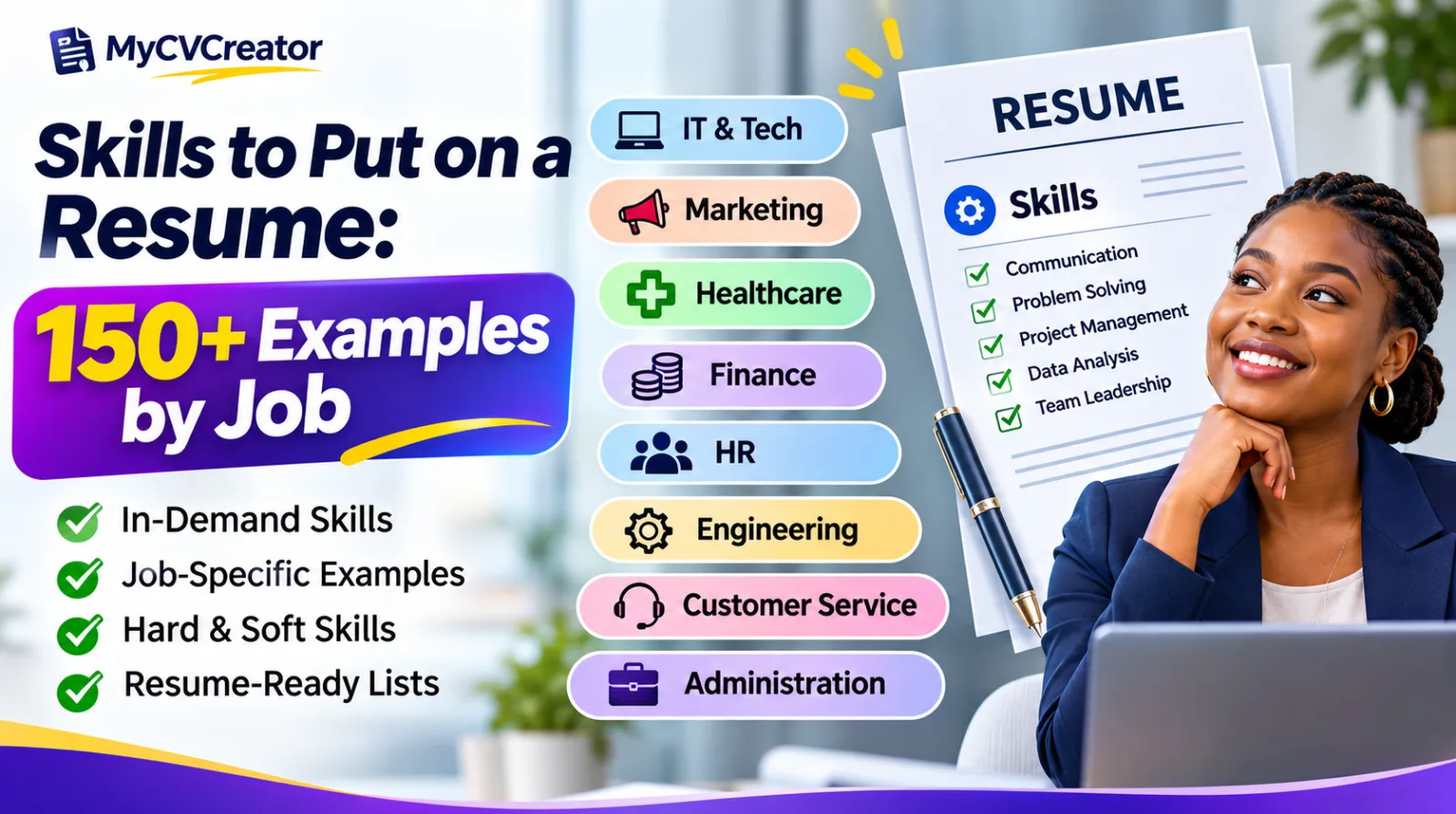
Quick answer: The best skills to put on a resume are the ones the job posting asks for that you can prove. Include 6 to 12 skills in a dedicated skills section, mostly hard skills such as software, tools, languages and certifications. Show your soft skills, such as communication and problem-solving, through results in your work experience rather than listing them on their own. Always match your wording to the job description.
That is the short version. The rest of this guide gives you more than 150 skill examples organised by type and by job, explains the difference between hard and soft skills, shows exactly where and how to put skills on your resume, and lists the skills you should leave off.
Hard skills vs soft skills
Employers look for two kinds of skills, and they treat them differently.
| Hard skills | Soft skills | |
|---|---|---|
| What they are | Teachable, measurable abilities for specific tasks | Personal qualities that shape how you work with people and problems |
| Examples | Excel, Python, bookkeeping, forklift operation, Spanish, SEO | Communication, teamwork, problem-solving, adaptability |
| How to prove them | Certifications, tools used, test results, portfolio | Stories and results in your experience section |
| Where they go | Skills section, and in your bullets | Mainly in your bullets and summary |
| How screening software treats them | Matched closely against the job description | Often ignored when listed alone |
There is a third group worth knowing: transferable skills. These are skills you built in one setting that carry into another, such as a teacher's presentation skills moving into corporate training, or a hospitality manager's scheduling skills moving into project coordination. They matter most if you are changing careers.
What employers want most in 2026
Two 2026 surveys show the direction clearly.
In the National Association of Colleges and Employers' Job Outlook 2026 Spring Update, the attributes employers most wanted to see on graduates' resumes were the ability to work in a team, problem-solving and effective communication, ahead of technical skills.
In Microsoft's 2026 Work Trend Index, a survey of 20,000 knowledge workers who use AI at work, the skills rated most important as AI takes on more work were quality control of AI output (50 percent) and critical thinking (46 percent).
The lesson is not to list those words. It is to prove them. Our article on why employers want critical thinking more than AI skills shows how.
The top 10 hard skills to put on a resume
These are widely requested across industries in 2026:
- Microsoft Excel or Google Sheets (formulas, pivot tables, data cleaning)
- Data analysis (SQL, Power BI, Tableau, reporting)
- AI tools (using and checking AI for research, drafting and analysis)
- Project management (planning, scheduling, tools such as Asana, Trello or Jira)
- Customer relationship management software (Salesforce, HubSpot, Zoho)
- Digital marketing (SEO, email marketing, social media advertising)
- Bookkeeping and accounting software (QuickBooks, Xero, Sage)
- Programming (Python, JavaScript, SQL)
- Foreign languages (with a stated level)
- Industry certifications and licences (nursing licence, CDL, PMP, CompTIA and so on)
The top 10 soft skills to put on a resume
- Communication (written and verbal)
- Problem-solving
- Critical thinking
- Teamwork and collaboration
- Adaptability
- Time management
- Attention to detail
- Leadership
- Customer focus
- Work ethic and reliability
Remember: on their own, these words prove nothing because every candidate uses them. Use them as a guide for which stories to tell in your experience section.
Hard skills examples by category
Computer and software skills
- Microsoft Word, Excel, PowerPoint and Outlook
- Google Workspace (Docs, Sheets, Slides, Drive)
- Typing speed (state your words per minute)
- Video conferencing (Zoom, Microsoft Teams, Google Meet)
- Shared drives and file management
- Adobe Acrobat and PDF editing
- Canva
- Basic HTML and website content management (WordPress, Wix, Shopify)
Data and analysis skills
- SQL
- Python for data analysis (pandas)
- Power BI
- Tableau
- Advanced Excel (VLOOKUP, XLOOKUP, pivot tables, macros)
- Data visualisation and dashboard building
- Statistical analysis
- Data cleaning and validation
- A/B testing
- Forecasting and budgeting models
AI skills
- Prompt writing for research, drafting and summarising
- Quality checking and fact-checking AI output
- AI-assisted data analysis
- Building simple automations (Zapier, Make, Microsoft Power Automate)
- Using AI assistants such as ChatGPT, Claude, Gemini and Microsoft Copilot
- Setting up and supervising AI agents for team workflows
Our guide to AI skills on your resume explains how to describe these without sounding generic.
Technical and IT skills
- Python, JavaScript, Java, C#
- React, Node.js
- Cloud platforms (AWS, Microsoft Azure, Google Cloud)
- Git and version control
- APIs and integrations
- Network troubleshooting
- IT help desk and ticketing systems
- Cybersecurity basics
- Database management
Marketing and sales skills
- Search engine optimisation (SEO)
- Google Ads and Meta Ads
- Email marketing (Mailchimp, Klaviyo)
- Content writing and copywriting
- Social media management
- Google Analytics
- Lead generation and prospecting
- CRM pipeline management
- Negotiation
- Market research
Finance and administration skills
- Bookkeeping
- Accounts payable and receivable
- Payroll processing
- Invoicing and reconciliation
- Financial reporting
- Budget management
- Diary and calendar management
- Travel coordination
- Minute taking
- Records management
Project and operations skills
- Project planning and scheduling
- Agile and Scrum
- Risk assessment
- Process improvement
- Supply chain and inventory management
- Vendor and supplier management
- Quality assurance
- Health and safety compliance
Healthcare skills
- Patient assessment
- Electronic health records (Epic, Cerner)
- Medication administration
- Basic life support (BLS) and CPR
- Infection control
- Phlebotomy
- Medical terminology
- Clinical documentation
Trades and technical skills
- Electrical installation and troubleshooting
- HVAC maintenance
- Plumbing
- Welding
- Blueprint reading
- Forklift operation (with certification)
- Commercial driving (with CDL class)
- Equipment maintenance and repair
Languages
List the language and your level, for example "French (professional working proficiency)" or "Yoruba (native)." Avoid vague words like "basic" without context.
Soft skills examples by category
Communication skills
- Written communication
- Public speaking and presenting
- Active listening
- Explaining technical information simply
- Report writing
- Negotiation
- Conflict resolution
People and leadership skills
- Team leadership
- Mentoring and coaching
- Delegation
- Stakeholder management
- Cross-team collaboration
- Giving and receiving feedback
- Training new staff
Thinking skills
- Problem-solving
- Critical thinking
- Decision-making
- Research
- Analytical thinking
- Creativity
- Attention to detail
Work habits
- Time management
- Organisation
- Prioritisation
- Adaptability
- Working under pressure
- Reliability
- Self-motivation
- Working independently
Skills to put on a resume by job
Use these as starting points. Always check the specific job posting and adjust.
| Job | Skills to include |
|---|---|
| Customer service representative | CRM software (Zendesk, Salesforce), live chat and ticketing, de-escalation, product knowledge, active listening, typing speed, multitasking, complaint resolution |
| Administrative assistant | Microsoft Office, Google Workspace, calendar management, travel booking, minute taking, filing systems, invoicing, confidentiality |
| Registered nurse | Patient assessment, medication administration, EHR systems, BLS and ACLS, wound care, care planning, patient education, infection control |
| Software developer | Programming languages, frameworks, Git, testing, APIs, cloud platforms, code review, documentation |
| Data analyst | SQL, Excel, Power BI or Tableau, Python, data cleaning, statistics, dashboard design, presenting findings |
| Sales representative | Prospecting, CRM, negotiation, pipeline management, product demonstrations, relationship building, closing, forecasting |
| Marketing coordinator | SEO, social media, email marketing, Canva, Google Analytics, copywriting, campaign reporting, content calendars |
| Accountant or bookkeeper | QuickBooks or Xero, reconciliation, accounts payable and receivable, payroll, tax preparation, Excel, financial reporting, attention to detail |
| Teacher | Lesson planning, classroom management, assessment design, differentiated instruction, learning platforms, parent communication, safeguarding |
| Project manager or coordinator | Project planning, scheduling tools, budget tracking, risk management, stakeholder communication, Agile or Scrum, reporting |
| Warehouse or logistics worker | Forklift operation, inventory systems, order picking, shipping and receiving, safety procedures, scanner use, physical stamina |
| Truck driver | CDL class, safe driving record, route planning, electronic logging devices, vehicle inspection, cargo securement, time management |
| Retail associate | Point of sale systems, cash handling, merchandising, stock control, customer service, upselling, loss prevention |
| Graphic designer | Adobe Photoshop, Illustrator and InDesign, Figma, typography, branding, layout, print preparation |
| Human resources assistant | HR information systems, recruitment coordination, onboarding, employee records, payroll support, confidentiality, employment law basics |
For more detail on specific roles, see our customer service representative resume guide, administrative assistant resume guide and guide to becoming a data analyst without a degree.
How to choose the right skills for each job
Do not use the same skills list for every application. Take ten minutes to tailor it.
- Copy the job description into a document.
- Highlight every skill, tool and qualification it mentions.
- Mark the ones you genuinely have and can talk about in an interview.
- Put those at the top of your skills section, using the same wording the posting uses. If it says "stakeholder management," do not write "working with other teams."
- Make sure each important skill also appears in your experience section, attached to a real result.
- Remove skills that are irrelevant to this role, even if they are impressive.
This matters because most employers now screen resumes with software that compares your resume with the job description. Matching the posting's language, honestly, helps you rank. Our guide to how AI reads your resume explains how that comparison works.
Where to put skills on your resume
Skills should appear in three places, not one.
1. A skills section. A short, scannable list, usually after your experience (or near the top if you are a student or career changer). This is where most hard skills live.
2. Your summary. Two or three of your strongest skills, named in the opening lines.
3. Your experience bullets. This is where skills become believable, because you show them working.
Skill listed only:
Skills: Excel, data analysis, attention to detail
Skill proven in a bullet:
Built an Excel tracker for 400 supplier invoices that flagged duplicates automatically, recovering about $8,000 in double payments in the first quarter.
The bullet proves Excel, data analysis and attention to detail at once, without using any of those words.
How to format a skills section: three examples
Simple list (works for most people)
Skills Microsoft Excel (pivot tables, XLOOKUP) · SQL · Power BI · Data cleaning · Stakeholder reporting · Python (pandas) · Spanish (conversational)
Grouped by type (good for technical and senior roles)
Technical skills: Python, JavaScript, React, Node.js, PostgreSQL, AWS, Git
Tools: Jira, Figma, Postman, Docker
Languages: English (native), French (professional working proficiency)
Skills with context (good for career changers and graduates)
Event planning: Organised three university careers fairs, 1,200+ attendees each
Budget management: Managed a society budget of ₦2.4 million, ended the year in surplus
Social media: Grew the society's Instagram following from 800 to 3,100 in one year
If your whole resume is built around skills rather than job titles, see our guide to the skills-based resume format.
How many skills should you list?
Between 6 and 12 in your skills section for most people. Fewer looks thin. More than about 15 starts to look like a keyword dump, and readers stop believing any of it.
Technical roles can justify a longer, grouped list. In every case, quality beats quantity: each skill should be relevant to the job and something you could discuss confidently.
Should you rate your skills?
Avoid star ratings, progress bars and percentages such as "Python 80%." They are meaningless to a reader (80 percent of what?), they invite questions about the missing 20 percent, and graphics like these are often unreadable by screening software.
If you need to show level, use words: "advanced," "working knowledge," "native," "conversational," or better, show what you have done with the skill.
Skills to leave off your resume
- Outdated basics: "Internet browsing," "email," "Microsoft Word" on its own for professional roles. These are assumed.
- Vague buzzwords alone: "hardworking," "go-getter," "team player," "detail-oriented" with nothing to back them up.
- Skills you cannot demonstrate: if you would struggle to answer an interview question about it, leave it out.
- Irrelevant skills: your forklift licence probably does not belong on a marketing resume.
- Personal hobbies listed as skills, unless they relate directly to the job.
- Anything you would not want to do every day: listing a skill tells the employer you are happy to use it.
Skills for students and people with no experience
If you have little work experience, your skills section matters more. Draw on:
- Coursework and projects: research, data analysis, presentations, lab skills
- Part-time and casual work: customer service, cash handling, stock control
- Volunteering and societies: event planning, fundraising, social media, budgeting
- Online courses and certifications: Google, Microsoft, HubSpot and Coursera certificates
- Self-taught tools: design software, coding languages, video editing
Then give each one a line of evidence. Our guide on how 2026 graduates compete covers building that evidence, and our list of certifications that pay can help you choose what to learn next.
Frequently asked questions
What are good skills to put on a resume? The best skills are the ones listed in the job posting that you can prove. Strong general examples include Excel, data analysis, project management, CRM software, AI tools, communication, problem-solving and teamwork.
What are examples of hard skills? Hard skills are teachable, measurable abilities such as Microsoft Excel, SQL, Python, bookkeeping, SEO, forklift operation, phlebotomy, Adobe Photoshop, foreign languages and professional certifications.
What are examples of soft skills? Communication, teamwork, problem-solving, critical thinking, adaptability, time management, leadership and attention to detail.
How many skills should I put on my resume? Usually 6 to 12 in a skills section, chosen for the specific job. Technical roles may list more if they are grouped clearly.
Where do skills go on a resume? In a dedicated skills section, in your summary, and most importantly in your experience bullets where you show them producing results.
Should I put soft skills on my resume? Yes, but show them rather than list them. A bullet describing how you resolved a difficult client issue proves communication far better than the word "communication."
Should I use the same skills for every application? No. Tailor your skills to each job description, using the posting's own wording for skills you genuinely have.
What skills should I not put on a resume? Outdated basics like "email," unproven buzzwords, skills you cannot demonstrate, and anything irrelevant to the job.
The short version
Put 6 to 12 relevant skills in a clear skills section, led by the hard skills the job posting asks for. Use the employer's wording. Name your top skills in your summary, then prove them in your experience bullets with real results. Leave out vague buzzwords and anything you could not discuss in an interview, and tailor the list for every application.
Build your resume on MyCVCreator and add a tailored skills section in minutes.
Sources: National Association of Colleges and Employers, Job Outlook 2026 Spring Update; Microsoft 2026 Work Trend Index.
Related reading
- AI Skills on Your Resume: What to List and How
- Skills-Based Resume Format: When and How
- Employers Want Critical Thinking More Than AI Skills
- How AI Reads Your Resume Now: ATS 2.0 and Semantic Matching
- Certifications That Pay in 2026
- The Career-Pivot Resume
- How Can I Make a CV for a Job?
- Common Interview Questions and How to Answer Them