
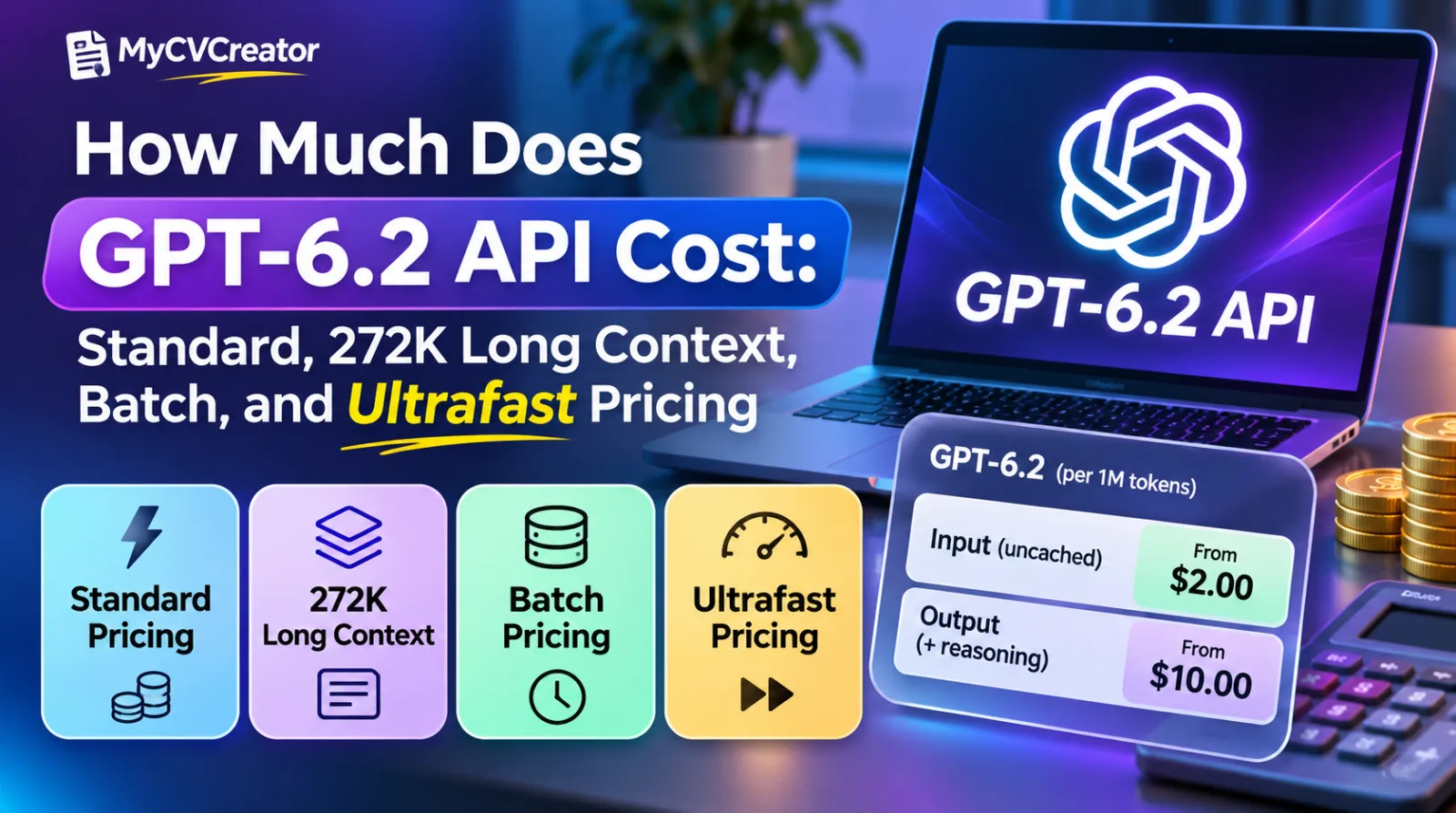
For requests up to 272,000 input tokens, GPT-6.2 Sol (gpt-6.2-sol) costs USD 2.00 per million input tokens and USD 10.00 per million output tokens (USD 0.10 cache read), while GPT-6.2 Astra (gpt-6.2-astra) costs USD 8.00 input and USD 40.00 output (USD 0.40 cache read, cutting base rates 20% and cache reads 60% compared with earlier GPT-6 Astra at USD 10 / USD 50 / USD 1.00). Once a request exceeds 272,000 input tokens, OpenAI reprices the entire call to USD 4.00 input / USD 15.00 output on Sol and USD 16.00 input / USD 60.00 output on Astra, before applying service multipliers that range from 0.5x Batch to 3.0x Ultrafast (6.0x starting March 1, 2027).
Founders building document-heavy SaaS products (automated resume and portfolio analyzers, contract review portals, applicant-tracking copilots, and developer tools) rarely blow their monthly AI margin on base token prices alone. Margin erosion happens when unguarded prompts cross the 272,000-token whole-request threshold, when engineers leave Ultrafast enabled on background jobs, or when teams choose the wrong cache write horizon. Modeling all four pricing dimensions together turns unpredictable usage spikes into fixed, predictable unit costs per user action.
Complete Token Rate Card Below and Above the 272,000-Token Cliff
Both GPT-6.2 Sol and GPT-6.2 Astra support a 1,050,000-token total window (922,000 maximum input and 128,000 maximum output). Unlike graduated tax brackets where only tokens above the threshold pay the higher rate, crossing 272,000 input tokens flips the rate table for every single input, cache, and output token in that request.
| Rate Category (per 1M Tokens, Standard Speed) | GPT-6.2 Sol (Up to 272K Input) | GPT-6.2 Sol (Above 272K Input) | GPT-6.2 Astra (Up to 272K Input) | GPT-6.2 Astra (Above 272K Input) |
|---|---|---|---|---|
| Uncached input tokens | USD 2.00 | USD 4.00 (2.0x) | USD 8.00 | USD 16.00 (2.0x) |
| Output + internal reasoning tokens | USD 10.00 | USD 15.00 (1.5x) | USD 40.00 | USD 60.00 (1.5x) |
| Prompt cache read tokens | USD 0.10 | USD 0.20 (2.0x) | USD 0.40 | USD 0.80 (2.0x) |
| 30-minute explicit cache write | USD 2.50 | USD 5.00 (2.0x) | USD 10.00 | USD 20.00 (2.0x) |
| 12-hour extended cache write | USD 5.00 | USD 10.00 (2.0x) | USD 20.00 | USD 40.00 (2.0x) |
Pay special attention to two columns in that rate card:
1. Output tokens jump by 50% when input crosses 272,000 tokens. Even if your model emits the exact same 12,000-token structured JSON report, attaching 275,000 input tokens instead of 265,000 input tokens raises Sol's output charge from USD 10.00 to USD 15.00 per million and Astra's output charge from USD 40.00 to USD 60.00 per million.
2. Two explicit cache retention horizons (30-minute vs 12-hour) serve different traffic shapes. A 30-minute cache write carries only a 1.25x premium over standard input (USD 2.50 vs USD 2.00 on Sol), paying for itself on the very first cache read (USD 2.50 + USD 0.10 = USD 2.60 vs USD 4.00 for two cold calls). A 12-hour cache write costs 2.5x standard input (USD 5.00 on Sol; USD 20.00 on Astra), earning back its upfront write premium as soon as the shared prefix is read three or more times across a full business workday without expiring during lunch breaks or meeting gaps.
Service Speed Multipliers and the March 1, 2027 Ultrafast Doubling
On top of context-length brackets, GPT-6.2 offers six latency and queuing tiers plus a regional compliance surcharge. Applying these multipliers changes the bill on an identical prompt by up to twelvefold:
1. Batch API (0.5x multiplier): Cuts token charges in half for asynchronous workloads tolerant of multi-hour completion windows.
2. 8-Hour Background Tier (-40%, or 0.6x multiplier): Ideal for overnight portfolio scoring, bulk candidate matching, or nightly code documentation updates that need same-day delivery without Batch file management.
3. 2-Hour Background Tier (-30%, or 0.7x multiplier): Fits webhook-driven pipelines such as post-upload document indexing, automated PR reviews, or multi-page report generation where users receive an email or push notification on completion.
4. Standard Synchronous Tier (1.0x multiplier): Default interactive API rate shown in the table above.
5. Fast Tier (2.0x multiplier): Doubles per-token cost for prioritized token streaming in interactive user sessions.
6. Ultrafast Tier (3.0x through February 28, 2027; 6.0x starting March 1, 2027): Promotional 3x billing runs only until the end of February 2027. On March 1, 2027, Ultrafast doubles to 6.0x standard rates (USD 12.00 / USD 60.00 on Sol; USD 48.00 / USD 240.00 on Astra below 272K, or USD 96.00 input / USD 360.00 output on Astra above 272K!).
7. Regional Data Residency (+10% uplift): Pinning inference processing to specific geographic compliance zones adds a 10% surcharge onto the selected tier.
Teams looking to avoid surprise direct-tier multipliers while accessing discounted developer gateway groups and unified usage caps can compare live OpenAI-compatible routing on reAPI before exposing high-speed tiers to free-plan users.
Three Worked Cost Calculations for Real SaaS Workloads
Abstract per-million figures rarely click until you multiply them across real customer actions. Walk through three everyday SaaS unit-cost calculations:
Scenario 1: High-Volume Document & Resume Optimization SaaS (10,000 Jobs on Sol)
Suppose each job evaluates a 6,000-token user resume and target job description against a shared 20,000-token industry rubric and style guide, returning 3,500 reasoning-plus-output tokens on gpt-6.2-sol (Standard tier):
1. Write the 20,000-token rubric once each morning using a 12-hour cache write (20,000 * USD 5.00/1M = USD 0.10 once per 12 hours, negligible across 10,000 jobs).
2. Each individual job pays 20,000 * USD 0.10/1M = USD 0.002 (cached rubric) + 6,000 * USD 2.00/1M = USD 0.012 (fresh user upload) + 3,500 * USD 10.00/1M = USD 0.035 (output), totaling USD 0.049 per customer job (USD 490.00 for 10,000 jobs). Routing non-urgent background exports through the 2-hour Background tier (-30%) drops unit cost further to USD 0.034 per job.
3. Avoid rasterizing born-digital PDFs unnecessarily: although both GPT-6.2 models accept image inputs, converting a four-page selectable-text PDF or DOCX resume into high-resolution PNG screenshots multiplies input token counts compared with extracting clean Markdown text first. Attach rendered page images only on the final visual-layout check where margin alignment, font hierarchy, and whitespace balance actually need inspection.
Scenario 2: Trimming a 300,000-Token Enterprise Dossier Below the 272K Cliff
Suppose an enterprise legal or procurement analyzer sends 300,000 uncached input tokens and generates 10,000 output tokens on gpt-6.2-astra:
Uncut 300K Call = (300K * USD 16/1M) + (10K * USD 60/1M) = USD 4.80 + USD 0.60 = USD 5.40
Trimmed 265K Call = (265K * USD 8/1M) + (10K * USD 40/1M) = USD 2.12 + USD 0.40 = USD 2.52
Removing just 35,000 tokens of boilerplate appendices, duplicate email headers, or blank table padding ahead of the API call cuts the invoice on that single request from USD 5.40 to USD 2.52 (a 53.3% instant reduction across 1,000 enterprise reports, saving USD 2,880 without changing models).
Scenario 3: Protecting Interactive Copilots Against the March 2027 Ultrafast Hike
Running 1,000 interactive coding or career-coaching sessions per day on gpt-6.2-sol (40,000 uncached input tokens + 4,000 output tokens = USD 0.12 at Standard 1.0x) costs USD 0.36/session on promotional 3.0x Ultrafast today, then jumps overnight to USD 0.72/session (USD 21,600/month) on March 1, 2027. Keeping interactive chat on 1.0x Standard or 2.0x Fast while warming a 30-minute prompt cache cuts that monthly run rate by 65% to 85%.
Five Pre-Launch Billing Guardrails for Engineering Leads
Lock these five controls into your backend service before scaling GPT-6.2 traffic:
1. Run a local token-count preflight at 268,000 tokens. Whenever assembled prompt context sits between 272,001 and 330,000 tokens, strip redundant HTML/whitespace or run a lightweight retrieval filter first so accidental boilerplate never triggers the 2x whole-request cliff.
2. Match cache TTL to traffic cadence. Use 30-minute cache writes for bursty multi-turn chat threads and 12-hour cache writes for global system rubrics and shared tool schemas that receive steady daytime traffic.
3. Default async workers to 2-hour (-30%) or 8-hour (-40%) Background tiers. Never pay synchronous 1.0x or 2.0x Fast rates inside cron jobs, queue consumers, or email report generators.
4. Feature-flag Ultrafast behind paid enterprise seats with a calendar alert set two weeks ahead of March 1, 2027 when the multiplier steps from 3.0x to 6.0x.
5. Enforce hard max_output_tokens caps per route. Because reasoning tokens bill at full output rates and neither Sol nor Astra accepts reasoning_effort: "none", cap reasoning_effort at low or medium on routine extraction endpoints. Developers prototyping cost-capped workflows across GPT-6.2 Sol and multimodal endpoints can also check live channel rates and unified balance controls on GPT-6.2 Sol at SeedRouter.