
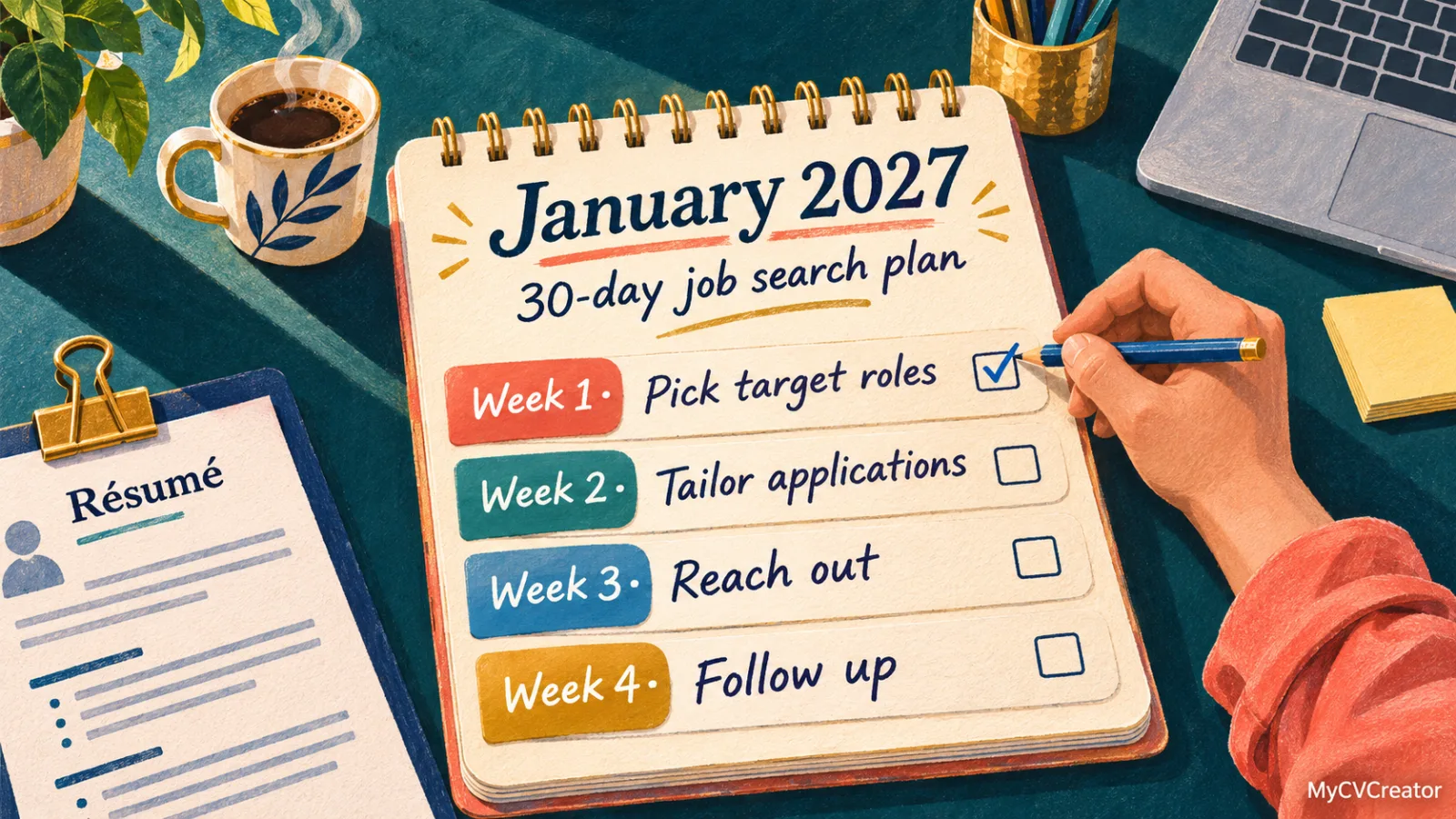
The January Hiring Surge: A 30-Day Job Search Plan for 2027
Every January, two things happen at once. Many employers unlock new annual budgets and restart hiring paused over the holidays. And millions of people make "new job" their new-year goal.
The second wave is the bigger one. Indeed's January 2026 data showed job searches surging in early January while postings moved much less. LinkedIn's research found that applications typically peak between January and May, and its earlier analysis found more views and applications per job in January than in any other month.
So January is an opportunity, but a crowded one. The people who win it are the ones who prepare in December and apply with focus, not volume. This 30-day plan shows you how.
Before the surge: what to do in December
Most people start on the first Monday of January. Indeed's UK data found that day was the busiest day of the year for job searches. Use December to be ready before they are.
- Decide your target. Write down one or two job titles, your preferred sectors, your location or remote preference, and the salary range you need.
- Update your CV. Rewrite your summary and add your 2026 results while you still remember the numbers. Follow the checklist in resume trends 2027.
- Refresh LinkedIn. Match your headline and dates to your CV, and turn on the open-to-work setting for recruiters only if you are currently employed.
- Build a target list. List 20 to 30 organisations you would like to work for, and note who you know at each.
- Prepare your stories. Write five short examples of problems you solved, using the situation, action, and result shape. You will use them in every interview.
- Reconnect lightly. Holiday greetings to former colleagues and managers are a natural way to restart contact before you ask for anything.
If you see a good role in early December, apply anyway. Some hiring teams try to finish interviews before the break.
The 30-day plan, week by week
The plan runs from the first working day of January to early February. Indeed has found that postings often reach their January peak at the very end of the month, so pace yourself across all four weeks rather than front-loading everything.
Week 1: Launch (days 1 to 7)
- Apply to the 5 to 8 best-fit roles already open on your target list.
- Tailor your CV to each one. Change the summary and reorder the bullets, not just the job title.
- Message 10 people from your network: former colleagues, managers, and classmates.
- Set up job alerts for your target titles so new postings reach you the day they go live.
Week 2: Expand (days 8 to 14)
- Apply to 8 to 10 new roles, focusing on postings less than a week old.
- Ask for two informational chats with people in roles you want.
- Follow up on week 1 applications where you have a named contact.
- Practise your five stories out loud, ideally recorded.
Week 3: Interview mode (days 15 to 21)
- Keep a steady 8 to 10 applications.
- Prepare for each interview: research the company, its recent news, and the interviewer.
- Expect screening calls, AI interviews, and skills tests. Our guides to AI interviews and screening and AI skills tests cover both.
- Send a short thank-you note within 24 hours of every interview.
Week 4: Review and push (days 22 to 30)
- Look at your numbers: applications sent, replies, interviews. If replies are under 1 in 10, fix the CV before applying more.
- Apply to fresh end-of-month postings.
- Reach out again to anyone who went quiet, once, politely.
- If an offer arrives, prepare to negotiate. See how to negotiate salary.
If the month ends without an offer, that is normal. February and March are also strong hiring months. Keep the routine going.
Daily routine and weekly targets
A job search is easier to sustain as a short daily habit than as weekend marathons. About 90 minutes a day is enough if you are working; double it if you are not.
Block | Time | What to do |
|---|---|---|
New postings | 15 minutes | Check alerts and save roles posted in the last 48 hours |
Applications | 45 minutes | Tailor and send one or two strong applications |
Networking | 15 minutes | Send two messages or follow-ups |
Preparation | 15 minutes | Practise one interview story or research one company |
Weekly targets to track:
- Applications: 8 to 10 tailored applications
- Conversations: 3 to 5 networking messages and at least 1 call
- Follow-ups: every application with a named contact
- Learning: one small skill or certification step, which also gives you something new to talk about
Keep a simple tracker with the company, role, date applied, contact, and status. Patterns become obvious after two weeks: which job titles reply, which sectors stay silent, and where your CV needs work.
Networking in January: messages that get replies
When inboxes are full of applications, a referral or a warm introduction moves you up the pile. January is also a natural time to get back in touch, because everyone is planning the year ahead.
Keep messages short, specific, and easy to say yes to. Three examples to adapt:
To a former colleague
Hi Amaka, happy new year. I'm looking for my next operations role this quarter, ideally in logistics or retail. Is your team hiring, or is there anyone you'd suggest I speak to? Happy to return the favour any time.
To someone in a role you want
Hi David, I'm moving into data analysis and saw you made a similar switch from finance. Would you have 15 minutes in the next two weeks to tell me what helped most? I'll keep it to 15 minutes.
Following up on an application
Hi Sarah, I applied for the customer success lead role last week. I've run a team of 9 handling about 400 calls a day, and I'd love to bring that to your team. Is there anything else you'd find useful from me?
Three rules: never attach your CV to a first cold message, ask for one small thing, and follow up once after a week, then let it go.
Mistakes that waste the January window
- Mass-applying with one CV. Fifty generic applications usually do worse than ten tailored ones, especially when every advert is flooded.
- Applying to old postings only. A role posted three weeks ago may already have hundreds of applicants. Prioritise roles posted in the last few days.
- Starting on 2 January with nothing ready. You lose the first week fixing your CV while others are already applying.
- Letting AI write everything. Recruiters notice generic, AI-sounding applications. Use AI to structure and tailor, then rewrite in your own words, as explained in should you use AI to write your CV.
- Ignoring your network. Online applications are the most crowded route in January. A warm introduction skips the queue.
- Giving up in week 3. Replies often come two to four weeks after you apply. The people who keep going through February catch the second wave.
- Not tracking anything. Without a tracker you cannot tell what is working, and you will forget to follow up.
Frequently asked questions
Is January really the best month to look for a job?
It is one of the best, but not the only one. January brings new budgets and a rush of job seekers, so competition is high. Autumn, especially September, is another strong period for postings, as we explain in how to use the fall hiring window.
Should I apply during the December holidays?
Yes, if you see a good role. Fewer people apply in late December, and your application will be waiting when the hiring manager returns.
How many applications should I send in January?
Around 8 to 10 tailored applications a week is a sustainable target for most people. Quality matters more than volume.
How long does it take to hear back?
Often two to four weeks, sometimes longer in January because hiring teams are processing more applications. Follow up once after about a week if you have a contact.
What if I am currently employed?
Keep the daily routine short, use evenings for applications, and schedule interviews early or late in the day. Keep your search off work devices.
Start your January plan now
The best January job searches start in December. Set your target, update your CV, and build your list of 20 to 30 organisations before the new year. Build or refresh your CV with MyCVCreator, and record a short video resume to send with networking messages. When everyone else is applying on the first Monday of January, you will already be ready.