AI Skills Tests in Hiring: How to Prepare
For years, "Are you comfortable with AI tools?" was a question you could answer with a confident yes. In 2027, more employers will ask you to prove it. Picture a second-round interview where the hiring manager opens a laptop, hands you a client brief, and says, "You have 20 minutes and any AI tool you like. Show me how you would handle this."
This is no longer a tech-industry habit. It is spreading to finance, healthcare, marketing, law, and administration. The good news is that an AI skills test is predictable. It measures a small set of habits, and you can build them in two weeks.
This guide explains why the tests are arriving, what they look like, what they score, and how to prepare.
Why employers are testing AI skills now
Employers are testing because a CV line that says "proficient in AI" proves nothing. Gartner predicts that by 2027, 75% of hiring processes will include certifications and tests for workplace AI proficiency. Three pressures are driving the change.
AI skills are now written into job adverts. AI skill requirements in entry-level postings nearly tripled between autumn 2025 and the spring 2026 hiring season, and more than a third of entry-level roles now ask for them, according to NACE data reported by WRKdefined.
Everyone claims the skill. When most applicants list AI on their CV, the claim stops separating candidates. A demonstration does.
Employers also fear over-reliance. The same Gartner release predicts that through 2026, half of global organisations will require "AI-free" skills assessments, because heavy AI use can weaken critical thinking. So expect to be tested in two directions: can you use AI well, and can you think without it?
The rollout is uneven. One workforce report found that the share of employers still working out how to assess AI skills doubled from 16% in 2025 to 32% in 2026, as reported by Khaleej Times. That means formats vary widely between companies, and prepared candidates have a real edge.
These tests sit alongside the automated screening already in use. For the full picture, read how AI automated interviews and screening work.
What an AI skills test looks like
There is no single standard test yet, but five formats cover most of what candidates report. Real examples come from employers named in an Irish Times report: McKinsey asks junior consulting candidates to show how they use AI to research, analyse data, and refine ideas, and says it scores judgment, not prompting tricks. At Envoy, a senior accounting candidate walked through the prompts and data behind a technical memo.
Format | What happens | What it checks |
|---|---|---|
Live work task | You complete a realistic task with an AI tool while the interviewer watches or reviews the result | Your workflow, speed, and quality control |
Prompt repair | You are shown a weak prompt and asked to improve it | Whether you can give clear context and constraints |
Scenario questions | "How could AI improve this process in our team?" | Practical thinking about your own field |
Walkthrough | You explain how you used AI on a past piece of work | Honesty, depth, and real experience |
AI-free exercise | A written or verbal problem with no tools allowed | Independent reasoning and judgment |
Some employers let you bring your own tools. Others give you theirs. If the invitation does not say, ask the recruiter before the day. It is a reasonable question, and it shows you take the test seriously.
The five skills these tests measure
Whatever the format, assessors score the same five habits. None of them requires coding.
1. Choosing the right tool for the task
Know what a chat assistant, a spreadsheet copilot, and a research tool are each good at, and where each one fails. Be ready to explain why you picked one.
2. Giving clear instructions
A strong prompt states the role, the goal, the audience, the format, and the limits. Compare "Write an email to a client" with "Draft a 120-word email to a retail client whose delivery is five days late. Apologise once, give the new date of 14 January, and offer a 10% credit. Plain and warm tone."
3. Checking the output
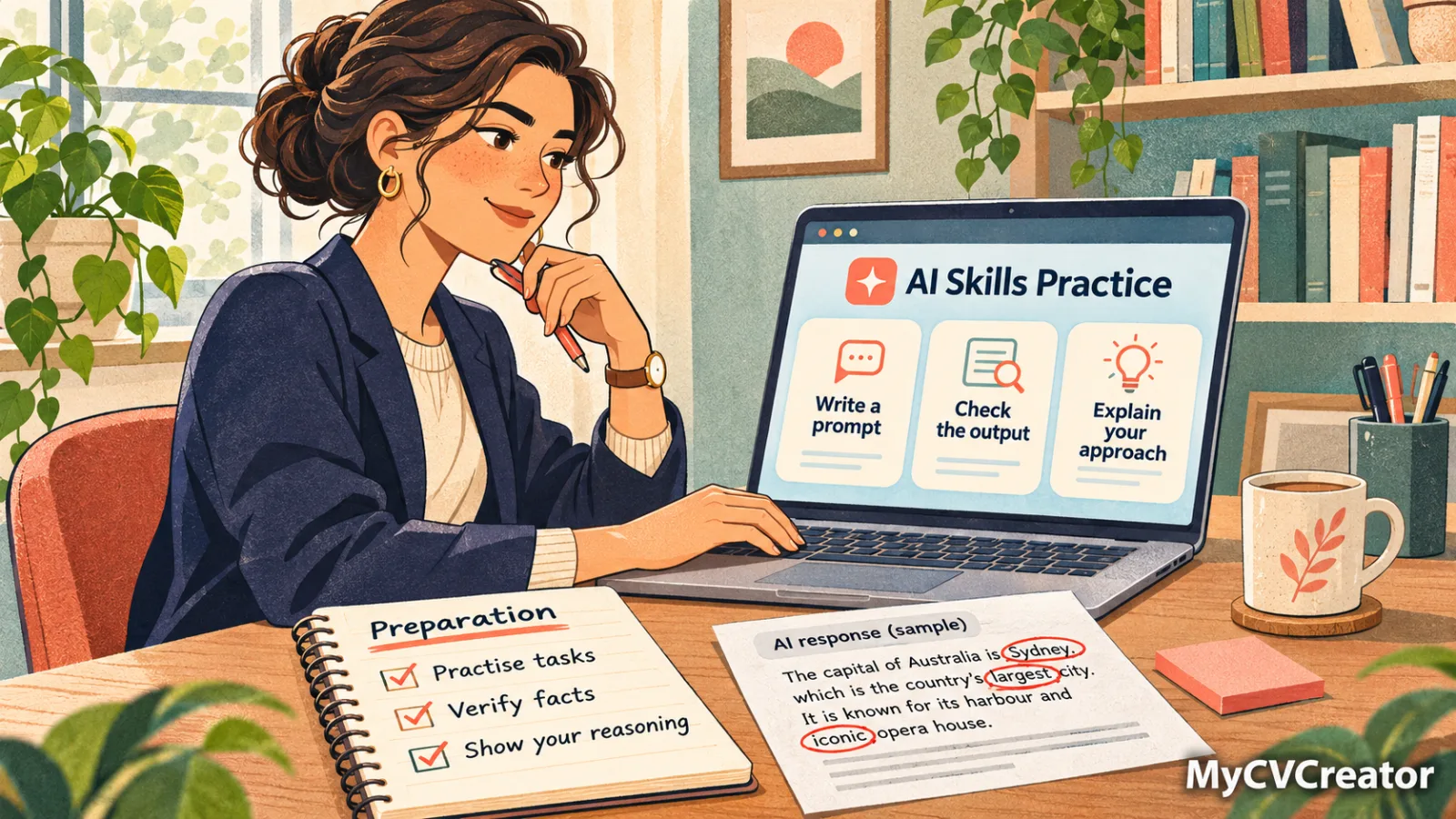
This is where most marks are won or lost. AI tools produce confident errors: wrong figures, invented sources, outdated rules. Assessors watch whether you verify numbers, names, and claims before you accept them. In a Microsoft survey of AI users, half said quality control of AI output is becoming a more important human skill, according to Analytics Insight.
4. Protecting data
Never paste customer records, salaries, patient details, or confidential files into a public AI tool. In a test, say this aloud: "I would remove the client names before using this." It is one of the easiest ways to stand out.
5. Adding your own judgment
The AI draft is a starting point. Assessors want to see what you change, cut, or add because you know the field. A finance candidate who spots that the AI ignored a tax rule proves more than one who produces a polished but generic answer.
A 14-day preparation plan
Thirty minutes a day for two weeks is enough to walk into a test with real examples.
Days | Focus | What to do |
|---|---|---|
1 to 2 | Pick your tools | Choose one general assistant and one tool common in your field. Read the job advert for any tools the employer names. |
3 to 5 | Daily tasks | Use AI for three real tasks from your own job: a summary, an email, and a piece of analysis. Save the prompts and results. |
6 to 7 | Prompt practice | Rewrite each prompt with role, goal, audience, format, and limits. Compare the outputs side by side. |
8 to 9 | Error hunting | Ask the tool factual questions about your field and check every answer against a trusted source. Note the mistakes you catch. |
10 | Data safety | Write down what you would never paste into a public tool, and how you would anonymise it. |
11 to 12 | AI-free drills | Solve two work problems on paper with no tools, then explain your reasoning aloud in two minutes. |
13 | Build your stories | Prepare two examples in this shape: the task, the tool, how you checked it, the result. |
14 | Mock test | Set a 20-minute timer, complete a realistic task, and talk through each step as you work. |
By day 14 you will have saved prompts, caught errors, and two rehearsed examples. That is more evidence than most candidates bring.
Certifications and courses worth adding
Gartner's prediction covers certifications as well as tests, so a recognised credential can carry you past the first filter. You do not need an expensive one. The options below suit non-technical professionals, with prices as listed in a DataCamp review from July 2026. Confirm current prices and exam codes on each provider's site before you pay.
Credential | Provider | Format | Approximate cost | Best for |
|---|---|---|---|---|
Elements of AI | University of Helsinki and Reaktor | Free online course | Free | Understanding the concepts before spending money |
AI for Marketers | HubSpot Academy | Free video course and badge | Free | Marketing and content roles |
Azure AI Fundamentals | Microsoft | Proctored exam with free study modules | About US$99 per attempt | Staff in organisations that run on Microsoft |
AWS Certified AI Practitioner | Amazon Web Services | Proctored exam | About US$100 to US$150 | Business and IT-adjacent staff in AWS environments |
AI Biz (AIS-210) | CertNexus | Proctored exam | About US$250 to US$300 | Managers who want a vendor-neutral credential |
Google AI Essentials on Coursera is another popular short course for beginners. Its listed price and length vary by source, so check the course page.
A free course teaches you the ideas. A proctored exam gives employers something they can verify. If budget allows only one, pick the exam that matches the tools your target employers use. For a wider look at credentials that raise earnings, see certifications that pay.
Mistakes that fail candidates on test day
Most failures come from habits, not from a lack of technical skill.
- Accepting the first answer. Submitting the first draft unchanged tells the assessor you cannot tell good output from bad.
- Working in silence. In a live task, your reasoning is the thing being scored. Say what you are doing and why.
- Skipping the check. One unverified figure can undo an otherwise strong answer.
- Pasting sensitive data. Entering confidential details into a public tool is an instant red flag in regulated fields.
- Hiding your AI use. Secretly using a tool in an AI-free round, or reading answers off a second screen in a video interview, risks disqualification. Employers are already alert to candidate fraud, as covered in prove you are real: deepfake candidates and identity verification.
- Naming tools you have never opened. A follow-up question will expose it within a minute.
Show your AI skills on your CV before the test
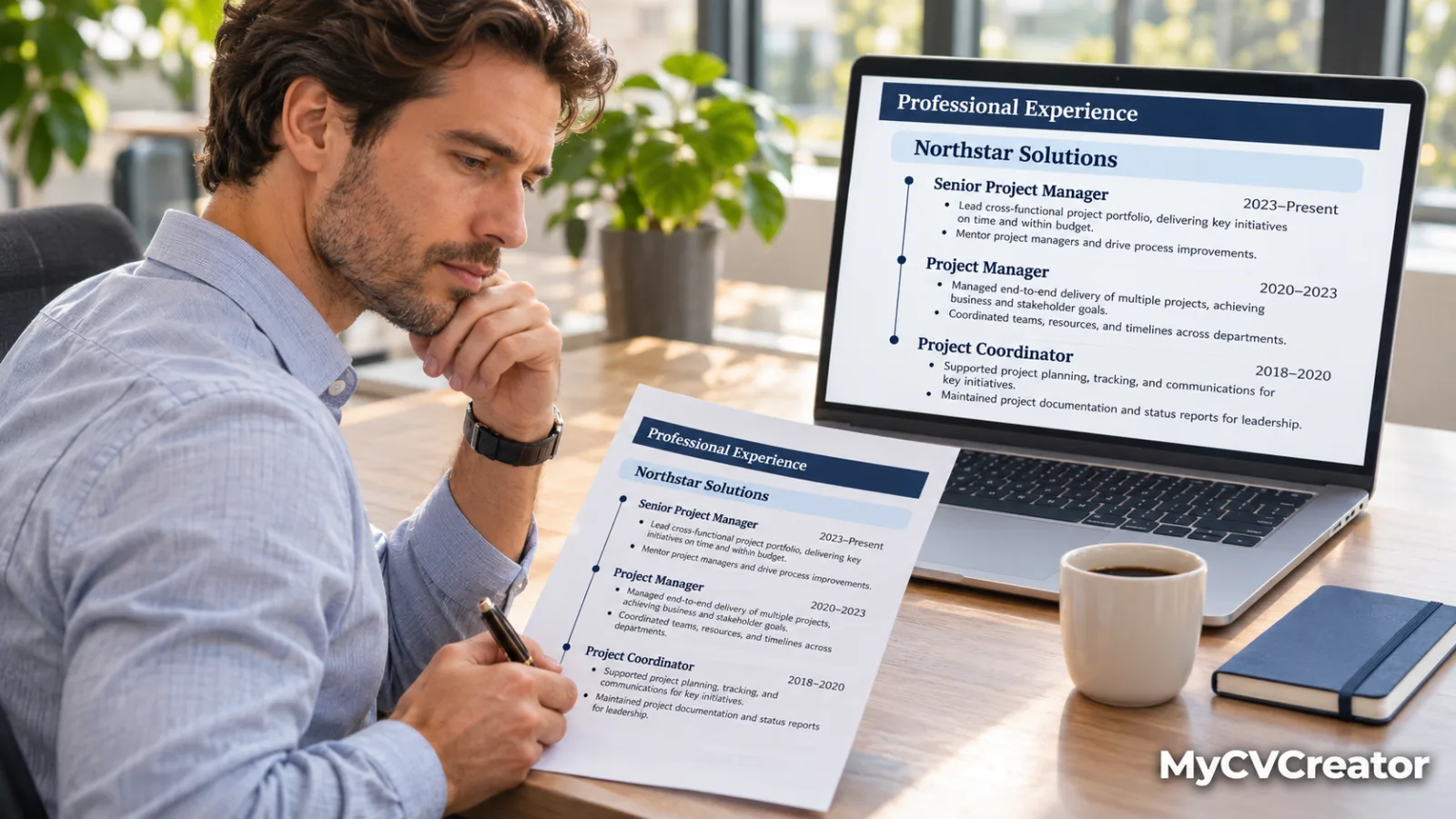
The test usually comes after the CV screen, so your CV has to earn the invitation first. Treat AI like any other skill and prove it with a result.
Weak | Strong |
|---|---|
Proficient in AI tools | Drafted weekly client reports with Copilot and verified every figure against source data, cutting preparation from 4 hours to 90 minutes |
Used ChatGPT for research | Summarised 40 supplier contracts with an AI assistant, then reviewed each summary by hand and flagged 6 renewal risks |
Familiar with automation | Built a prompt library for the support team that cut average reply time by 30% |
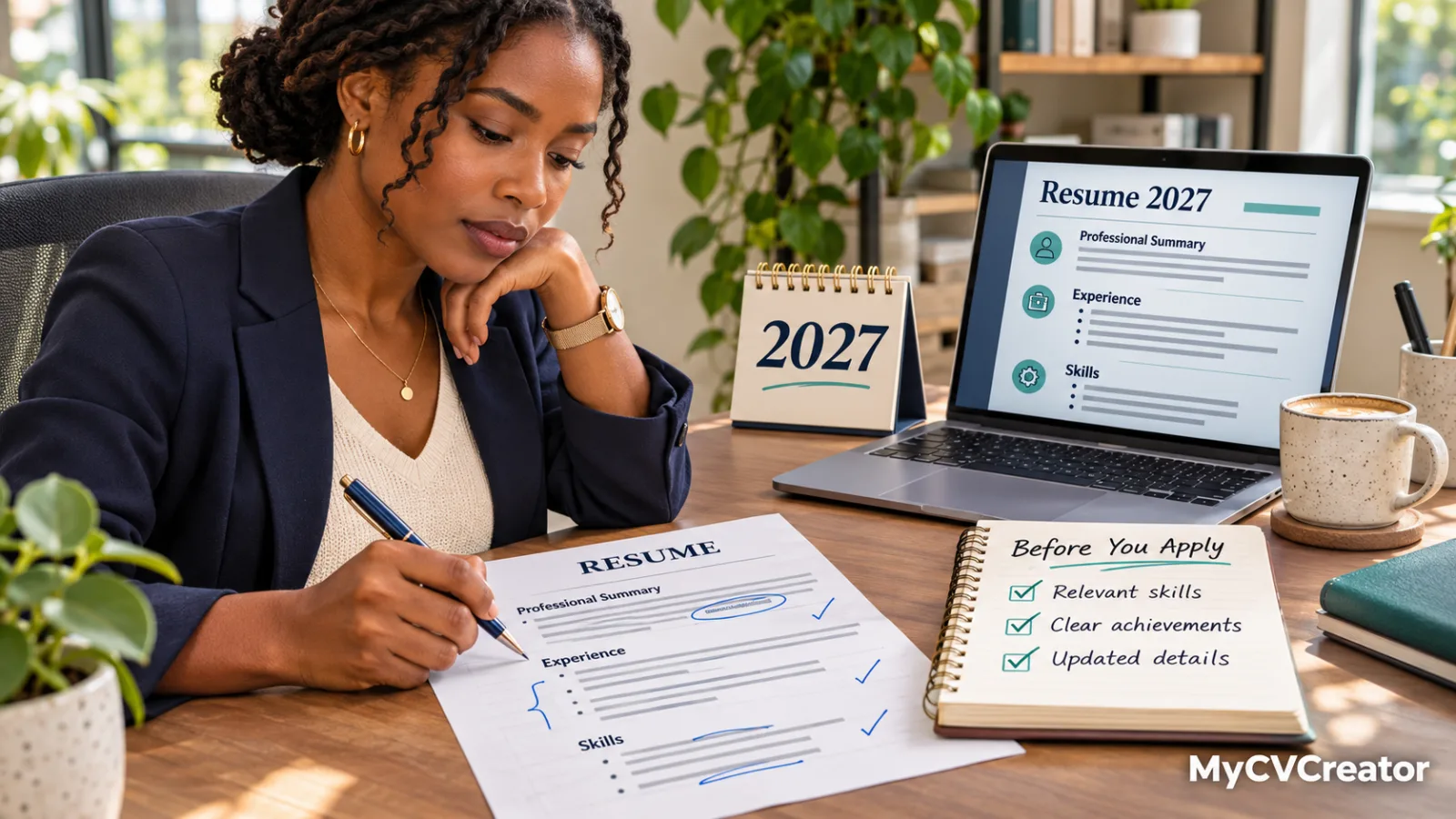
Add any certificate under "Certifications" with the provider and year. For the full list of what recruiters expect this year, read resume trends 2027. If you work in finance, the examples in how to write a finance CV that passes ATS screening show the same method in detail.
Frequently asked questions
What is an AI skills test in hiring?
It is an assessment of how well you use AI tools for real work. It can be a live task, a prompt exercise, scenario questions, or a walkthrough of past work. It checks judgment and accuracy more than technical knowledge.
Do I need to know how to code?
No. For most non-technical roles the test covers everyday tools such as chat assistants and office copilots. Coding is only tested for technical positions.
Which AI tools should I learn first?
Start with one general assistant and the copilot built into the office software you already use. Then add one tool that is common in your field. Depth in two or three tools beats a long list.
Can I fail for using AI too much?
Yes. Gartner expects half of global organisations to require AI-free assessments, so some rounds will ban tools altogether. In open rounds, relying on unchecked output is the most common way to lose marks.
Are AI certifications worth it?
They help at the screening stage, mainly when the provider is well known and the exam is proctored. They do not replace a demonstration, so pair any certificate with real examples.
Will entry-level applicants face these tests?
They are the most likely group. According to McKinsey, quoted in the Irish Times, AI tests are so far used mainly for entry-level roles. For the wider context, see entry-level jobs are shrinking.
Prepare before the invitation arrives
The AI skills test rewards people who already use the tools with care. Start the 14-day plan this week, add one credential, and rewrite two CV bullets to show AI use with a checked result. Then build your updated CV with MyCVCreator and record a video resume that shows employers how you think.