Can Gaming Skills Go on Your CV: When and How to Add Them
Gaming can build real skills. In a University of Glasgow trial, students who played selected video games over eight weeks showed improvements in communication, adaptability, and resourcefulness compared with a control group.
But employers are divided. In a German survey of HR managers, only 28% viewed gaming positively on a CV and 51% had a generally negative view, with older respondents more negative. Researchers who tested how hiring managers react found that listing gaming on a CV can be problematic compared with an alternative such as team sports. In tech, the picture is warmer: a 2026 Logitech study found IT leaders were more likely to consider candidates who list gaming as a skill.
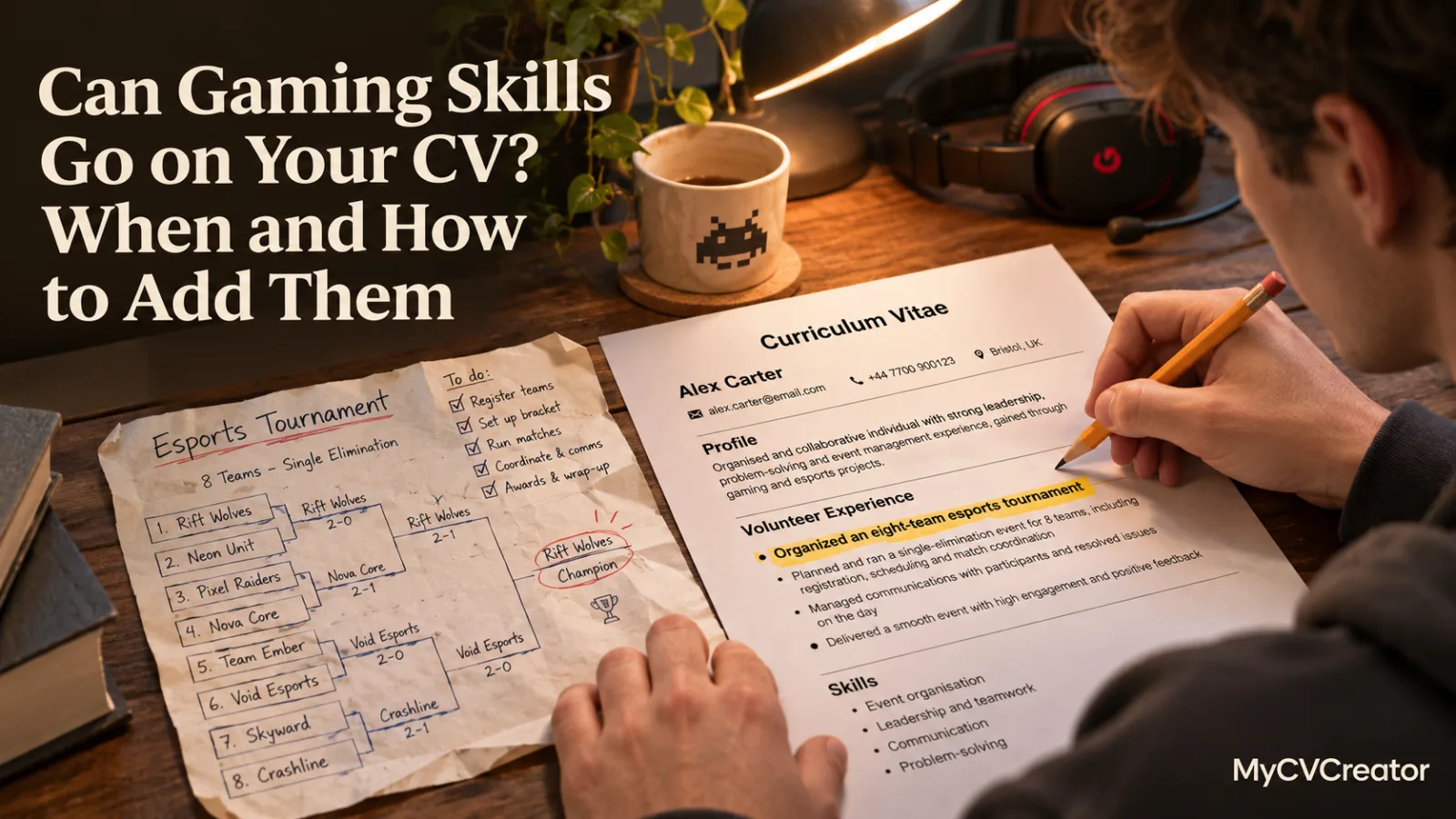
So the answer depends on what you write and who reads it. "I love gaming" rarely helps. "I ran a 200-member gaming community and organised monthly tournaments" often does. This guide shows the difference.
When gaming belongs on a CV
Include gaming when at least one of these is true:
- You did something beyond playing. You led, built, organised, created, or earned money. Achievement is what counts, not hours played.
- It is relevant to the job. Games, tech, esports, streaming, community management, marketing, and event roles value it most.
- You have little other experience. For students and school leavers, a real gaming achievement can fill a gap that would otherwise be empty.
- You can show a result. Members, viewers, revenue, rankings, downloads, or events delivered.
Leave it out when:
- It is only a hobby with no achievement attached.
- The role is in a conservative field, such as law, banking, or government, and you have stronger examples elsewhere.
- The game or community could be seen as offensive or unprofessional.
A useful test: would the line still impress you if you replaced the game with a sport or a club? If yes, it probably belongs.
Gaming activities that show real skills
Activity | Skills it can show | Best for roles in |
|---|---|---|
Running a guild, clan, or Discord community | Leadership, moderation, conflict resolution, scheduling | Community management, team leadership, customer success |
Organising tournaments or events | Event planning, logistics, budgeting, partnerships | Events, operations, marketing |
Streaming or creating gaming videos | Content creation, audience growth, editing, public speaking | Marketing, social media, media production |
Competitive esports | Teamwork, strategy, performance under pressure, discipline | Sales, team roles, sports and esports industry |
Modding or building game levels | Programming, design, problem solving, user feedback | Software, game design, product |
Writing guides, wikis, or reviews | Writing, research, explaining complex ideas simply | Content, technical writing, journalism |
Coaching other players | Teaching, feedback, patience | Training, education, management |
Testing beta versions and reporting bugs | Attention to detail, clear reporting | QA, software testing |
Trading in in-game economies | Analysis, negotiation, market awareness | Finance, sales, analytics |
Notice that every row describes an action you took, not just a game you played.
How to write gaming experience on your CV
Choose the right section. Significant work, such as streaming income or running an esports team, can go under Experience or Projects, just like a job. Smaller achievements fit under Leadership, Volunteering, or Interests.
Describe the role, not the game. Lead with what you did and the result. Mention the game name only if it helps the reader, such as for a games industry role.
Use numbers. Members, viewers, events, rankings, or money raised.
Use workplace language. "Recruited and managed a team of 12" reads better than "raid leader".
Weak | Strong |
|---|---|
Avid gamer | Founded and moderate a 450-member Discord community; set rules, resolved disputes, and trained 5 volunteer moderators |
Raid leader in an online game | Led a 20-person team through weekly scheduled sessions for 18 months, planning roles and reviewing performance after each session |
I stream on Twitch | Built a gaming channel to 1,200 followers in 10 months; plan and edit weekly content and manage two brand partnerships |
Competitive gamer | Captain of a university esports team; organised training, scouted 3 new players, and reached the national quarter-finals in 2026 |
Made some game mods | Built 4 game mods in C#, downloaded 15,000+ times; fixed bugs from user reports within a week |
The examples above are illustrative. Use your own real numbers, and be ready to back them up with links or screenshots.
For more on leading with skills when your experience is non-traditional, see skills-based hiring and your CV.
How to talk about gaming in an interview
If an interviewer asks about your gaming experience, treat it like any other example.
- Use a simple structure: the situation, what you did, and the result.
- Connect it to the job. "Managing a volunteer moderation team taught me how to give feedback to people who don't report to me, which I'd use in this role working across departments."
- Keep it short. Two minutes at most. Do not explain game mechanics.
- Show balance. Mention it as one example among others from work, study, or volunteering.
- Read the room. If the interviewer seems unconvinced, move to another example rather than defending gaming.
If gaming is your strongest example, a short video resume can help you explain it in your own words before the interview.
Mistakes to avoid
- Listing "gaming" as a hobby with nothing else. It tells the reader nothing and, for some, creates a negative impression.
- Bragging about hours played. Thousands of hours is not an achievement and can raise concerns about time management.
- Using gamer slang. Terms like "raid", "clan", or "grinding" may confuse a recruiter. Translate them.
- Exaggerating numbers. Follower counts and rankings are easy to check.
- Linking to unprofessional content. Review your stream, channel, or community before linking to it. Remove anything you would not want an employer to see.
- Leading with it for the wrong job. For a conservative employer, put stronger examples first and keep gaming brief.
Since the GTA 6 launch is on everyone's mind this week, a related warning: building gaming into your CV is smart, but faking a sick day for a game is not. See calling in sick for GTA 6.
Frequently asked questions
Should I put video games under hobbies on my CV?
Only if you add an achievement. "Gaming" alone adds little. "Organise monthly online tournaments for 60 players" shows a skill.
Do employers care about esports experience?
Some do, especially in tech, sport, media, and marketing. Present it like any competitive team activity: your role, your team, and your results.
Can streaming count as work experience?
Yes, if you treat it like a small business, with a regular schedule, audience growth, editing, and especially income or brand partnerships. List it under Experience or Projects.
Is gaming a good example for an entry-level CV?
It can be, when you have little work experience. Choose examples that show leadership, teamwork, or creating something.
Will gaming on my CV hurt me?
It can with some employers if you list it as a hobby only. Framed as clear achievements with results, the risk is much lower.
Turn play into proof
Gaming will not get you a job on its own. What you built, led, and achieved while gaming can. Pick your strongest example, translate it into workplace language, add a number, and put it where a recruiter will see it.
Build your CV with MyCVCreator. If gaming has you thinking about working in games, read how to get a job in the games industry.