Your CV Got You Shortlisted. Here's How to Prepare for the Questions It Will Raise
Getting shortlisted means your CV did its job: it convinced someone that you are worth an hour of their time. The interview is where they check whether the CV is true, and most of the questions in a first-round interview come straight from what you wrote. That is good news, because it means you can predict a large part of the conversation before you walk in.
Here is how to prepare for the interview using the document you already know best.
1. Read your CV the way the interviewer will
Interviewers rarely read a CV top to bottom on the day. They skim it a few minutes before the call and mark a handful of lines to ask about: the biggest claim, any number, a gap between dates, a short stint, a change of field, a skill listed as "advanced".
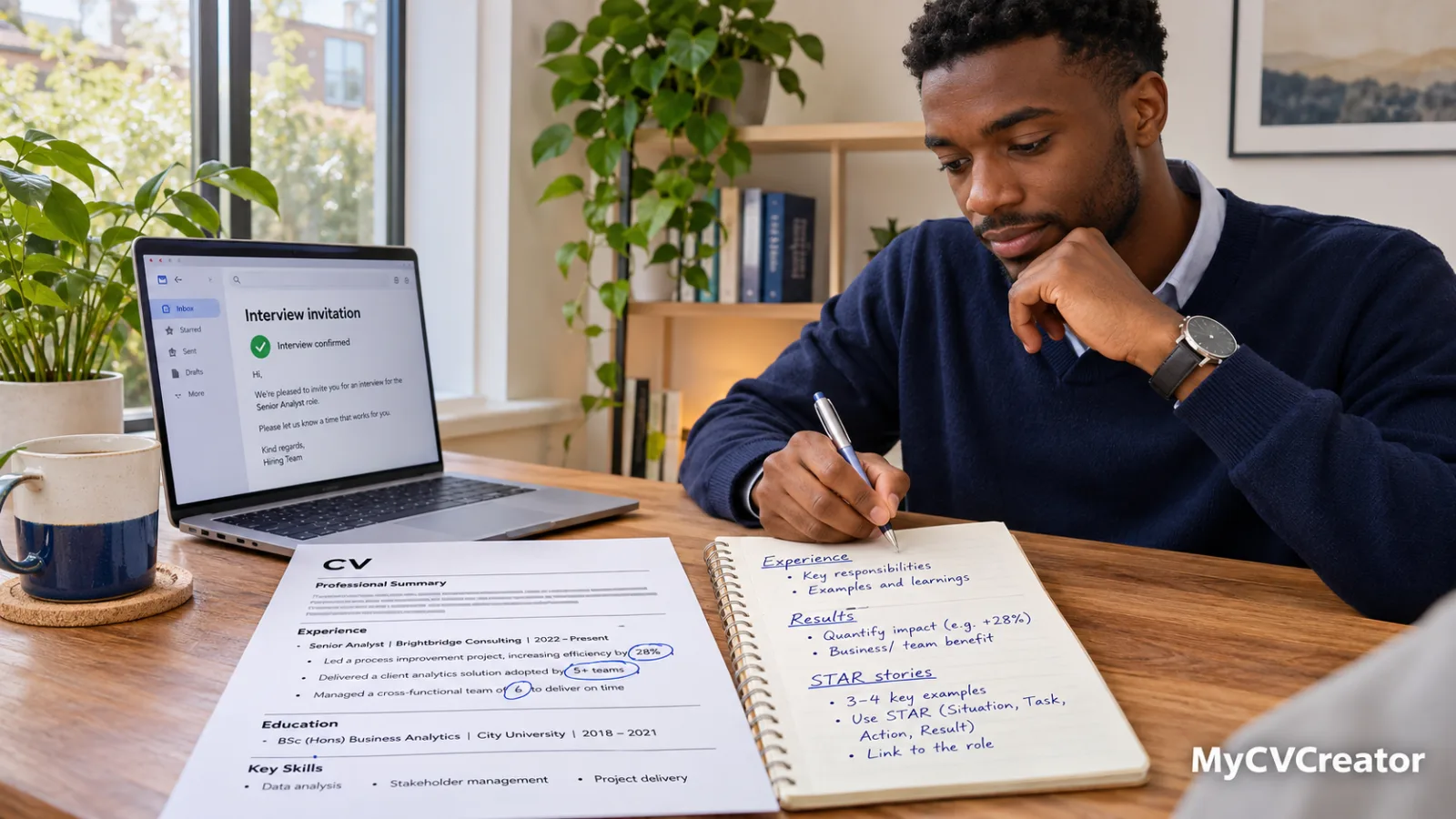
Print your CV and do the same. Circle five lines you would question if you were sitting on the other side of the table. Those five lines are your first preparation list.
2. Prepare a 60-second walk-through
"Tell me about yourself" or "walk me through your CV" opens almost every interview. It is not an invitation to read the document aloud. A simple structure works for freshers and experienced candidates alike:
Present: who you are now (your degree, or your current role and company).
Past: one or two experiences from your CV that matter most for this job, with a result.
Why this role: what draws you to it and where your experience fits.
Aim for about a minute. If you find it hard to compress a whole CV into that, a free tell-me-about-yourself generator can turn your background into a 30, 60 or 90-second draft. Treat the draft as a starting point and rewrite it in your own words, so it sounds like you rather than a script.
3. Be ready to back up every number
Numbers make a CV stand out, and they are also the first thing an interviewer probes. If your CV says you "increased sales by 20%" or "cut processing time by half", expect three follow-up questions: How was it measured? What exactly was your part? What was it before?
Write down the answer to each of these for every number on your CV. If you cannot explain a figure confidently, it is better to soften it on the CV than to struggle with it in the interview.
4. Have a story behind each key bullet point
Behavioural questions such as "tell me about a time you handled a difficult deadline" are usually aimed at the experiences listed on your CV. The STAR method keeps these answers clear:
Situation: one or two sentences of context.
Task: what you needed to achieve and why it was hard.
Action: what you did, step by step. Say "I", not "we". This should be the longest part.
Result: what changed, with a number if you have one, and what you learned.
Prepare five or six of these stories from your strongest bullet points. One good story can answer several questions: a project where you fixed a data problem under time pressure covers problem-solving, deadlines and teamwork.
5. Prepare honest answers for gaps and changes
Gaps between jobs, a role that lasted only a few months or a switch into a new field will almost always come up. The worst response is to look surprised. Prepare a short, factual answer and then move the conversation forward:
"I took eight months off to care for a family member. During that time I completed a certificate in data analysis, which is part of why I'm applying for this role."
"The company restructured six months after I joined, and my team was closed. I used what I learned there in my next role, where I…"
Keep it to two or three sentences. Interviewers mainly want to know that the reason is clear and that it will not repeat.
6. Match your CV to the job description
The panel will compare your CV with the job description, so do it first. Pick the three requirements that matter most in the advert and, for each one, choose a line from your CV and a short story that proves it. If a requirement has nothing on your CV, decide in advance how you will address it: a related project, a course, or an honest plan to learn it.
7. Practise out loud, not in your head
Answers that sound fine in your head often come out too long or in the wrong order. Say your walk-through and your STAR stories out loud, time them, and record yourself at least once. Listen for filler words and for the moment you start to ramble.
It also helps to practise with someone who asks follow-up questions, because that is where unprepared answers fall apart. If no one is available, free practice tools such as 360Interview.ai let you run a short AI mock interview in the browser without signing up: you hear a question, answer out loud and get scored feedback when you finish.
A quick checklist for the day before
Re-read your CV and know every date, title and number on it.
Make sure your LinkedIn profile matches your CV.
Re-read the job description and your three requirement stories.
Prepare two questions to ask the interviewer about the role or the team.
For video interviews, test your camera, microphone and connection in the same room you will use.
Your CV opened the door. Treat it as the outline of the interview, prepare the stories and numbers behind it, and you will spend the conversation explaining your experience instead of defending it.