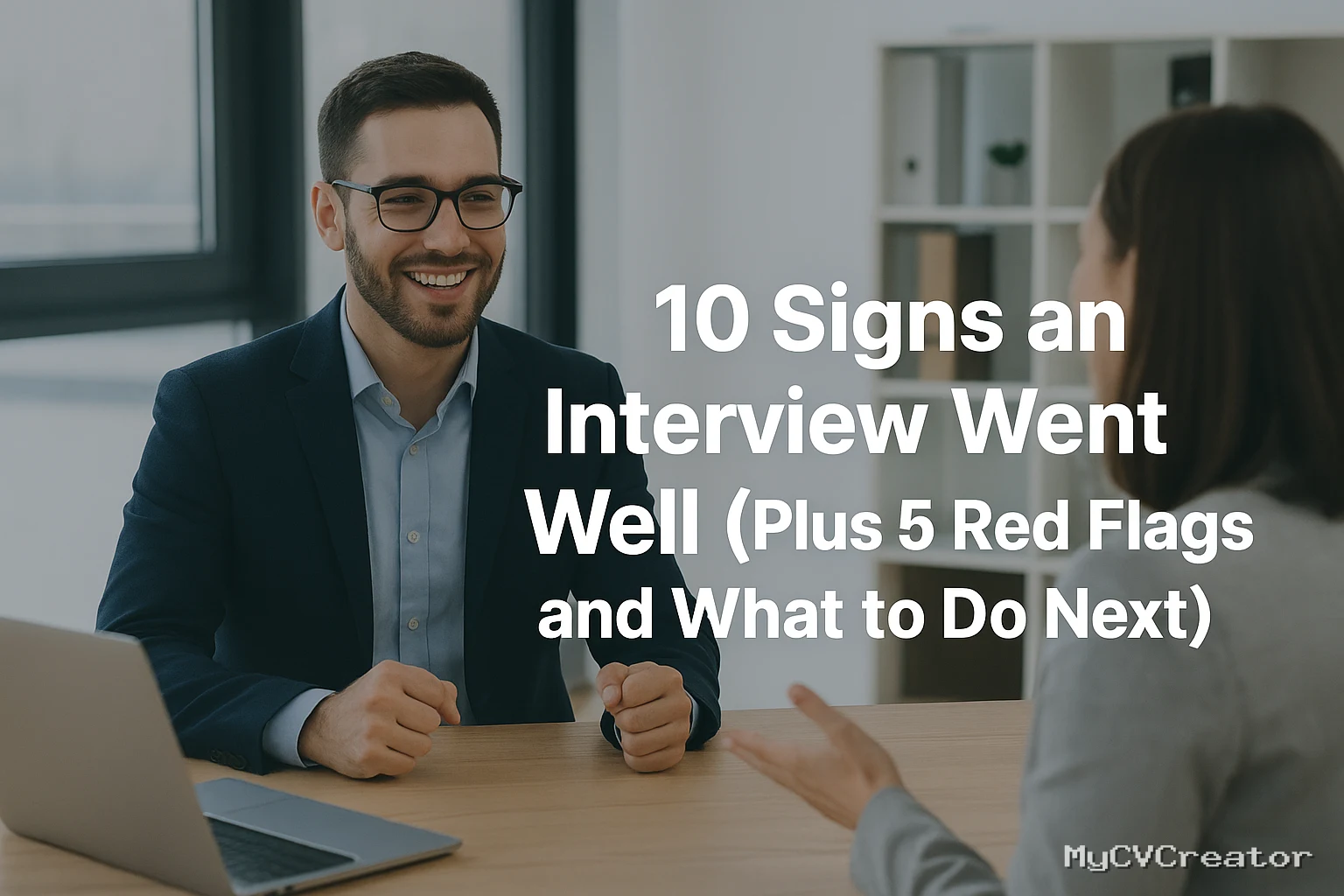
10 Signs an Interview Went Well (Plus 5 Red Flags and What to Do Next)
You walk out of an interview and the silence afterwards can feel louder than the conversation itself. Suddenly you’re replaying your answers, your tone, even the moment you said “you too” when they told you to enjoy your day. Because interviews are high-stakes and emotionally charged, it’s completely normal to feel unsure. Still, there are usually a few reliable clues that indicate whether you connected with the interviewer and moved closer to an offer.
Most candidates aren’t just looking for reassurance. They want a realistic read on their chances so they can decide what to do next: send a follow-up, prepare for a second round, keep applying aggressively, or adjust their approach before the next interview. The challenge is that hiring decisions happen behind the scenes, and one awkward pause does not automatically mean you failed. What matters is the overall pattern of signals you got during the conversation and in the wrap-up.
In simple terms, the signs an interview went well are the verbal and non-verbal indicators that the interviewer is engaged, can picture you in the role, and is moving you forward in the hiring process. These signs often show up as a natural back and forth conversation, detailed questions about your experience, future-focused language, introductions to other team members, and clear next steps. On the flip side, red flags tend to look like a rushed meeting, low engagement, vague answers about the role, or no timeline for what happens next.
This topic matters even more now because many interviews happen over video, hiring processes include multiple stages, and employers are comparing candidates quickly. Small cues like whether they expand on your answers, “sell” the role, or ask about your availability can carry more weight than you’d expect. At the same time, some signals are easy to misread. A quiet interviewer might simply be methodical, and a short interview can be normal if the company uses structured scoring.
In this guide, you’ll learn 10 positive signs you will get the job after an interview, plus 5 red flags that suggest things may not have landed as strongly. You’ll also get practical “what to do next” steps, including how to send a professional thank-you email, when to follow up, and how to interpret common closing lines like “we’re still interviewing.” By the end, you’ll be able to evaluate your interview more calmly, spot the signals that matter most, and take the next action that improves your odds.
10 Green Flags Your Interview Went Well (At a Glance)
Quick answer: An interview usually went well when the interviewer stays engaged, explores your experience in detail, and starts talking like you’re a realistic hire, for example by discussing timelines, next steps, and how you’d fit with the team. These are often called green flags because they signal genuine interest and forward momentum in the hiring process.
While no single sign guarantees an offer, a cluster of positive signals is a strong indicator you’re moving up the shortlist. Pay attention to both what was said and how it was said: tone, body language, and whether the conversation shifted from “can you do this job?” to “what would it look like if you joined us?”
- The conversation felt natural, not like an interrogation. There was real back and forth, follow-up questions, and a comfortable rhythm.
- They dug into your CV and asked specific follow-ups. Curiosity about projects, results, and decision-making usually means they’re picturing you doing similar work for them.
- Positive body language and verbal encouragement. Smiling, nodding, leaning in, and “tell me more” cues suggest you held their attention.
- The interview ran longer than scheduled (or they didn’t rush you). Time is scarce in hiring, so extra time often equals extra interest.
- They asked about availability, notice period, or start date. These questions typically come up when you’re being considered seriously.
- Future-focused language came up. Phrases like “when you start” or “you’d be working with” can be a subtle but meaningful shift.
- You were introduced to other team members. This often signals a culture-fit check and internal buy in, not just a courtesy.
- They “sold” you on the role, culture, or benefits. When they start persuading, they’re often trying to keep you interested.
- Clear next steps and a timeline were shared. Specifics about second interviews, tasks, or decision dates are a strong sign of process movement.
- You received a warm, prompt follow-up (or they invited you to follow up). Personalised communication and quick responses usually indicate you’re still in the running.
Key takeaway: The best signs your interview went well are engagement plus specificity. If they explored your experience deeply, discussed practical logistics, and clarified what happens next, you likely made a strong impression and should act accordingly with a timely thank-you email and readiness for the next stage.
What “Interview Went Well” Really Means (Clear Definition)
Most candidates use “the interview went well” to mean “it felt good.” In hiring terms, it means something more specific: you gave the interviewer enough evidence that you can do the job, fit the team’s working style, and are worth moving forward in the process. A good feeling can be part of that, but it is not the same thing.
Practically, an interview went well when three things happen at once. First, your answers clearly match the role’s requirements, not just in a general “I’m hardworking” way, but with relevant examples, outcomes, and decision-making. Second, the interviewer’s questions shift from basic screening to “how you’d operate here,” which signals they are testing real-world fit. Third, the conversation ends with a sense of momentum, such as clear next steps, timeline, or additional stakeholders being mentioned.
What “Interview Went Well” Really Means (Clear Definition) Details
Clear definition: An interview went well when the interviewer leaves with reduced risk and increased confidence that hiring you will solve their problem, and you leave with signals that you are being actively considered rather than simply evaluated.
That definition matters because many “positive signs you will get the job after interview” are easy to misread. Friendly rapport, a long chat, or lots of smiling can be genuine, but they can also reflect an interviewer’s personality or a company’s culture. The more reliable indicators are tied to hiring decisions: evidence, alignment, and process movement.
Use this section as your decision filter. If you are trying to judge how you did, ask yourself which of these buckets the interview landed in:
- Evidence of capability: Did you demonstrate the core skills with specific examples, metrics, or clear outcomes? Strong interviews usually include follow-up questions that drill into your process, tradeoffs, and results.
- Evidence of fit: Did you and the interviewer align on how work gets done, such as pace, collaboration style, stakeholder management, or autonomy? Fit is often tested through scenario questions and “tell me about a time” prompts.
- Evidence of mutual intent: Did they discuss availability, salary range, notice period, or start date? Those topics often appear when the employer is checking feasibility, not just curiosity.
- Evidence of forward motion: Did you leave with clear next steps, a timeline, or an introduction to other team members? Movement in the process is one of the strongest practical signs an interview went well.
There are also tradeoffs to keep in mind. A short interview is not automatically bad if it was structured and decisive, especially for high-volume hiring. A long interview is not automatically good if it stayed surface-level. Similarly, an interviewer who challenges you can be a positive sign if they are pressure-testing how you think, but it can be a red flag if they seem unconvinced and stop exploring your answers.
The most useful takeaway: judge the interview by decision signals, not vibes. When you focus on what reduces hiring risk and what advances the process, you can more accurately interpret the signs and choose the right next step, whether that is a confident thank-you email, a targeted follow-up, or adjusting your approach for the next interview.
Why Reading Interview Signals Helps You Plan Your Next Move
Interview “signals” are the verbal and non-verbal clues that hint at how the hiring team is evaluating you, such as the depth of their follow-up questions, how they discuss next steps, and whether the conversation shifts into future-focused language. Reading these cues matters because it helps you move from post-interview overthinking to practical decision-making: what to do next, when to follow up, and how to position yourself if you get another round.
Timing is a big part of why this is useful. The window right after an interview is when you can still influence the outcome with a sharp thank-you email, a thoughtful follow-up, or extra materials like a portfolio sample. If you noticed strong signs an interview went well, you can reinforce momentum by referencing a specific discussion point, confirming enthusiasm, and making it easy for them to imagine you starting. If you saw red flags, you can adjust quickly by clarifying a misunderstood answer, addressing a concern you sensed, or simply redirecting your energy to other applications without spiralling.
In the real world, hiring decisions are rarely based on one perfect answer. They’re shaped by overall fit, communication style, confidence, and whether the interviewer can picture you solving their problems. That’s why “positive signs you will get the job after interview” often look like engagement and specificity: they ask about your availability, talk about the team you’d work with, or spend time explaining the role’s challenges. Those are not guarantees, but they’re meaningful indicators of traction.
Just as importantly, reading interview signals helps you protect your time. A rushed interview, vague responses about the process, or low engagement can indicate a slow or uncertain hiring process. Recognising that early helps you plan your next move: keep applying, line up more interviews, and avoid waiting in limbo. The goal is not to decode every gesture, but to use the patterns you observed to guide smart next steps, reduce anxiety, and stay in control of your job search.
- If signs were strong: send a tailored thank-you, prepare for a second interview, and be ready to discuss start date, salary expectations, and references.
- If signals were mixed: follow up with a brief clarification or work sample that supports a key requirement, then continue applying elsewhere.
- If red flags were clear: treat it as a learning moment, document what you’d improve, and prioritise new opportunities rather than waiting.
Why Reading Interview Signals Helps You Plan Your Next Move Details
Interview “signals” are the verbal and non-verbal clues that hint at how the hiring team is evaluating you, such as the depth of their follow-up questions, how they discuss next steps, and whether the conversation shifts into future-focused language. Reading these cues matters because it helps you move from post-interview overthinking to practical decision-making: what to do next, when to follow up, and how to position yourself if you get another round.
Timing is a big part of why this is useful. The window right after an interview is when you can still influence the outcome with a sharp thank-you email, a thoughtful follow-up, or extra materials like a portfolio sample. If you noticed strong signs an interview went well, you can reinforce momentum by referencing a specific discussion point, confirming enthusiasm, and making it easy for them to imagine you starting. If you saw red flags, you can adjust quickly by clarifying a misunderstood answer, addressing a concern you sensed, or simply redirecting your energy to other applications without spiralling.
In the real world, hiring decisions are rarely based on one perfect answer. They’re shaped by overall fit, communication style, confidence, and whether the interviewer can picture you solving their problems. That’s why “positive signs you will get the job after interview” often look like engagement and specificity: they ask about your availability, talk about the team you’d work with, introduce you to other stakeholders, or spend extra time explaining what success looks like in the first 90 days. Those are not guarantees, but they’re meaningful indicators that you’re being seriously considered.
Just as importantly, reading interview signals helps you protect your time and manage your pipeline. A rushed interview, vague responses about the process, or low engagement can indicate a slow or uncertain hiring process, internal changes, or that they’re comparing multiple candidates closely. Recognising that early helps you plan your next move: keep applying, line up more interviews, and avoid waiting in limbo. The goal is not to decode every gesture, but to use the patterns you observed to guide smart next steps, reduce anxiety, and stay in control of your job search.
- Use positive signals to act quickly: send a tailored thank-you within 24 hours, mention a relevant achievement, and confirm interest in the role.
- Use mixed signals to strengthen your case: share a short follow-up that addresses a requirement discussed, such as a work sample, a brief plan, or a clarification.
- Use negative signals to stay strategic: document what you’d improve, continue applying, and set a clear follow-up date so you don’t lose momentum.
 Create your Resume Now
What to Do Next After the Interview (24 Hours to 1 Week)
The hours and days after an interview are where strong candidates quietly separate themselves. Your goal is simple: stay top of mind, reinforce why you’re a fit, and keep momentum in your job search without coming across as pushy. The steps below work whether you saw clear signs an interview went well or you’re still unsure.
Within 2 hours: Capture details while they’re fresh
Before you get pulled back into your day, write quick notes on what was discussed. This helps you send a sharper follow-up and prepares you for a second interview.
- Key priorities: What problem are they hiring for? What outcomes did the interviewer emphasize?
- Your strongest examples: Which stories landed well, and which answers felt unclear or rushed?
- Names and roles: Everyone you spoke to, their titles, and what they seemed to care about.
- Next-step signals: Any timeline mentioned, assessments, references, or availability questions.
Within 24 hours: Send a targeted thank-you email (not a generic one)
A thank-you email is both professional etiquette and a subtle way to remind them of your value. Keep it brief, specific, and confident. If you interviewed with multiple people, send individual messages tailored to each person’s focus.
- Open with appreciation: Thank them for their time and a specific detail you enjoyed discussing.
- Reinforce fit: Tie your skills to one or two job requirements that came up in the conversation.
- Add a useful detail: Clarify a point you didn’t explain perfectly, or share a relevant example you didn’t get to mention.
- Close with next steps: Confirm your interest and ask about the timeline if it wasn’t clear.
If you’re worried the interview went badly, this email is also your chance to correct one small gap. Do it lightly and professionally, without apologizing excessively or rehashing the whole interview.
Days 2 to 3: Prepare for the next stage like it’s already scheduled
Many “positive signs you will get the job after interview” are followed quickly by a second round, a task, or a reference request. Use the next couple of days to get ready while you still remember the conversation.
- Build a short prep sheet: 5 role-specific questions you might be asked next, plus bullet-point answers.
- Strengthen your stories: Pick 3 achievements and tighten them into clear problem-action-result summaries.
- Research with purpose: Focus on their current priorities, customers, competitors, and any recent changes that affect the role.
- Line up references: Ask permission, confirm contact details, and brief them on the role so they’re not caught off guard.
Days 3 to 5: Keep your search moving (without undermining your confidence)
Even if the conversation felt natural and the interview ran longer than scheduled, avoid “waiting mode.” Continue applying and networking so you’re not emotionally dependent on one outcome. This also improves your negotiating position if you do get an offer.
At the same time, review the job description and compare it to what you learned in the interview. If there’s a skill gap, identify one concrete way you’d close it, such as a short course, a portfolio example, or a process you’ve used before. This can become a strong talking point if they follow up.
Days 5 to 7: Follow up the right way (timing and wording matter)
If they gave you a timeline, wait until it passes. If they didn’t, a polite follow-up after about a week is reasonable. Keep it short and assume good intent. Hiring decisions often slow down due to scheduling, approvals, or additional interviews.
- Subject line: “Following up: [Role Title] interview”
- Message goal: Reconfirm interest, ask if they need anything else, and request an update on next steps.
- Professional tone: No guilt-tripping, no multiple follow-ups in a short window.
If you still hear nothing after your follow-up, give it a few business days and then move on gracefully while keeping the door open. A calm, professional approach protects your reputation and keeps you in consideration if their first choice falls through.
Real-World Examples of Strong vs Weak Interview Signals
Quick definition: “Interview signals” are the observable cues during and immediately after an interview that suggest whether the hiring team is leaning toward moving you forward (strong signals) or quietly ruling you out (weak signals). No single moment is definitive, but patterns are often very telling.
The easiest way to judge how an interview went is to compare what happened to what typically happens when a company is genuinely picturing you in the role. Strong interviews feel specific, future-oriented, and two-way. Weak interviews feel generic, rushed, and closed off.
Below are realistic scenarios that show the difference, plus what you can do next if you’re unsure.
Example 1: “It felt like a conversation” vs “It felt like a checklist”
Strong signal scenario: You answer a question about handling deadlines, and the interviewer responds with, “That’s exactly what we deal with during month-end. How would you prioritise if Sales changed the requirements mid-week?” They share a quick story, you laugh, and the discussion naturally moves into how the team works.
What it usually means: They’re testing real fit, not just collecting answers. They’re engaged enough to explore how you think in their environment.
Weak signal scenario: The interviewer asks, “Tell me about yourself,” “What are your strengths?” and “Why this company?” with minimal reaction. After each answer they say, “Okay,” glance down, and move to the next question without follow-ups.
What it usually means: Either they’re inexperienced, distracted, or they’ve already decided you’re not the top choice. It can also mean they’re strictly standardising interviews, so look for other signals before concluding.
Example 2: Deep CV follow-ups vs surface-level interest
Strong signal scenario: They zoom in on a bullet point: “You reduced onboarding time by 30%. What did you change, and how did you measure it?” Then they ask, “If you joined us, which part of our onboarding would you tackle first?”
Why it’s strong: They’re connecting your past impact to their current problems, which is one of the clearest positive signs you will get the job after an interview.
Weak signal scenario: They barely reference your CV and spend most of the time describing the company. When you mention a key project, they don’t ask how you did it or what the outcome was.
Why it’s weak: Strong candidates typically trigger curiosity. A lack of follow-up can mean your examples didn’t land, or they’re not seeing a match.
Example 3: Future-focused language vs vague wrap-up
Strong signal scenario: You hear phrasing like, “When you start,” “In your first 90 days,” or “You’d be partnering with our Head of Ops.” They discuss what success looks like and how performance is measured.
Weak signal scenario: The closing is vague: “We’re chatting with a few people. We’ll be in touch.” No timeline, no next step, and no mention of what happens after this stage.
What to do if you get the vague version: Ask a clean, non-pushy question before leaving: “What are the next steps and the decision timeline?” If you’ve already left, follow up by email (template below).
Example 4: They “sell” the role vs they stay neutral
Strong signal scenario: Midway through, they start highlighting benefits, flexibility, learning budget, or promotion paths. They say things like, “People tend to stay because…” or “The team is proud of…”
Why it matters: When an interviewer starts recruiting you, it often means you’ve passed the “could you do the job?” threshold and they’re moving to “will you accept?”
Weak signal scenario: You ask about development or culture and get short answers: “It’s fine,” “It depends,” “We’re busy.” No examples, no enthusiasm.
Important nuance: Some companies train interviewers to avoid overselling. Pair this signal with others like next-step clarity and detailed role discussions.
Example 5: Next steps are specific vs the process feels foggy
Strong signal scenario: They outline the process: “Next is a 45-minute call with the hiring manager, then a short task. We’ll decide by next Friday.” They confirm who will contact you and how.
Weak signal scenario: They don’t mention next steps unless you ask, and even then it’s non-committal: “We’ll see,” “HR will reach out,” “No set timeline.”
What to do next: Treat it like an open loop you can close professionally with one follow-up message.
Copy and paste follow-up template (when signals are mixed)
Subject: Thank you and next steps
Message: Hi [Name], thank you again for your time today. I enjoyed learning more about [team/project] and the priorities for this role, especially [specific detail you discussed]. I’m very interested in the position and I’m confident I could help with [relevant goal/problem].
Could you share the expected timeline for next steps? Happy to provide anything else you need.
Best regards, [Your Name]
A simple way to score your interview signals
- Strong: Detailed follow-ups + future-focused language + clear next steps (you likely did well).
- Mixed: Good conversation but unclear timeline (follow up and keep applying).
- Weak: Rushed, minimal engagement, no curiosity about your experience (reflect, improve, and move on quickly).
If you’re stuck replaying the interview, focus on what was concrete: Did they explore your examples, connect you to real work, and explain what happens next? Those are the signals that usually matter most.
5 Red Flags Your Interview Went Badly (And What They Suggest)
Not every awkward pause means you failed, but certain patterns are reliable red flags. In most cases, these signs point to one of two things: the interviewer didn’t get enough evidence you can do the job, or they didn’t feel confident about fit, communication, or motivation. The good news is that each red flag usually maps to a fix you can apply in your next interview.
Use the list below as a practical “diagnosis” tool. For each warning sign, you’ll see what it often suggests and the most common mistakes behind it, plus exactly how to avoid repeating them.
- The interview felt rushed or ended early. This can suggest the interviewer didn’t see a match quickly, or your answers weren’t landing clearly enough to justify digging deeper. Common mistakes include giving long, unfocused responses, not answering the question asked, or failing to connect your experience to the role. Avoid it by leading with a direct headline answer, then adding one strong example (situation, action, result). Aim for 60 to 90 seconds per answer unless they ask for more detail.
- The interviewer seemed distracted or low-engagement. If they’re checking screens, not reacting, or offering minimal follow-ups, it may suggest your delivery didn’t build momentum, or you didn’t create a two-way conversation. Mistakes here include speaking in a monotone, overloading them with jargon, or not pausing for confirmation. Avoid it by using clear, concrete language, asking quick check in questions (“Would you like the short version or the detailed example?”), and matching their pace. On video, keep your setup clean, camera at eye level, and answers tighter.
- They asked very few questions about your CV or achievements. This can suggest your opening pitch didn’t spark curiosity, or your experience wasn’t presented in a way that felt relevant. A common mistake is listing responsibilities instead of outcomes. Avoid it by preparing 3 to 5 “proof stories” tied to the job description, each with measurable results (time saved, revenue influenced, errors reduced, customers supported). Make it easy for them to imagine you doing the work.
- You weren’t given much time to ask questions (or your questions fell flat). When the Q&A is rushed, it can signal low interest, but it can also happen when candidates don’t manage time or ask questions that don’t add value. Mistakes include saving all questions for the end, asking things answered on the website, or focusing only on perks. Avoid it by weaving in smart questions throughout (“How does success get measured in the first 90 days?”) and keeping 2 to 3 high-impact questions ready about priorities, team workflows, and what a strong hire does differently.
- No clear next steps or timeline was shared. This can suggest you’re not being progressed, or simply that the process is disorganised. The mistake many candidates make is leaving without professionally “closing” the conversation. Avoid it by asking directly, “What are the next steps and decision timeline?” and finishing with a brief close that restates fit (“Based on what you shared, I’m confident I can help with X and Y. I’d love to move forward.”).
If you noticed one or two of these signs, don’t assume it’s over. Send a concise thank-you note that reinforces your strongest matching example, and if you missed a key point, add a short clarification. Then use what happened as feedback: tighten your stories, make your evidence more measurable, and practise delivering answers that are both confident and easy to follow.
 Create your Resume Now
Recruiter-Backed Tips to Improve Odds After Any Interview
If you’re looking for a reliable “sign an interview went well,” here’s the recruiter reality: the strongest indicator is whether the team can clearly picture you solving their problems. Your job after the interview is to make that picture sharper, not to overanalyse every pause or facial expression.
Start by doing a quick, structured debrief while it’s fresh. Write down the top 3 themes they cared about (for example: stakeholder management, hitting targets, handling ambiguity), the examples you used, and any question you answered imperfectly. This turns post-interview nerves into a practical plan and gives you material for a smart follow-up.
Send a thank-you email within 24 hours, but make it count. Recruiters and hiring managers can spot generic templates instantly. Aim for a short message that reinforces fit and reduces doubt: reference one specific discussion point, restate your value in the language they used, and confirm enthusiasm without sounding desperate.
- Personalise it: “I enjoyed discussing how your team is approaching X.”
- Prove alignment: “My experience doing Y is directly relevant to your goal of Z.”
- Address a gap: “You asked about A. Here’s a quick example of how I handled it.”
If you noticed a red flag, don’t ignore it, but don’t panic either. Instead, clarify professionally. For example, if the role sounded different from the job description, reply with one clean question: “To confirm priorities for the first 90 days, is the focus more on X or Y?” Strong candidates seek clarity, and good employers respect it.
When it comes to following up, match their timeline. If they said “next week,” wait until the day after that window closes. If they gave no timeline, a polite check in after 5 to 7 business days is reasonable. Keep it brief, assume positive intent, and make it easy to respond with a simple status update.
Finally, keep your momentum. Even if you saw positive signs you’ll get the job after the interview, continue applying and interviewing. Recruiters routinely see delays caused by approvals, scheduling, or internal changes. Staying active protects your confidence, improves your options, and paradoxically makes you come across as more relaxed and in demand in any next stage.
Interview Results FAQ: Follow-Up Timing, Offers, and Next Steps
Even when you spot several signs an interview went well, the waiting period can still feel uncertain. Hiring decisions depend on more than your performance, including internal approvals, other candidates’ schedules, and budget sign off. The goal now is to stay professional, keep momentum in your job search, and communicate clearly without sounding anxious.
As a simple rule: if the interviewer gave you a timeline, follow it. If they did not, a polite follow-up after about a week is usually appropriate. In the meantime, your best “next step” is to send a brief thank-you note, capture what you learned while it’s fresh, and prepare for a second interview or task in case you move forward quickly.
FAQ: Interview results, follow-ups, and offers
- How long does it usually take to hear back after an interview?
Many employers respond within one to two weeks. You may hear back sooner for high-urgency roles, and later for senior positions, multi-stage processes, or when multiple stakeholders need to agree. If they mentioned a decision date, treat that as your primary guide. - When should I follow up after an interview?
If you were given a timeline, follow up one business day after that date passes. If no timeline was shared, follow up after 5 to 7 business days. Following up too early can look impatient; waiting too long can make you seem disengaged. - How do I follow up on an interview without sounding pushy?
Keep it short and practical: confirm your continued interest, ask if there’s an updated timeline, and offer to provide anything else they need. Avoid multiple messages in quick succession. One follow-up is usually enough; if there’s no response, a second check in about a week later is reasonable. - What are the strongest signs I will get the job after an interview?
The most reliable indicators are future-focused language (“when you start”), clear next steps (second interview, references, assessment), availability and notice period questions, and introductions to team members. A warm tone helps, but concrete process movement matters most. - If the interview went well, will I always get an offer?
Not always. You can do everything right and still lose out to a candidate with slightly more relevant experience, a stronger internal referral, or better alignment with a specific team need. Treat “good signs” as encouraging signals, not guarantees, and keep applying until you have an offer in writing. - Can a bad interview still lead to a job offer?
Yes. Some interviews feel awkward because the interviewer is tired, rushed, or focused on checking requirements rather than building rapport. If you clearly met the role’s must haves and handled key questions well, you can still progress. This is another reason to avoid over-interpreting one uncomfortable moment. - What should I do while waiting to hear back?
Send a thank-you email within 24 hours, then write down the questions you were asked and how you answered. Identify one or two improvements for next time, and prepare for likely follow-ups such as salary expectations, references, or a work sample. Keep your job search active so you’re not relying on a single outcome. - What if I get rejected after seeing positive signs?
Ask for feedback politely, especially if you reached later stages. You may not always get detailed notes, but you can sometimes learn whether it was a skills gap, experience level, or simply strong competition. Use that information to refine your CV, interview examples, and target roles that match your strengths.
Knowing the positive signs you will get the job after an interview can help you judge how things went, but your actions after the interview often influence the final decision. A timely thank-you note, a well-paced follow-up, and calm preparation for the next stage show professionalism and confidence.
Next steps: send your thank-you email, track the timeline you were given, and set a reminder to follow up if needed. Then keep building momentum by applying to other roles and improving your interview stories with specific results and examples. Whether this interview turns into an offer or not, you’ll be in a stronger position for the next opportunity.