Reference Letter Examples, Template, & How to Write a Strong Reference Letter
A reference letter can quietly make or break a candidate’s chances often more than people realize.
On paper, it may seem like a simple formality. In reality, it’s often the one piece of the application that tells a hiring manager what the candidate is like to work with from someone who has actually seen them in action. That kind of social proof can carry a lot of weight.
The problem is that most hiring managers don’t have time to read long, generic recommendations. They skim, and they skim fast. If a letter opens with vague praise, stiff language, or copy-and-paste phrases, it can lose impact within seconds. Even worse, a weak reference letter can make a strong candidate look average not because they are, but because the letter failed to show what makes them stand out.
That’s the bad news.
The good news is that writing a strong reference letter is much easier once you understand what hiring managers are actually looking for. They don’t need a dramatic speech or a page full of flattering adjectives. They need clarity, relevance, and proof.
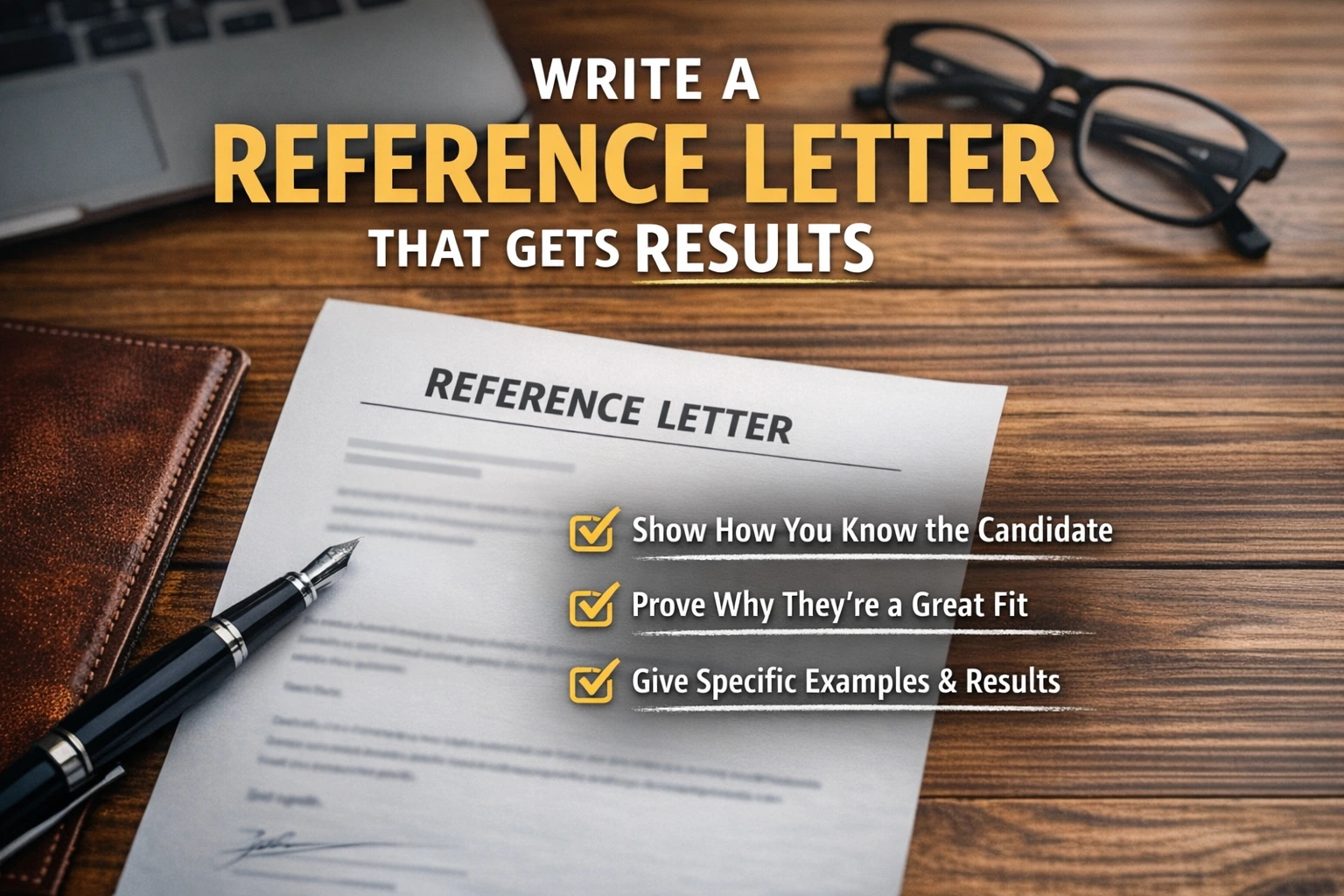
A strong reference letter does three things well:
-
It explains how you know the candidate and why your opinion matters
-
It shows why they’re a strong fit for the role
-
It backs that up with specific examples of their skills, work ethic, and results
In other words, the best reference letters don’t just say someone is “hardworking,” “reliable,” or “nice.” They show what those qualities looked like in real situations. They describe how the person solved a problem, supported a team, improved a process, handled pressure, or delivered strong results. And most importantly, they connect those strengths to the job the person is applying for.
That’s what makes a reference letter persuasive and what gives the candidate a real advantage.
This guide will show you how to do exactly that.
What You’ll Learn
-
What a reference letter is and when it’s used
-
How to write a professional reference letter for a job or internship
-
A simple reference letter template you can customize
-
A reference letter example (job/internship)
-
How to write a character reference letter
-
Common mistakes that make reference letters weak
What Is a Reference Letter?
A reference letter (also called a recommendation letter) is a written statement from someone who knows the applicant professionally or personally and can speak to their qualifications.
For jobs and internships, the writer is usually:
-
A manager
-
Supervisor
-
Professor
-
Mentor
-
Team lead
-
Senior colleague
A strong reference letter confirms the applicant’s:
-
Skills
-
Work ethic
-
Achievements
-
Reliability
-
Character
-
Fit for the position
The key is specificity. A hiring manager learns much more from “She reduced reporting errors by 30%” than from “She’s a great employee.”
How to Ask for a Reference Letter
If you’re the applicant, the quality of your reference letter starts with who you ask.
Choose someone who:
-
Knows your work well
-
Has seen your performance directly
-
Can speak confidently about your strengths
-
Has credibility (manager, professor, client, etc.)
Make it easy for them
Don’t just ask, “Can you write me a letter?”
Send them:
-
The job description
-
Your resume
-
A short note explaining what role you’re applying for
-
3–5 achievements or qualities you’d like them to highlight
This helps them write a detailed, relevant letter instead of a generic one.
How to Write a Reference Letter
A strong reference letter follows a clear structure. It doesn’t need fancy language it needs the right information in the right order.
1) Use the Right Reference Letter Format
A professional reference letter should use standard business formatting:
-
1-inch margins
-
Single spacing
-
A clean font (Arial, Calibri, Cambria, Times New Roman)
-
Left-aligned text
-
Clear paragraphs
-
Contact information at the top
ADVERTISEMENT
Standard reference letter structure
-
Your contact information
-
Date
-
Recipient’s name and title (if known)
-
Salutation
-
Opening hook
-
How you know the applicant
-
Skills + achievements relevant to the role
-
Recommendation + call to action
-
Professional closing
2) Start With a Hook (Not a Flat Introduction)
Most weak reference letters begin like this:
“I am writing to recommend John for the position…”
That’s not wrong but it’s forgettable.
Your first lines should quickly communicate confidence and create interest.
Better opening examples
-
“I’m pleased to recommend Sarah Ahmed for your Operations Analyst role. In three years of working with her, she consistently delivered work at a level far beyond her experience.”
-
“I rarely write reference letters this enthusiastically, but David is one of the most dependable and resourceful employees I’ve managed.”
-
“If you’re looking for a project coordinator who can stay calm under pressure and keep teams aligned, I strongly recommend Maria.”
A good opening tells the reader two things immediately:
-
You know the candidate well
-
You genuinely recommend them
3) Explain How You Know the Applicant
The next paragraph should establish your relationship clearly.
This is where many letters become too generic. Don’t just say, “She was my student” or “He worked with me.”
Be specific.
Include:
-
Your role
-
Their role
-
How long you worked together
-
The context (team, department, project, class, etc.)
Example
“I worked with Samuel for two years at Northbridge Labs, where I was the Engineering Manager and he reported to me as a junior software developer. During that time, he contributed to our internal analytics platform and quickly became one of the most reliable members of the team.”
This gives the letter credibility and context.
4) Match the Letter to the Job Description
This is the part that makes a reference letter powerful.
A generic letter says:
-
“She is hardworking.”
-
“He is a team player.”
-
“They are punctual.”
A strong letter says:
-
What the person did
-
What impact it had
-
Why it matters for this role
How to customize a reference letter
Before writing, review the job description and identify:
-
The top skills required
-
The core responsibilities
-
Any soft skills emphasized (communication, leadership, problem-solving)
Then choose 2–4 examples that directly match those needs.
Example (generic vs strong)
Weak:
“James is smart and works hard. He would be a good fit for your company.”
Strong:
“James stands out for his problem-solving and ownership. While working on our monthly reporting workflow, he identified a bottleneck in the data validation process and built a simpler system that reduced processing time by 35%. He also documented the process clearly, which improved handoffs across our finance and operations teams. Those same strengths analytical thinking, initiative, and cross-team communication make him an excellent fit for your Business Analyst role.”
That’s the difference between a letter that gets skimmed and a letter that gets remembered.
5) Add Specific Achievements (This Is What Hiring Managers Trust)
The most effective reference letters include concrete proof.
Good details to include
-
Results (time saved, revenue increased, errors reduced)
-
Project outcomes
ADVERTISEMENT -
Leadership examples
-
Process improvements
-
Awards or recognition
-
Academic performance (for students/interns)
-
Personal qualities shown in real situations
Examples of strong proof statements
-
“She trained three new hires and helped reduce onboarding time by nearly two weeks.”
-
“He maintained a 98% customer satisfaction rating across a high-volume support queue.”
-
“During a difficult semester, she led a team project that was later selected for faculty presentation.”
-
“He consistently met deadlines without sacrificing quality, even during peak season.”
Even one or two measurable examples can transform the entire letter.
6) End With a Clear Recommendation and a Call to Action
A weak ending just says:
“Thank you for your time.”
A strong ending reinforces your recommendation and opens the door to follow-up.
Strong closing elements
-
A clear recommendation
-
Confidence in the applicant
-
Your willingness to speak further
Example
“I recommend Anita without hesitation for your internship program. She is capable, thoughtful, and highly dependable. If helpful, I’d be happy to speak further about her work and qualifications.”
This adds weight to the letter and signals sincerity.
Professional Reference Letter Template
Use this reference letter template for jobs or internships:
[Your Full Name]
[Your Job Title]
[Company / Organization]
[Address]
[City, State, ZIP]
[Email Address]
[Phone Number]
[Date]
[Hiring Manager’s Name]
[Title]
[Company Name]
[Address]
[City, State, ZIP]
Dear [Hiring Manager’s Name],
I am pleased to recommend [Applicant Name] for the [Job Title / Internship Title] position at [Company Name]. I have had the opportunity to work with [Applicant Name] for [length of time] in my role as [your role], and I can confidently say that [he/she/they] is one of the most [positive qualities] individuals I have worked with.
I know [Applicant Name] through [explain relationship: employee/student/team member/project]. During our time working together, [he/she/they] consistently demonstrated [key strengths], especially in [specific area]. [Add a brief example that shows work ethic, reliability, or skill.]
One of [Applicant Name]’s strongest qualities is [quality relevant to the role]. For example, [specific achievement or result]. [Optional: Add a second example tied to the job description.] I believe [his/her/their] experience in [relevant skill/area] would make [him/her/them] a strong fit for your team.
I recommend [Applicant Name] without hesitation. [He/She/They] would be a valuable addition to [Company Name]. Please feel free to contact me if you would like additional information.
Best regards,
[Your Full Name]
[Your Title]
Reference Letter Example (Job / Internship)
Here’s a polished reference letter example you can adapt:
Martha Cole
Operations Manager
Brightline Logistics
1450 West Main Street
Denver, CO 80202
m.cole@brightlinelogistics.com
(555) 812-4402
February 22, 2026
Daniel Reed
Hiring Manager
NorthPeak Systems
2200 Franklin Ave
Austin, TX 78701
Dear Daniel,
I am pleased to recommend Kevin Johnson for the Project Coordinator position at NorthPeak Systems. I worked with Kevin for nearly three years at Brightline Logistics, where he supported our operations team and later took on project coordination responsibilities across multiple internal process-improvement initiatives.
Kevin is highly organized, dependable, and exceptionally calm under pressure. He quickly became someone our team relied on for keeping projects on track, communicating updates clearly, and spotting problems before they became delays. He has a strong ability to balance details with deadlines, which is rare and extremely valuable.
One example that stands out is a workflow redesign project Kevin helped coordinate last year. He organized stakeholder meetings, tracked task ownership, and created a simple reporting system that improved visibility across teams. As a result, we reduced project delays and improved handoff accuracy between operations and customer support. He also helped standardize documentation, which made onboarding new team members much easier.
Kevin’s communication skills, follow-through, and problem-solving mindset make him an excellent fit for a role that requires coordination across teams and moving parts. I am confident he would bring the same professionalism and consistency to your organization.
I recommend Kevin without hesitation. Please feel free to contact me if you would like to discuss his qualifications in more detail.
Best regards,
Martha Cole
Operations Manager
Brightline Logistics
How to Write a Character Reference Letter
A character reference letter (also called a personal reference letter) is different from a job reference. It focuses more on the person’s integrity, behavior, and reliability than on job-specific skills.
Character references are often used for:
-
Housing/rental applications
-
Court matters
-
Immigration cases
-
Volunteer roles
-
Scholarship applications
-
Community programs
What to include in a character reference letter
-
How you know the person
-
How long you’ve known them
-
The context of your relationship
-
Their key character traits
-
Specific examples that show those traits
-
A clear recommendation
Character Reference Letter Template
[Your Full Name]
[Your Title / Role (if relevant)]
[Organization (optional)]
[Address]
[City, State, ZIP]
[Email Address]
[Phone Number]
[Date]
[Recipient Name]
[Title / Organization]
[Address]
[City, State, ZIP]
Dear [Recipient Name],
I am writing to provide a character reference for [Person’s Full Name], whom I have known for [length of time] as [relationship].
Throughout the time I have known [Name], [he/she/they] has consistently shown [positive traits: honesty, responsibility, kindness, reliability, etc.]. [Add one specific example that demonstrates character.]
In addition, [Name] is [another trait], and I have seen this firsthand when [brief example]. [Optional: Add one more example.]
Based on my experience with [Name], I can confidently recommend [him/her/them] as a person of strong character and good judgment. Please feel free to contact me if you need any additional information.
Best regards,
[Your Full Name]
[Title, if relevant]
Character Reference Example
John A. Mensah
Community Volunteer Coordinator
Hope Outreach Center
31 Ridge Avenue
Abuja
john.mensah@email.com
+234-000-000-0000
February 22, 2026
To Whom It May Concern,
I am writing to provide a character reference for Grace Eze, whom I have known for over five years through our community outreach work and local education support programs.
Grace is one of the most dependable and compassionate people I know. She regularly volunteers her time to support families in need and consistently follows through on commitments, even in challenging situations. She is respectful, honest, and trusted by both volunteers and community members.
One example of Grace’s character stands out clearly: during a school supply drive, she noticed several families were unable to attend the distribution day. Without being asked, she organized a follow-up plan and personally helped coordinate deliveries to ensure no child was left out. Her initiative and empathy made a real difference.
I recommend Grace wholeheartedly as a person of excellent character, integrity, and responsibility. Please feel free to contact me if you would like any additional information.
Best regards,
John A. Mensah
Community Volunteer Coordinator
Common Reference Letter Mistakes to Avoid
Even well-meaning letters fail when they make these mistakes:
1) Being too vague
Avoid statements like:
-
“She is nice.”
-
“He is a hard worker.”
-
“They are good at everything.”
These say very little. Replace them with specific examples.
2) Repeating the resume
A reference letter should support the resume, not copy it. Add insight only someone who worked with the candidate would know.
3) Using generic praise without evidence
Strong recommendation letters use proof:
-
achievements
-
results
-
examples
-
observations
4) Ignoring the job description
A letter that doesn’t match the role feels generic. Tailor it.
5) Writing too much
Keep it focused. Most great reference letters are one page.
6) Sounding hesitant
If you can’t genuinely recommend someone, it’s better to decline than write a weak letter.
Quick Tips for Writing a Stronger Reference Letter
-
Use a professional but warm tone
-
Be honest and specific
-
Focus on 2–3 key strengths
-
Add one or two measurable achievements
-
Match the job requirements
-
End with a confident recommendation
-
Offer to be contacted
Key Takeaway
A great reference letter does more than praise someone it makes a case for them.
If you want your reference letter to actually help the applicant, remember this:
-
Explain how you know them (and for how long)
-
Show, don’t just tell (use specific examples)
-
Tailor the letter to the role
-
End with a clear recommendation and a willingness to follow up
That’s what turns a polite note into a persuasive professional reference letter.