
- Posted On: 2026-02-01
- Posted By: Lery
How to Put Summa or Magna Cum Laude on a Resume (With Examples)
Latin honors can look like “extra fancy words” printed on a diploma something that sounds impressive but doesn’t feel practical. In reality, they’re one of the quickest academic signals a recruiter, scholarship reviewer, or admissions team can recognize at a glance. When you add summa cum laude or magna cum laude to your resume, you’re communicating a simple message: you performed at a top level compared to your peers and you did it consistently enough to earn an official distinction from your institution.
This matters most when you’re still building career proof. If you’re a student, fresh graduate, or early-career applicant, you may not have years of work achievements to show yet. In that situation, Latin honors act like a “trust badge” that supports your credibility. They can strengthen internship applications, graduate trainee roles, competitive entry-level jobs, scholarships, leadership programs, and graduate school admissions especially when reviewers are scanning a large stack of applications and need quick indicators of strong performance.
But here’s the part that confuses many people: Latin honors are not standardized globally or even nationally. The same phrase can mean very different things depending on the school. One university might award summa cum laude to the top 5% of the class, while another uses a strict GPA threshold, and another calculates it within a specific college or major. Some institutions also include additional requirements like completing a thesis, earning a minimum number of credits on campus, or meeting specific conduct standards. So while the ranking is consistent (summa is higher than magna), the requirements behind those words can vary widely which is why it’s smart to understand the system, not just the label.
In this guide, you’ll learn what summa and magna actually mean, which one carries the higher rank, and the main ways universities decide who qualifies. You’ll also get clear, resume-ready examples showing exactly how to list Latin honors in a clean, ATS-friendly way so when you build your resume with MyCVCreator, you can highlight your achievement professionally without clutter, confusion, or formatting mistakes.
What do “summa” and “magna” actually mean?
Most schools that use Latin honors follow a three-level ladder:
-
cum laude = “with honor / with praise”
-
magna cum laude = “with great honor / with great praise”
-
summa cum laude = “with highest honor / with highest praise”
So what’s the difference?
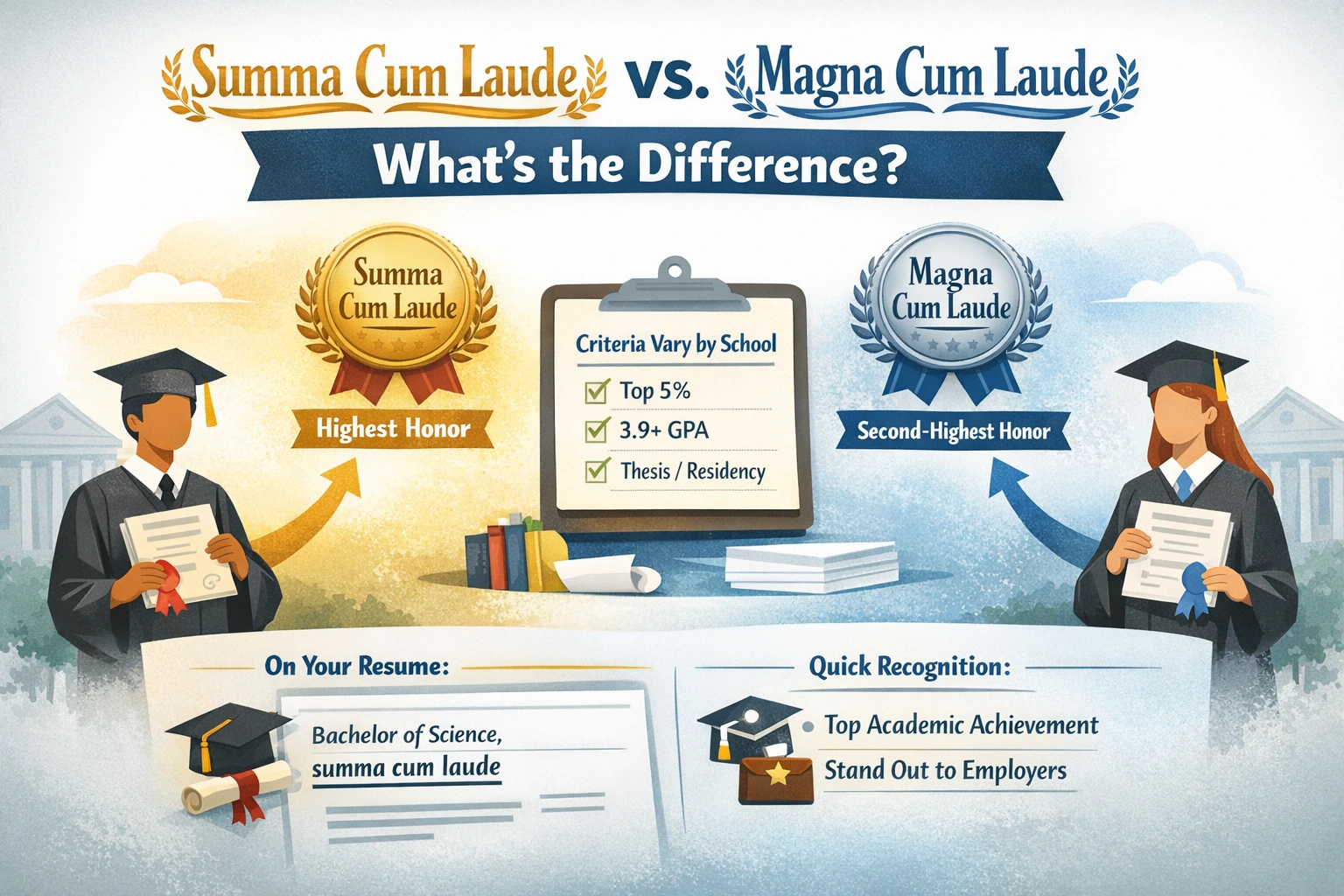
Summa cum laude is the highest Latin honor.
Magna cum laude is the second-highest.
That ranking is consistent across institutions. What changes is how you qualify.
The #1 thing people miss: criteria vary a lot by school
There’s no universal GPA rule for summa or magna. Some schools award honors by percentile, others use fixed GPA cutoffs, and many use a hybrid (percentile + minimum credit requirements, school-by-school breakpoints, etc.).
Here are the most common systems universities use:
1) Percentile / class rank (very common)
A school may award Latin honors to set portions of the graduating class (sometimes overall, sometimes within a college, sometimes within a major).
Real examples:
-
Boston University awards Latin honors to the top 30% in each school/college, split as top 5% (summa), next 10% (magna), next 15% (cum laude).
-
Columbia University engineering policies describe Latin honors capped at 25% of the class, with ≤5% summa, ≤10% magna, and ≤10% cum laude (and a minimum semesters requirement).
Why this matters: Two students can both be “magna,” yet have different GPAs depending on the GPA distribution and policy that year.
2) Fixed GPA thresholds (also common)
Some institutions publish clear GPA bands (example: “3.90–4.00 = summa”). But those bands can still shift by year, department, or school.
Why this matters: “Magna” doesn’t always equal the same GPA across schools and sometimes not even across departments.
3) Major/department cohort comparisons (a big twist)
Some universities calculate honors within the major, using cohort data across multiple years.
Example:
-
University of Chicago uses a major cohort approach and awards Latin honors based on where a student’s cumulative GPA falls in comparison to prior cohorts.
Why this matters: Being top-ranked in a rigorous major can be judged differently than being top-ranked across the whole university.
4) Extra requirements beyond grades
Some institutions add requirements like:
-
Honors thesis / capstone
-
Faculty review/approval
-
Minimum credits completed at the institution (residency)
-
Good disciplinary standing
Why this matters: Latin honors can be more than “just GPA.”
At-a-glance: what’s consistent vs what varies
Consistent everywhere
-
Summa outranks magna
-
Both outrank cum laude
Varies by school
-
The GPA/percentile needed
-
Whether ranking is by university, college, or major
-
Extra rules (thesis, review, residency, conduct rules)
Do these honors matter to employers and scholarships?
Yes mostly early on.
Latin honors can help when you have limited work experience because they signal:
-
Consistency and discipline
-
Strong academic performance compared to peers
-
Ability to handle complex workloads
They tend to matter most for:
-
Internships and graduate trainee roles
-
Competitive entry-level positions
-
Scholarships and graduate school applications
Later in your career, employers usually focus far more on measurable work outcomes. Latin honors become a “nice credibility detail,” not the headline.
How recruiters interpret “summa” vs “magna” (what it signals)
Think of Latin honors as a tiered badge, not a full story:
-
Summa cum laude: “Top-tier academic performance (often top few percent).”
-
Magna cum laude: “Excellent academic performance (often top 10–15%).”
-
Cum laude: “Strong academic performance above the class average.”
Even when recruiters don’t know your exact school cutoff, they understand the ranking and that alone can help.
How to list summa or magna cum laude on a resume (the right way)
Best placement: Education section
Most candidates list Latin honors directly under the degree or on the same line.
Option A: Same line
-
B.Sc. Computer Science, summa cum laude
Option B: Next line
-
B.A. Economics
Honors: magna cum laude
Formatting guidance commonly recommends lowercase and italics for the Latin phrase.
Use the exact wording from your transcript/diploma
Don’t translate or “upgrade” what your school didn’t award. If your institution uses:
-
“First Class Honors”
-
“With Distinction”
-
“Upper Second-Class (2:1)”
…keep the official wording.
Should you include GPA too?
Include GPA when:
-
The job application asks for it
-
You’re early-career and GPA is strong
-
Your school’s policy is unusual and GPA clarifies the achievement
Skip GPA when:
-
You have solid experience and want a tighter resume
-
GPA isn’t impressive or relevant
-
Your resume is already dense
(If you include GPA, keep it neat: “GPA: 3.92/4.00” or “CGPA: 4.68/5.00” based on your system.)
MyCVCreator tip: the cleanest way to add Latin honors (ATS-friendly)
When building a resume in MyCVCreator, aim for clarity + consistency. Here’s a structure that works across most templates:
Recommended Education layout
University Name — City, Country
Degree, Major (magna cum laude)
Graduation: Month Year | GPA: X.XX/4.00 (optional)
If your template has an “Honors/Awards” field
Use it like this:
-
summa cum laude (Latin honors)
-
Dean’s List (2023–2024)
-
Academic Excellence Scholarship (2022)
ATS note: Latin honors are searchable keywords (“summa cum laude,” “magna cum laude”). Placing them in Education helps ATS and humans find them fast.
Resume examples you can copy (and adapt)
1) New graduate (simple and strong)
B.Sc. Accounting, magna cum laude
University of X — 2026
2) With GPA included
B.A. International Relations, summa cum laude
University of X — 2026 | GPA: 3.95/4.00
3) Two degrees (keep formatting consistent)
M.Sc. Data Science
University of X — 2027
B.Sc. Mathematics, magna cum laude
University of Y — 2025
4) If your school doesn’t use Latin honors (common outside the U.S.)
B.Sc. Computer Science — First Class Honours
University of X — 2026
5) Nigeria-style classification (very common)
B.Sc. Biochemistry — Second Class Upper (2:1)
University of X — 2026
(Only use Latin honors if your institution officially awarded them.)
Where else you can mention it (and where you shouldn’t)
Place it in Education under honors/description:
-
“Graduated magna cum laude”
Cover letter
Mention it once if it strengthens your story:
-
“I graduated summa cum laude while leading a capstone project that…”
Don’t put it in Skills or Work Experience
Latin honors are an academic credential, not a skill. Putting it under Skills can look like filler.
Common mistakes to avoid
-
Capitalizing every word (“Summa Cum Laude”) on the resume
Most style guidance favors lowercase and italics: summa cum laude. -
Claiming Latin honors you didn’t earn
Recruiters can ask for transcripts, and some employers verify. -
Hiding the honor in a crowded section
Put it where it belongs: Education. -
Using it as your main selling point
Use it to support your candidacy then win with projects, results, internships, certifications, and skills.
FAQ: Summa vs magna cum laude
Is summa cum laude higher than magna cum laude?
Yes. Summa is the highest; magna is second-highest.
What GPA do you need for summa or magna?
There’s no single number. Some schools use fixed GPA cutoffs; many use percentiles within a college or major; policies vary by institution and year.
Are Latin honors used for master’s degrees?
Usually, Latin honors are most common for undergraduate degrees (and sometimes law degrees), and less common for graduate degrees this varies by institution and country.
When did Latin honors start in the U.S.?
Common references place the start of U.S. Latin honors at Harvard College in the late 1800s.


