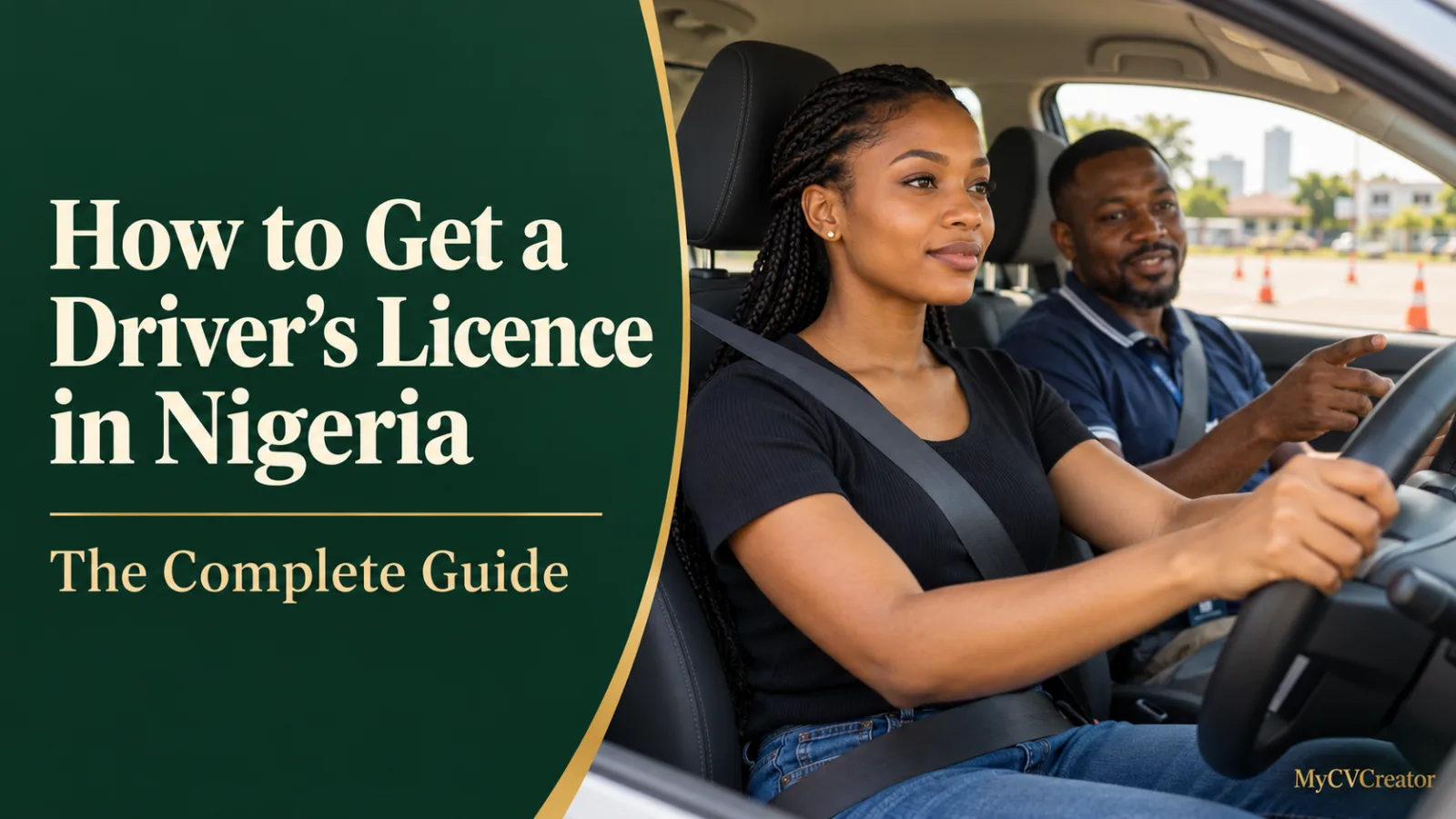
How to Get a Driver's Licence in Nigeria: The Complete Guide
A driver's licence is more than permission to drive. In Nigeria it is also one of the most widely accepted forms of identification, and for many jobs it is a hard requirement: field sales, logistics, ride-hailing, site supervision and any role that comes with an official car. Recruiters list it in job adverts as "valid driver's licence required" and screen out applicants who cannot show one.
The process is run by the Federal Road Safety Corps (FRSC), working with state licensing authorities. Today it starts with an accredited driving school, continues on the FRSC online portal, and ends with biometric capture at a Driver's Licence Centre. This guide covers each stage, the official fees, the licence classes, and how to renew or replace a licence.
The short version
- Train at an FRSC-accredited driving school and get your driving school certificate.
- Complete the driving test and medical checks required in your state.
- Apply on the official FRSC portal, nigeriadriverslicence.org, using your certificate number, and pay the official fee online.
- Book and attend your biometric capture at an FRSC Driver's Licence Centre.
- Collect your licence.
A new private car licence costs ₦15,000 for 3 years or ₦21,000 for 5 years. A motorcycle or tricycle licence costs ₦7,000 or ₦11,000.
Who can get a driver's licence
You must be at least 18 years old to apply for a licence to drive a private car. You will also need:
- A valid National Identification Number (NIN). The details you enter on the licence application must match your NIN record, so check your name and date of birth before you start. If you do not have a NIN yet, our guide to getting your NIN in Nigeria explains the process.
- A certificate from an FRSC-accredited driving school. The portal will not start a fresh application without the certificate number.
- A valid means of identification and a recent passport photograph.
You must attend in person. The FRSC says no one can submit an application or do your capture on your behalf.
Licence classes: which one do you need?
Nigerian driver's licences are issued in classes, labelled A to J. The two that most people need are:
- Class A: motorcycles and tricycles.
- Class B: private cars and light vehicles.
The other classes cover commercial vehicles, heavy goods vehicles, articulated vehicles, agricultural and earth-moving machines, and special vehicles. They come with extra requirements, including a medical certificate and the relevant driving school certificate.
As a first-time applicant, you can apply for a maximum of two classes, and the FRSC portal says fresh applicants may only choose Classes A and B. Commercial classes must be applied for at a Driver's Licence Centre. Each class is charged separately, so applying for both A and B means paying for both.
Tip: If a job advert asks for a licence to drive a company car, Class B is what you need. If the role involves driving a bus, truck or commercial vehicle, check which class the employer requires before you apply.
Step 1: Train at an accredited driving school
Driving school is no longer optional. The FRSC requires every fresh applicant to complete mandatory training at an accredited driving school, which issues a certificate with a number you will enter on the portal.
Under the FRSC's driving school standards, certified schools are expected to use roadworthy dual-control training cars and licensed instructors, and to provide classroom teaching on the Highway Code and traffic law. FRSC procedures also set a minimum training programme of 26 sessions of at least one hour each, recorded on the FRSC system.
Choosing a school:
- Ask to see the school's FRSC accreditation before you pay. A certificate from an unaccredited school will not work on the portal.
- Ask for the full price in writing, including the certificate and any test fees. Driving school costs vary widely by city and school.
- Take the full course seriously. The licence is meant to prove you can drive, and the lessons are your chance to learn properly.
Many states also issue a learner's permit through the state Vehicle Inspection Office (VIO) or Motor Vehicle Administration while you train. Requirements and fees vary by state, so ask your driving school what applies where you live.
Step 2: Complete the driving test and checks
Before your licence is processed, you will go through the competence and fitness checks required in your state. These usually include:
- A driving test conducted through the Vehicle Inspection Office, which issues a certificate of competence when you pass.
- An eye test and basic medical fitness check.
These tests are handled at state level, so the exact order and fees differ between states. Your driving school will usually guide you through them. Keep every certificate and receipt you receive.
Step 3: Apply on the FRSC portal
The official portal is nigeriadriverslicence.org. On a phone, switch your browser to "desktop site" if the pages do not display properly.
- Select DL Application, then New Driver's Licence Application.
- Enter your driving school certificate number and submit.
- Complete your personal details. Make sure your name, date of birth and other details match your NIN exactly.
- Choose your licence class and validity: 3 years or 5 years.
- Choose the Driver's Licence Centre where you will do your biometric capture.
- Submit the application and generate your payment reference.
Step 4: Pay the official fee
Pay through the portal's official payment gateway by card, bank transfer or USSD. These are the official FRSC fees for a new licence:
| Licence Class | 3 Years | 5 Years |
|---|---|---|
| Class A (motorcycle or tricycle) | ₦7,000 | ₦11,000 |
| Other classes, including Class B (private car) | ₦15,000 | ₦21,000 |
These fees took effect on 8 June 2025. Small payment channel charges may apply, and each class is charged separately.
Which validity should you choose? The 5-year licence costs ₦6,000 more for a car but saves you a renewal, a second capture visit and the time off work that comes with it. For most working adults, it is the better value.
Pay only through the portal. The FRSC fee is the same everywhere, and nobody needs to collect extra money to "process" your licence. The portal deletes unpaid applications after three months, so pay promptly once you apply.
Step 5: Biometric capture at a Driver's Licence Centre
Print your application and payment receipt, then go to the Driver's Licence Centre you selected. Bring:
- Your printed application and payment receipt
- Your driving school certificate and any test certificates
- Your means of identification and NIN
- A passport photograph
At the centre, officials will check your documents and capture your photograph, fingerprints and signature. Arrive early, because busy centres can have long queues.
Step 6: Collect your licence
Historically, applicants received a temporary driver's licence, valid for 60 days, while the permanent card was printed. In October 2025, the FRSC announced contactless biometric capture with on-the-spot printing, which it said would end temporary licences. The rollout has been gradual, so depending on your centre you may receive your permanent licence on the day, or a temporary licence first.
If you receive a temporary licence, carry it whenever you drive, and collect your permanent card as soon as you are notified. The FRSC has repeatedly urged Nigerians to collect licences that have been printed but left uncollected at centres.
When you collect your licence, check every detail before you leave: name, date of birth, class and expiry date.
What it really costs
The FRSC fee is only part of the total. For a first private car licence, budget for:
- Driving school, including the certificate. This is usually the biggest cost, and it varies widely by city and school.
- Learner's permit, if your state requires one.
- Driving test and medical or eye test fees, set at state level.
- The FRSC licence fee: ₦15,000 for 3 years or ₦21,000 for 5 years.
- Transport, photographs and printing.
Ask your driving school for a full written breakdown at the start, so there are no surprises.
Worked example: Ifeoma's licence for a new job
Ifeoma is 24 and lives in Abuja. She has been offered a field sales role that comes with a company car, but the offer is conditional on a valid driver's licence within two months.
Week 1. She checks that her NIN details match her birth certificate, then visits three driving schools and asks each one for proof of FRSC accreditation and a written price. She enrols at the school that shows its accreditation and itemises every fee.
Weeks 2 to 5. She completes the full training programme, including the Highway Code classes, and receives her driving school certificate.
Week 6. She completes the driving test and eye test arranged through the school. Then she applies on nigeriadriverslicence.org, chooses Class B for 5 years at ₦21,000, pays online and books the nearest Driver's Licence Centre.
Week 7. She attends her biometric capture with all her documents. She then forwards a copy of her licence to her new employer's HR team, ahead of her start date.
The lesson: the driving school is the longest stage, so start there first. The online application and capture take days, not weeks.
How to renew your driver's licence
Renew before your licence expires, or as soon as possible after. Driving with an expired licence is an offence.
- Go to nigeriadriverslicence.org and start a renewal application with your existing licence number.
- Choose the 3-year or 5-year validity and your Driver's Licence Centre.
- Pay the fee online. Renewal fees follow the same schedule as new licences.
- Attend the centre for capture if required, and collect your renewed licence.
You do not need to repeat driving school for a normal renewal of the same class.
Replacing a lost or damaged licence
If your licence is lost, stolen or damaged, apply on the portal for a Reissue of Driver's Licence. For a lost or stolen licence, you may need a police report or a sworn affidavit, so get these before you go to the centre.
Upgrading or adding a class
To add or remove classes, for example to move from Class B to a commercial class, apply on the portal. Choose Reissue if your current licence is still valid, or Renewal if it has expired. Higher classes require the relevant training certificate and, for commercial classes, a medical certificate.
Common mistakes to avoid
- Paying touts or "fixers." All fees go through the official portal. A licence obtained without real training or proper process can be revoked, and it leaves you unprepared on the road.
- Using an unaccredited driving school. Its certificate number will not work on the portal.
- Mismatched details. Your name and date of birth must match your NIN.
- Letting an application expire. Unpaid applications are deleted after three months.
- Not checking the card at collection. Errors are easier to fix at the counter.
- Waiting until a job offer arrives. If you are applying for roles that need a licence, start now, because training takes weeks.
Your driver's licence and your job search
If a role requires a licence, say so clearly on your CV. Add a line in your personal details or skills section, for example: "Valid Nigerian driver's licence (Class B), clean driving record." Recruiters screening for driving roles look for that line first, and leaving it out can get an otherwise strong application rejected. Our complete guide to writing a CV for a job shows where it fits.
Your licence also works as identification during onboarding, and some employers will ask for it alongside your NIN and other documents. If you are planning to work or travel abroad, our guide to getting an international passport in Nigeria covers the next document you will need.
Be careful with job offers that ask you to pay for a licence, training or "registration" before you are hired. Our guide to job application red flags and scams explains how to spot them.
Frequently asked questions
How much is a driver's licence in Nigeria in 2026? A new private car licence costs ₦15,000 for 3 years or ₦21,000 for 5 years. A motorcycle or tricycle licence costs ₦7,000 for 3 years or ₦11,000 for 5 years. Driving school, tests and permits cost extra.
What is the official website for a Nigerian driver's licence? The FRSC driver's licence portal is nigeriadriverslicence.org. Apply and pay only through the official portal.
Can I get a driver's licence without going to a driving school? No. The FRSC requires fresh applicants to complete training at an accredited driving school. The portal asks for your driving school certificate number before you can apply.
What is the minimum age for a driver's licence in Nigeria? You must be at least 18 years old to apply for a licence to drive a private car.
How long does it take to get a driver's licence? Driving school takes the longest, usually several weeks. After that, applying online and attending biometric capture can take a few days. Collection time depends on your centre; some centres now print licences on the spot.
Do I need a NIN to get a driver's licence? Yes. Your application details must match your NIN record.
How do I renew my driver's licence? Start a renewal application on nigeriadriverslicence.org with your existing licence number, pay the fee online and attend your Driver's Licence Centre if capture is required.
Related reading
- How to Get Your National Identification Number (NIN) in Nigeria
- How to Get an International Passport in Nigeria: The Complete 2026 Guide
- How Can I Make a CV for a Job? The Complete Beginner's Guide
- US Job Application Red Flags: Spotting Fake Job Postings and Scams
- Deepfake Job Candidates: How Honest Applicants Win
Put your licence to work
Many driving, logistics and field roles screen applicants on the licence line of their CV. MyCVCreator's builder makes it easy to list your licence, class and driving record clearly. Build your CV free.