
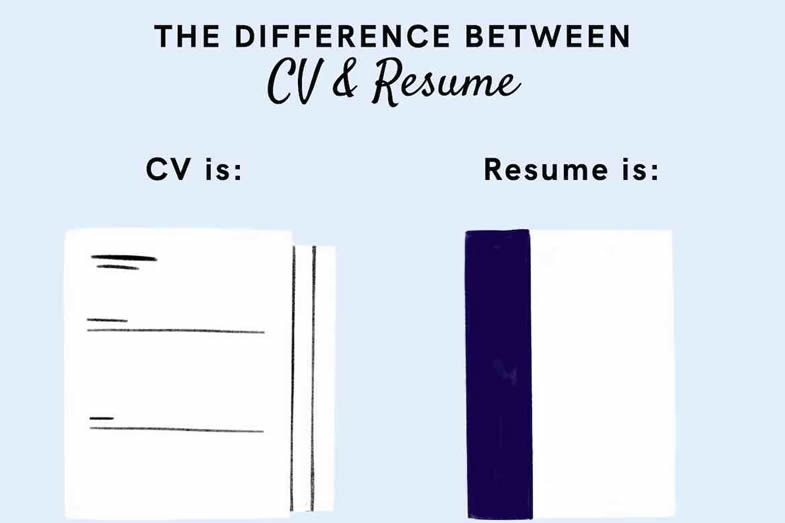
Difference Between Curriculum Vitae (CV) and Resume
CV vs. Resume: Understanding the Key Differences and When to Use Each
The terms “Curriculum Vitae (CV)” and “resume” are often used interchangeably, but they actually serve different purposes in job applications. While both are crucial tools for showcasing your qualifications, the main difference lies in scope, format, and use.
CV and Resume: What Do They Mean?
-
Curriculum Vitae (CV) is a Latin term meaning “course of life.”
It provides a comprehensive overview of your academic and professional journey, detailing education, research, publications, teaching experience, awards, and other achievements. -
Resume comes from the French word for “summary.”
It’s a concise, targeted snapshot of your skills, experience, and accomplishments relevant to a specific job.
Despite their differences, both CVs and resumes share the same goal — to help you stand out as a strong candidate and secure an interview.
What CVs and Resumes Have in Common
Both documents:
-
Should be tailored for the specific job and company you’re applying to.
-
Must highlight your strengths and position you as the most qualified candidate.
-
Are designed to get you an interview, not list every detail of your career.
-
Typically exclude personal interests unless they directly relate to the position.
If you’re pursuing both academic/research and corporate/industry opportunities, you’ll likely need both a CV and a resume — each crafted for its specific audience.
🎯 Tip: Use MyCVCreator.com to easily build both a professional CV and a tailored resume with AI-powered guidance and customizable templates.
Curriculum Vitae vs. Resume: Format and Content
The CV (Curriculum Vitae)
A CV provides a full history of your academic and professional credentials. It can range from two pages to several, depending on your experience.
Key Features:
-
Includes your education, research, publications, certifications, awards, and academic contributions.
-
Chronological and detailed—lists every relevant achievement in full.
-
Commonly used by professionals applying for fellowships, grants, postdoctoral positions, academic roles, and high-level research positions.
-
Graduate school applications may also require a CV, especially when publications or research projects are involved.
Regional Note:
In Europe, “CV” is the term used for all job application documents—including what Americans call a resume.
In the United States and Canada, the CV and resume are distinct: CVs are for academic or medical fields, while resumes are standard for most jobs.
The Resume
A resume is a targeted marketing document that highlights your most relevant experience, achievements, and skills for a specific job.
Key Features:
-
Focuses on skills and results, not exhaustive history.
-
Ideal for corporate, public sector, and non-profit job applications.
-
Usually one page long, but can extend to two pages for senior professionals.
-
Experienced candidates lead with their work history, placing education further down.
Example:
If you’ve been in the workforce for over a year, start with your professional experience, then list your education, certifications, and key skills.
CV vs. Resume: Quick Comparison
| Aspect | Curriculum Vitae (CV) | Resume |
|---|---|---|
| Meaning | Latin for “course of life” | French for “summary” |
| Purpose | Academic or research positions | Industry or corporate positions |
| Focus | Scholarly achievements | Job-specific skills and experience |
| Length | Variable (2–10+ pages) | 1–2 pages maximum |
| Structure | Detailed and chronological | Concise and targeted |
| Includes | Publications, awards, academic history | Measurable achievements and core competencies |
| Used In | Academia, medicine, research | Business, technology, public, and private sectors |
When to Use Each Document
Use a CV When:
-
Applying for academic, medical, or research-based roles.
-
Seeking fellowships, grants, or postdoctoral positions.
-
Submitting an application in Europe, the UK, or countries where “CV” is the standard term.
Use a Resume When:
-
Applying for corporate or industry positions.
-
Seeking roles in business, IT, marketing, finance, or public administration.
-
Applying to jobs in the United States or Canada, where resumes are the default.
💡 Pro Tip: When in doubt, check the job posting. If it doesn’t specify, you can always ask the recruiter which document they prefer.
Formatting Tips for Both Documents
For CVs:
-
Begin with education and list your academic credentials first.
-
Include your advisor’s name, thesis title, and a summary of your research.
-
Provide a complete list of publications, presentations, and professional memberships.
-
Use consistent headings, bullet points, and professional formatting.
-
Keep the layout clean and reader-friendly.
For Resumes:
-
Start with a professional summary or career objective.
-
Highlight your most relevant experience and measurable results.
-
Use action verbs (e.g., “managed,” “designed,” “achieved”).
-
Keep it concise and ATS-friendly—use job-related keywords.
-
Avoid unnecessary personal information or outdated experiences.
Global Differences in Usage
-
United States & Canada:
Resumes are standard; CVs are used in academia and medicine. -
United Kingdom & Europe:
The term “CV” is universal and refers to both academic and industry job applications. -
Australia & India:
“CV” and “resume” are often used interchangeably. -
Middle East & Asia:
CVs tend to include more personal details such as nationality and languages.
Practical Example
If you’re applying for a faculty position at a university:
➡️ Use a CV with your education, research, and publications in detail.
If you’re applying for a marketing manager role at a company:
➡️ Use a resume that highlights your campaign results, leadership skills, and measurable achievements.
In Summary
Both a CV and a resume are critical tools for your professional journey—but they serve different purposes.
-
A CV is your complete professional story.
-
A resume is your most relevant chapter.
By understanding the difference and adapting to your target industry or region, you’ll greatly increase your chances of getting shortlisted.
✨ Create Your Professional CV or Resume with Ease
Visit MyCVCreator.com to design a stunning, ATS-friendly CV or resume in minutes.
Choose from modern templates, customize in real-time, and let AI help you write compelling content tailored to your dream job.


